
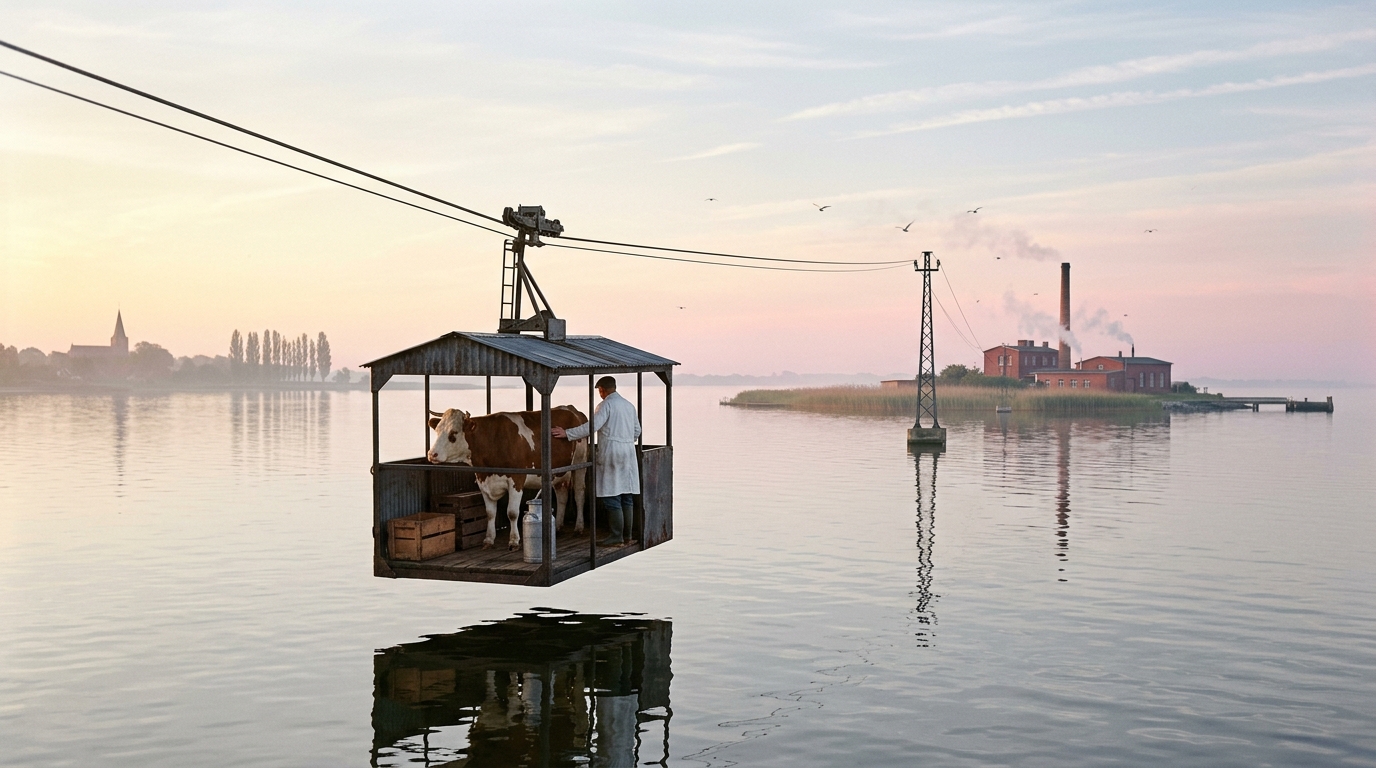
In 1910, Germany literally quarantined an island to shelter explosive experiments: tests on foot-and-mouth disease that regularly contaminated the neighboring town. More than a century later, this tiny exclave connected to the mainland since 1971 still houses one of the planet’s most sensitive laboratories.
- In 1898, Friedrich Loeffler and Paul Frosch demonstrated that foot-and-mouth disease is caused by a virus, the first animal virus identified by science
- From 1926 to 1971, a cable car transported people, livestock, and equipment between the island of Riems and the mainland
- The Friedrich-Loeffler-Institut still operates a Level 4 biosafety laboratory dedicated to large animals, a facility existing elsewhere only in Winnipeg and Geelong
- A German island transformed into a laboratory to escape contagion
- When the 1971 causeway changes the game for the isolated island
- Riems’ best-kept secret: a still-active institute at the heart of global biosafety
A German Island Transformed into a Laboratory to Escape Contagion
It all began with a discovery that reshaped veterinary medicine. In 1898, researcher Friedrich Loeffler, aided by Paul Frosch, showed that the culprit behind foot-and-mouth disease is not a bacterium as once thought, but a much smaller and far more elusive organism: a virus. It is simply the first animal virus ever identified by science, a foundational milestone for all modern virology.
Problem: to study this pathogen, it must be manipulated, and handling such a contagious virus near a populated town is akin to playing with fire. The experiments conducted by Loeffler around Greifswald repeatedly caused the pathogen to spread, with outbreaks appearing among nearby animals. Needless to say, the situation became untenable.
The solution chosen was radical yet pragmatic: isolate the research on a patch of land cut off from the world. The selection fell on the island of Riems, a tiny speck of land roughly 1,250 meters long and 300 meters at its widest, administratively attached to the city of Greifswald as an enclave. Loeffler wrote to the Prussian Minister of Agriculture to formalize the start of his work on site on a Monday in October 1910, a date that marks the founding of the oldest virology institute still active today.
When the 1971 Causeway Changes the Game for the Isolated Island
For decades, Riems remained literally an island, with all the logistical constraints that implies. From 1926 to 1971, a cable car ferried people, livestock, and equipment to the mainland. Picture the scene: cows suspended above the water in a gondola, heading to a laboratory meant to study animal diseases. Two sets of foundation pylons still stand today as silent witnesses of that somewhat crazy era.
Toward the late 1960s, authorities decided a more reliable link was needed. A roughly 500-meter-long road dike was built, opened to service traffic in 1971. Riems thus ceased to be a true island and became an artificial peninsula accessible by road. A practical change, but not insignificant for the local ecosystem.
This dyke indeed cut off the Gristower Wieck bay from open sea, leading to oxygen depletion in waters that became stagnant. Local wildlife paid the price for decades, until a 30-meter breach was reopened in autumn 2007 to restore water circulation. A striking example of how human infrastructure, even modest, can redraw the maps of an entire ecosystem.
Riems’ Best-Kept Secret: a Still-Active Institute at the Heart of Global Biosafety
Here lies the core of the matter, and what makes this island truly fascinating: the Friedrich-Loeffler-Institut, the oldest virology institute in the world, still operates a biosafety level 4 laboratory there. It isn’t a museum frozen in time but a fully operational research center at the forefront of handling dangerous pathogens.
The scale of the current facilities is dizzying. Two new complexes built on 62,500 square meters house 89 laboratories and 163 livestock units, designed for various biosafety levels. Among them, a Level 4 laboratory—the strictest there is—dedicated specifically to large animals. According to the FLI itself, this kind of research is possible elsewhere in the world only in Winnipeg, Canada and Geelong, Australia. In other words, Riems belongs to a very exclusive club.
And this work is far from academic or theoretical. AFP dispatches and the FLI’s national reference laboratory for foot-and-mouth disease confirmed, at the start of 2025, an outbreak of foot-and-mouth disease in water buffalo raised near Berlin, in Brandenburg. It was the first case detected in Germany since 1988, and the first in the European Union since 2011. More than a century after its founding to combat this disease, the institute thus continues to monitor its evolution closely.
De la cabine du téléphérique suspendue au-dessus des flots jusqu’aux laboratoires ultra-sécurisés d’aujourd’hui, l’histoire de Riems illustre une constante : la science a souvent besoin de distance physique pour avancer sans mettre en péril ceux qu’elle cherche à protéger. Une petite île balte, née d’une nécessité sanitaire, est ainsi devenue l’un des maillons les plus discrets mais les plus stratégiques de la recherche mondiale sur les maladies infectieuses animales.
