
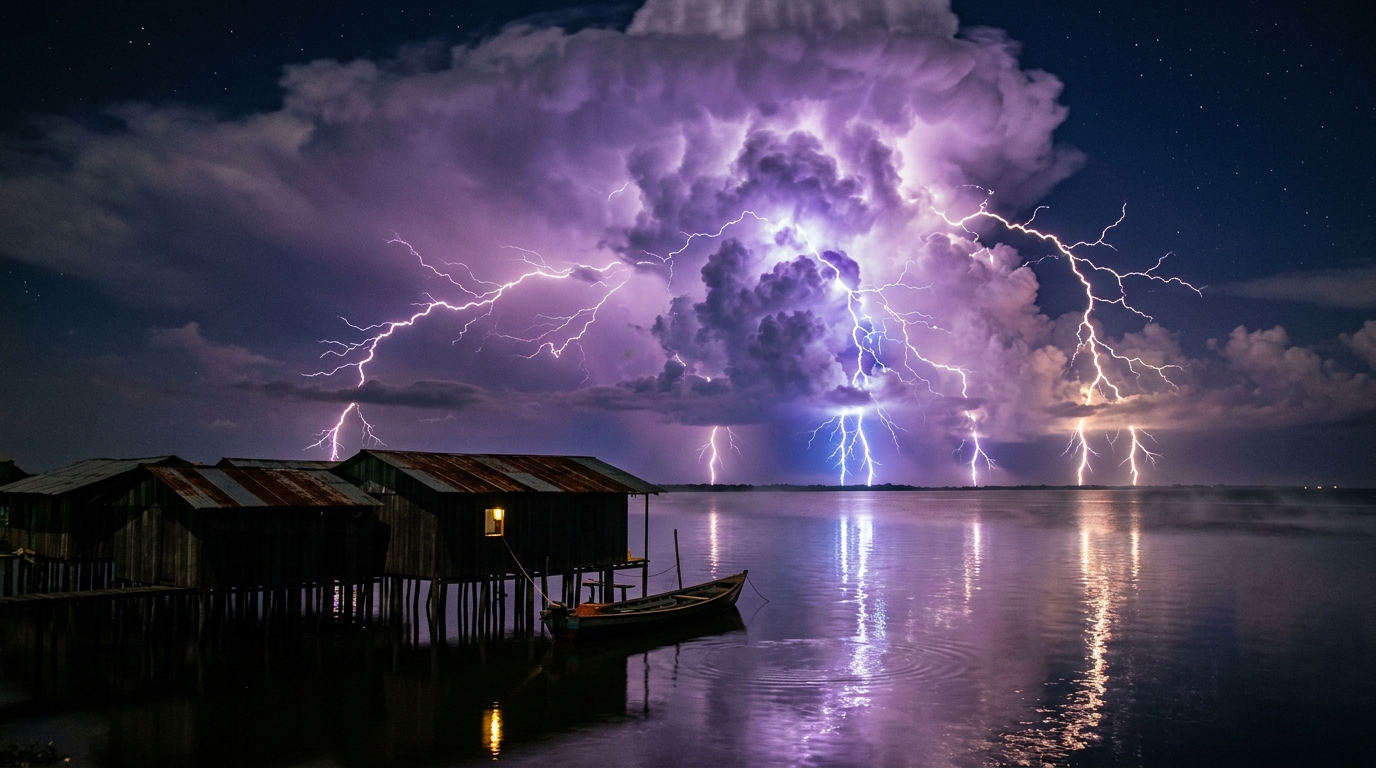
Imagine a sky that lights up almost every night, without deafening thunder or damage, but with a nearly mechanical regularity. Above Lake Maracaibo in Venezuela, this storm wears such a familiar face that it has been given a name: Catatumbo. A world record for lightning, inscribed in the books, was forged there, at the intersection of distinctive geography and a willing climate.
- Lake Maracaibo holds the world record for lightning density with 250 flashes per square kilometer per year, certified by Guinness World Records in 2014
- The phenomenon is explained by the lake’s geography, encircled by mountains that force the warm, humid air from the Caribbean to rise abruptly, creating thunderstorms nearly every day
- This balance remains fragile, as shown by the phenomenon’s pause for several weeks during the 2010 drought, while the lake also suffers from oil pollution and toxic algae
- A storm that returns almost every night for centuries
- The secret of Catatumbo: when geography and climate manufacture lightning
- A natural beacon entered into the record books and local culture
A Storm That Returns Almost Every Night for Centuries
Lake Maracaibo records about 250 thunderstorm nights per year, a world record for lightning frequency tied to the Catatumbo phenomenon. That figure alone is dizzying: it means the region’s inhabitants see the sky blaze almost two nights out of three, year-round.
This isn’t a local legend or a piece of sensational journalism. The record was certified by Guinness World Records, which on January 28, 2014 officially recognized this site as possessing the highest average density of lightning in the world, at 250 flashes per square kilometer per year. A figure that speaks to lightning density rather than the number of stormy nights, but that vividly illustrates the phenomenon’s intensity.
Behind this record lies a human story. It is ecologist Erick Quiroga, based in Zulia State, who led the nomination. He had spent seventeen years patiently documenting the phenomenon before he could finally persuade the Guinness authorities. A perseverance that deserves recognition, given that gathering data on a storm as capricious in its details, yet constant in its essence, requires rigor.
What strikes scientists is precisely this regularity. Most lightning events around the world are episodic, linked to particular and temporary weather conditions. Here, the phenomenon seems almost institutionalized, as if the sky has grown accustomed to returning to strike the same place, night after night, season after season.
The Secret of Catatumbo: When Geography and Climate Create Lightning
To understand why lightning strikes so relentlessly here, you need to study the map. Lake Maracaibo covers about 13,200 square kilometers in northwest Venezuela, and it is connected to the Caribbean Sea by a narrow strait. This geographic configuration is not accidental: it forms a true trap for moisture and winds, essential ingredients for storm formation.
The lake is ringed by mountains that channel the hot, humid winds from the Caribbean. These air masses, meeting the surrounding relief, are forced to rise abruptly. And it is precisely this mechanism—the rapid ascent of warm, humidity-laden air—that generates thunderclouds and, by extension, lightning. The lake behaves like a giant boiler, continuously fueled by the air currents.
To unravel the secrets of this atmospheric dynamic, researchers conducted field investigations. In 2015, the team led by Ángel Muñoz released weather balloons above the lake to study the conditions that favor this regularity with precision. These high-altitude measurements refined the understanding of how winds, temperature, and humidity interact in this particular zone.
The lake’s own history adds an extra dimension to this climatic equation. A few thousand years ago, Maracaibo was entirely freshwater. But between the 1930s and 1950s, the strait linking the lake to the sea was significantly widened by dredging to facilitate maritime traffic. This human intervention allowed seawater to infiltrate the lake, permanently altering its ecosystem.
Today, the lake presents a hybrid profile: its northern part has become brackish, while the southern part remains predominantly freshwater. This transformation, documented notably by NASA, has consequences for local aquatic life, though its direct influence on the storm pattern remains to be scientifically refined.
A Natural Beacon Entered into the Record Books and Local Culture
Before Lake Maracaibo officially claimed its title, another region of the globe held the crown. The area surrounding the village of Kifuka, in the Democratic Republic of the Congo, registered up to 158 lightning flashes per square kilometer per year, an already impressive figure but one that would be surpassed later.
The turn came from a 2016 satellite study that reanalyzed sixteen years of data collected by the Lightning Imaging Sensor aboard the TRMM satellite. This high-resolution analysis confirmed what local residents had intuitively known: the spot above Lake Maracaibo is indeed the planet’s most active lightning hotspot.
This phenomenon did not escape the attention of sailors and navigators of old, who already used it as a natural glowing beacon to orient themselves in the dark, long before GPS existed. It is even said that this recurring nocturnal illumination may have played a strategic role in certain regional historical events, given that its glow can be seen for tens of kilometers around.
Yet this celestial beacon is not invincible. In 2010, a severe drought dramatically lowered the lake level, disturbing the wind and humidity regimes necessary for storm formation. As a result, lightning ceased striking for several weeks, an unusual silence that worried scientists and locals accustomed to this almost permanent spectacle.
The phenomenon eventually returned, but that episode served as a wake-up call. It demonstrated how fragile this climatic balance is, no matter how spectacular, and dependent on precise environmental conditions. A lesson that resonates today, as the lake faces other, more insidious threats.
Beyond the lightning, Lake Maracaibo is suffering. Repeated oil spills tied to intensive regional oil extraction, along with the proliferation of Microcystis bacteria that produce toxic algae, are gradually degrading its ecosystem. In response, President Nicolás Maduro announced a plan to decontaminate and rehabilitate the lake, saying he had commissioned a technico-scientific study to assess the extent of the issue and to identify possible solutions.
Whether these commitments will translate into concrete actions remains to be seen. In the meantime, Catatumbo continues to glitter on nearly every night, a silent witness to a unique climatic balance in the world, but whose longevity also hinges on the health of the very lake that was its cradle. A reminder that even the most spectacular natural phenomena stay intimately tied to the fragility of the ecosystems that shelter them.
