
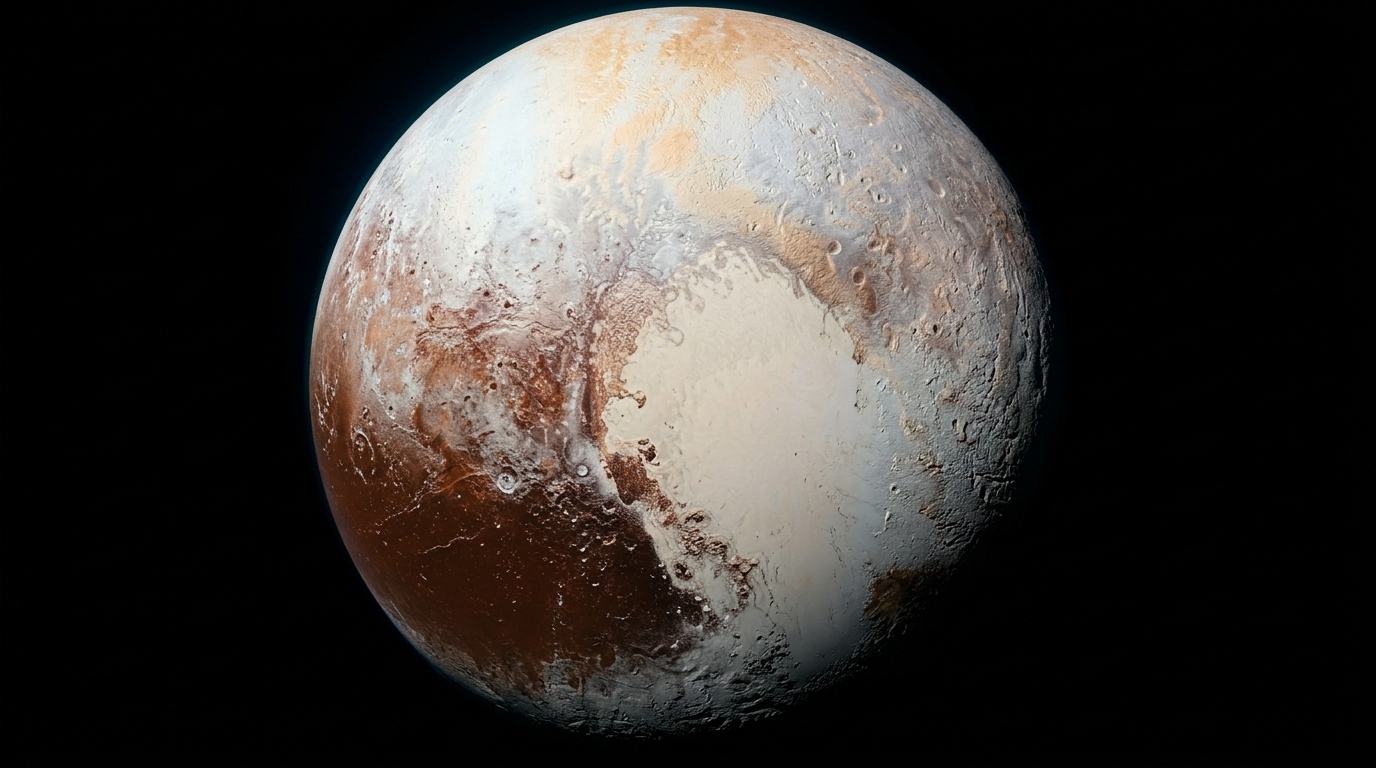
Pluto takes around 248 years to complete an orbit around the Sun. Discovered in 1930 at Lowell Observatory, it will finish its first orbital circuit since its discovery only in 2178. A staggeringly long interval that no human who witnessed its discovery will live to see its return to the starting point.
- Pluto completes an orbit in 247 years and 343 days, meaning its return to its starting point is scheduled for 2178
- Discovered by Clyde Tombaugh in 1930, Pluto was reclassified as a dwarf planet in 2006 and later passed by the New Horizons probe in 2015
- Awakened after roughly a year of dormancy, New Horizons is now about 9.5 billion kilometers from Earth, and its team has announced a possible discovery of liquid on Pluto’s surface
- An orbit so slow that a human century isn’t enough
- 1930: the moment Clyde Tombaugh changed the solar system map
- 2178, the rendezvous that no one alive today will witness
An orbit so slow that a human century isn’t enough
Pluto travels around the Sun at an average speed of 4.74 kilometers per second, roughly 16,809 kilometers per hour. That may sound quick, but at such a distance from the Sun, completing a full loop demands an enormous span of time. Its sidereal orbital period is precisely 247 years and 343 days, which means it requires almost 248 Earth years to complete a single orbit.
To grasp this slow pace, one must look at the shape of its path. Pluto’s orbit is eccentric, with an eccentricity of 0.25, indicating it is not circular but decidedly elongated. Its distance from the Sun ranges from about 4.44 to 7.375 billion kilometers depending on where it is along its journey. It is also inclined by 17 degrees relative to the ecliptic—the reference plane in which most planets of the solar system travel.
This wide swing between the closest and farthest points from the Sun partly explains why the dwarf planet takes so long to complete its circuit. Another factor comes into play: Pluto maintains a 3:2 orbital resonance with Neptune. In other words, its orbital period is exactly one and a half times longer than Neptune’s, a precise gravitational mechanism that prevents any collision between the two bodies even though their paths occasionally cross.
1930: the moment Clyde Tombaugh changed the solar system map
It all begins at the Lowell Observatory in Flagstaff, Arizona. There, Clyde Tombaugh, armed with patience and photographs taken only days apart, spots a bright point that drifts imperceptibly against the starry backdrop. The images date from January 23 and January 29, 1930, and the official discovery comes on February 18 of that year. The public announcement follows a few weeks later, on March 14, 1930.
For 76 years, Pluto proudly held the title of the ninth planet in the solar system. This status was called into question on August 24, 2006, when the International Astronomical Union voted to reclassify it as a dwarf planet after adopting new criteria for planetary definitions. The change sparked much debate, but it did nothing to diminish the fascination with this small, frozen world at the edge of our system.
It would be nearly 85 years after its discovery before a human-made craft approached it. On July 14, 2015, the New Horizons probe performed the first flyby in history and delivered images of unprecedented clarity. It helped establish Pluto’s diameter at about 2,370 kilometers, making Pluto the largest known object in the Kuiper Belt, ahead of Eris. The pictures also reveal a vast, heart-shaped region named Tombaugh Regio in honor of its discoverer. Its western lobe, Sputnik Planitia, turns out to be a colossal nitrogen glacier resting on an ancient impact basin.
2178, the rendezvous that no one alive today will witness
Do the math: if Pluto was spotted in 1930 and it takes roughly 248 years to complete a full orbit, it will only return to its starting point in 2178. No person alive today will be present for this event. It offers another way to measure the vast timescales at the edges of the solar system, where human reference points lose their meaning.
While awaiting this distant rendezvous, Pluto exploration continues in ways nobody anticipated. NASA has announced the awakening of New Horizons after its longest period of dormancy, nearly a full year. The spacecraft is currently about 9.5 billion kilometers from Earth, well beyond Pluto, in the Kuiper Belt, and remains in good health despite the distance.
A few weeks later, the mission’s scientific team released a statement that surprised many: “Discovery: Liquid Flowing on Pluto,” posted on the Johns Hopkins Applied Physics Laboratory site hosting the project. If this finding is confirmed in forthcoming publications, it would challenge some assumptions about the geological activity of this dwarf planet, long thought to be frozen in extreme cold.
Nearly a century after the first images were captured at Flagstaff, Pluto continues to yield surprises as instruments improve and data accumulate. Its orbit, meanwhile, goes about its quiet, unchanging journey, indifferent to human timescales, until the 2178 rendezvous that future generations may celebrate in our stead.
