
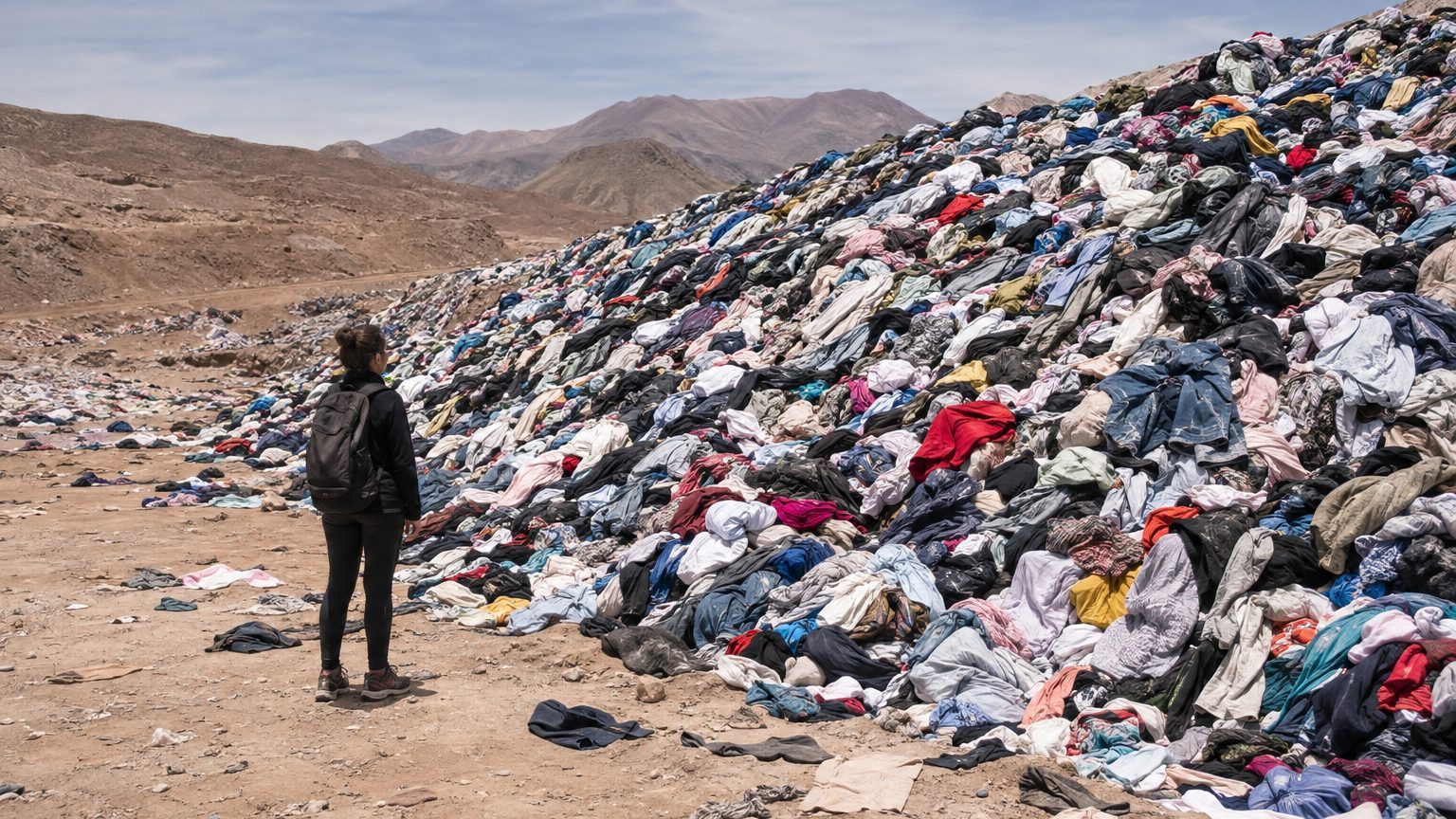
60,000 tonnes of clothing pile up in the Atacama Desert, to the north of Chile, near the town of Alto Hospicio. The mound covers an area the size of several hundred football fields, in one of the driest places on the planet. It has grown so large that it can now be seen in images taken from space.
A thrift-clothing dump, detectable from orbit.
- The pile covers the surface of hundreds of football fields near Alto Hospicio, Chile.
- The port of Iquique receives between 120,000 and 180,000 tonnes of clothing each year.
- Each European Union resident discards 11 kilograms of textiles annually, a major source of this flow.
- Burned or buried, synthetic textiles pollute the air and soil for a very long time.
A mountain of textiles spotted by satellites
Satellite photos were captured notably through the SkyFi imaging application, which makes it possible to distinguish the textile stain on the ochre soil. The latest figure tops 60,000 tonnes, according to 20 Minutes. These unsold or discarded textiles arrived from Europe, Asia and North America. The United Nations called the situation an “environmental and social emergency for the planet.”
The headline promises clothing that no one has ever worn, and the reality is more nuanced. Sources speak of “used or unsold” textiles, thus a mix. But on-site investigations have indeed uncovered items such as Christmas sweaters, ski boots, and labels still intact amid the piles.
These investigations were carried out by the NGO Ekō and the Chilean collective Desierto Vestido. They identified items from H&M, Zara, Hugo Boss, Adidas, Levi’s, Old Navy, Under Armour, Tommy Hilfiger and Nike among the discarded garments. Their presence reflects the diversity of shipments that end up there, not a single-mark responsibility.
The port of Iquique, hub of the secondhand market
The free port of Iquique receives between 120,000 and 180,000 tonnes of clothing each year. Some of this secondhand clothing feeds markets across Latin America. But a significant portion escapes this circuit, and in the absence of a responsible party to cover disposal costs, part of it is illegally dumped in the desert.
The first images of the dump circulated in 2020.
The engine driving this flow lies in our closets. According to the European Parliament, every EU resident purchases 26 kilograms of textiles per year and discards 11 kilograms. At that rate, 60,000 tonnes corresponds to the annual purchases of more than 2 million Europeans, a little more than the population of Paris within the city limits. And this calculation refers only to the Atacama pile, not to all clothing discarded each year around the world.
Fires, a blackened ground and exposed residents
On the ground, the clothing piles do more than accumulate. A portion is regularly burned, polluting the air, soil, and potentially the groundwater. Bastian Barría, one of the founders of Desierto Vestido, describes after certain fires a black layer that resembles solidified oil.
Synthetic fibers, such as polyester, degrade very slowly. Burning or burying these stocks does not solve the problem; it simply shifts the pollution into the air or beneath the surface.
According to National Geographic, cited by 20 Minutes, a truckload of used clothing is dumped or burned somewhere in the world every second.
For the residents of Alto Hospicio, the consequences are both environmental and health-related. Satellite monitoring programs, including Copernicus from the European Space Agency, have reportedly confirmed that the textile stain continues to grow. The site has become one of the most visible symbols of the excesses of fast fashion.
One final note on numbers: estimates vary by year and source. Some articles speak of 60,000 tonnes accumulated, others of 60,000 tonnes arriving annually at the port of Iquique; the pile lacks a single official tally. One constant, however, is the source of the flow: 11 kilograms per European per year. Extending the life of garments, reselling them, or depositing them in a collection point reduces the amount that can reach these ports.
Sources: keops-ingenierie.fr | noticiasambientales.com
