
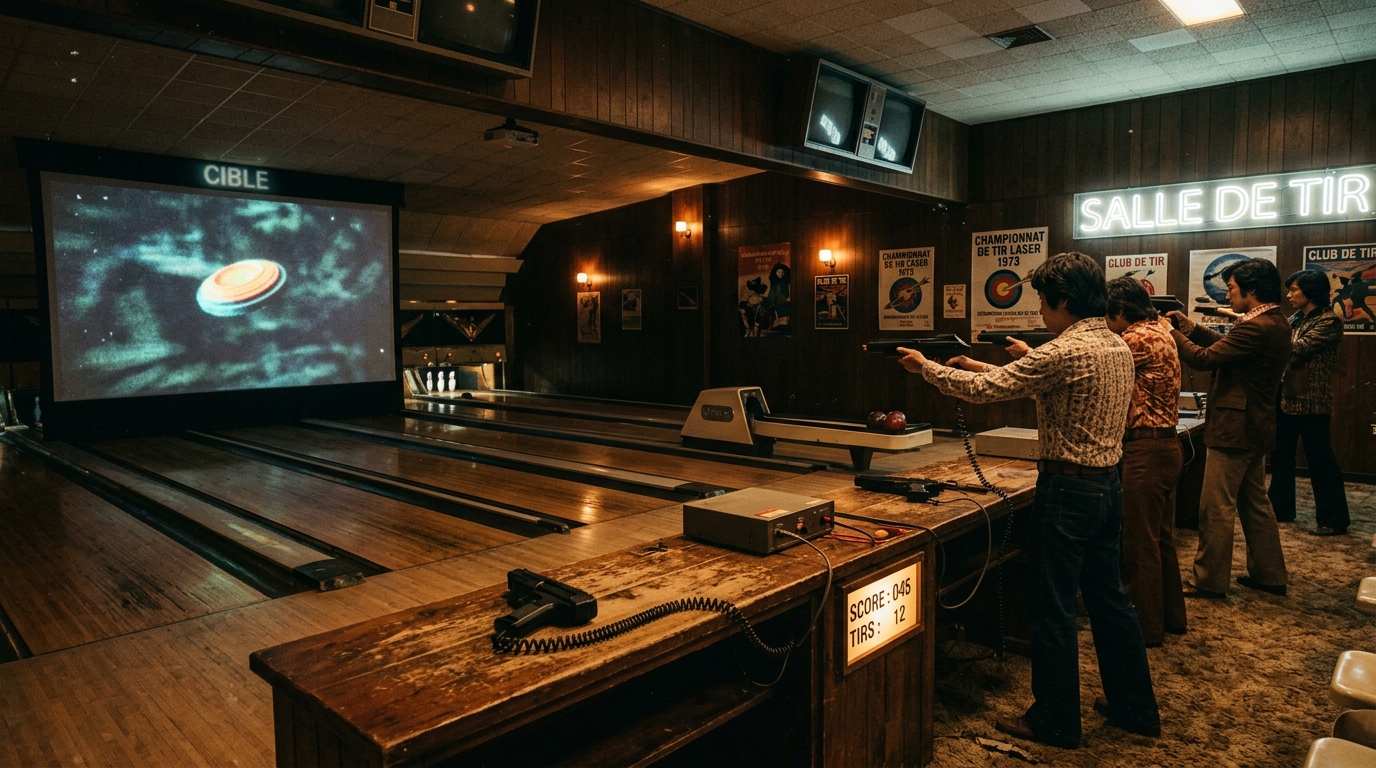
Imagine deserted Japanese bowling alleys transformed into laser shooting stalls, years before video games became what we know today. In 1973, Nintendo attempted this improbable gamble. A few months later, the company teetered on bankruptcy with about 5 billion yen in debt. Its salvation would come from a very simple idea: repurposing the technology.
- In 1973, Nintendo installs its Laser Clay Shooting System, a laser ball-trap, in former bowling alleys across Japan.
- The oil shock cancels orders and leaves the company with about 5 billion yen in debt.
- Yamauchi repurposes the technology into a miniature version, a base later used by Gunpei Yokoi to create the 1974 arcade game Wild Gunman.
- An unusual bet in the ruins of Japanese bowling alleys
- When the oil shock turns a success into a financial abyss
- From recycled laser to Wild Gunman, Nintendo’s unexpected revival
An Unusual Bet in the Ruins of Japanese Bowling Alleys
Before becoming the video game giant we know today, Nintendo was a Japanese company specializing in playing cards and then toys. In January 1973, it unveiled a bold concept for the era: the Laser Clay Shooting System, a kind of ball-trap without a real gun or ammunition.
The idea came directly from the company president, Hiroshi Yamauchi. Gunpei Yokoi, a central figure in Nintendo’s history, led the technical development of the project. Masayuki Uemura, freshly hired in 1971, worked alongside him with Genyo Takeda on the solar cell technology used to detect shots.
Concretely, the player shoulders a rifle and fires at clay pigeons launched in front of them. Each impact is recorded thanks to photoreceptors, a bit like a light sensor that reacts to the slightest flash. No powder, no lead, just light and electronics.
To install these full-scale shooting stalls, Nintendo needed space. The company thus set its sights on old Japanese bowling alleys that had fallen into disuse, converted into laser shooting rooms. The idea appealed, orders flowed in, and everything seemed to indicate that Nintendo had found a new revenue stream.
When the Oil Shock Turned a Success into a Financial Abyss
To finance this rapid expansion, Nintendo borrowed heavily. The company bet big on this new entertainment market, convinced that the Laser Clay Shooting System would continue to sell like hotcakes across the country.
But in 1973, the oil shock struck the global economy head-on. Japan, heavily dependent on energy imports, absorbed the price rise cruelly. Companies curtailed investments, and costly leisure activities were swept aside.
Result: most orders placed for the laser shooting system were canceled. Nintendo found itself with unsold machines in stock and loans to repay, without the expected revenue to cover them.
The bill was steep: about 5 billion yen in debt piled up, an amount that literally pushed the company to the brink. It is hard to imagine today that the future publisher of Mario and Zelda nearly went bankrupt because of a laser ball-trap installed in repurposed bowling alleys.
From Recycled Laser to Wild Gunman, Nintendo’s Unexpected Revival
Rather than simply abandoning this costly technology, Yamauchi chose to monetize it in a different way. In 1974, he launched a scaled-down and much cheaper version called Mini Laser Clay, designed for arcade venues and equipped with a simple 16-millimeter projector.
This miniaturization marked a turning point. It allowed Nintendo to reclaim part of its know-how without needing an entire former bowling alley for each installation. It is precisely this kind of technological recycling that would save the company from an announced bankruptcy.
Gunpei Yokoi then built on this technical base to design Wild Gunman, an electro-mechanical arcade game released in 1974. The concept remained close to the original Laser Clay, but the presentation changed radically: farewell to clay pigeons, and a Western duel between cowboys took their place.
The Wild Gunman cabinet uses two distinct 16-millimeter projectors: one displays the cowboys drawing and firing, the other shows their fall once struck by the player. A simple yet effective trick that creates the illusion of a true interactive duel decades before modern video games.
This technological lineage has not been forgotten. The Nintendo Museum, opened in 2024 in Uji, near Kyoto, in the former Uji Ogura factory, now offers an attraction called Zapper & Scope SP. It is presented as a modern reinterpretation of the Laser Clay from the 1970s, proof that Nintendo never truly closed the book on this turbulent chapter of its history.
This anecdote illustrates how major industrial successes sometimes spring from projects that nearly tipped everything over. Without the oil shock and those billions of yen in debt, Nintendo might never have needed to reinvent its arcade offerings. A lesson that still resonates today as the company continues to surprise with its consoles and iconic licenses.
