
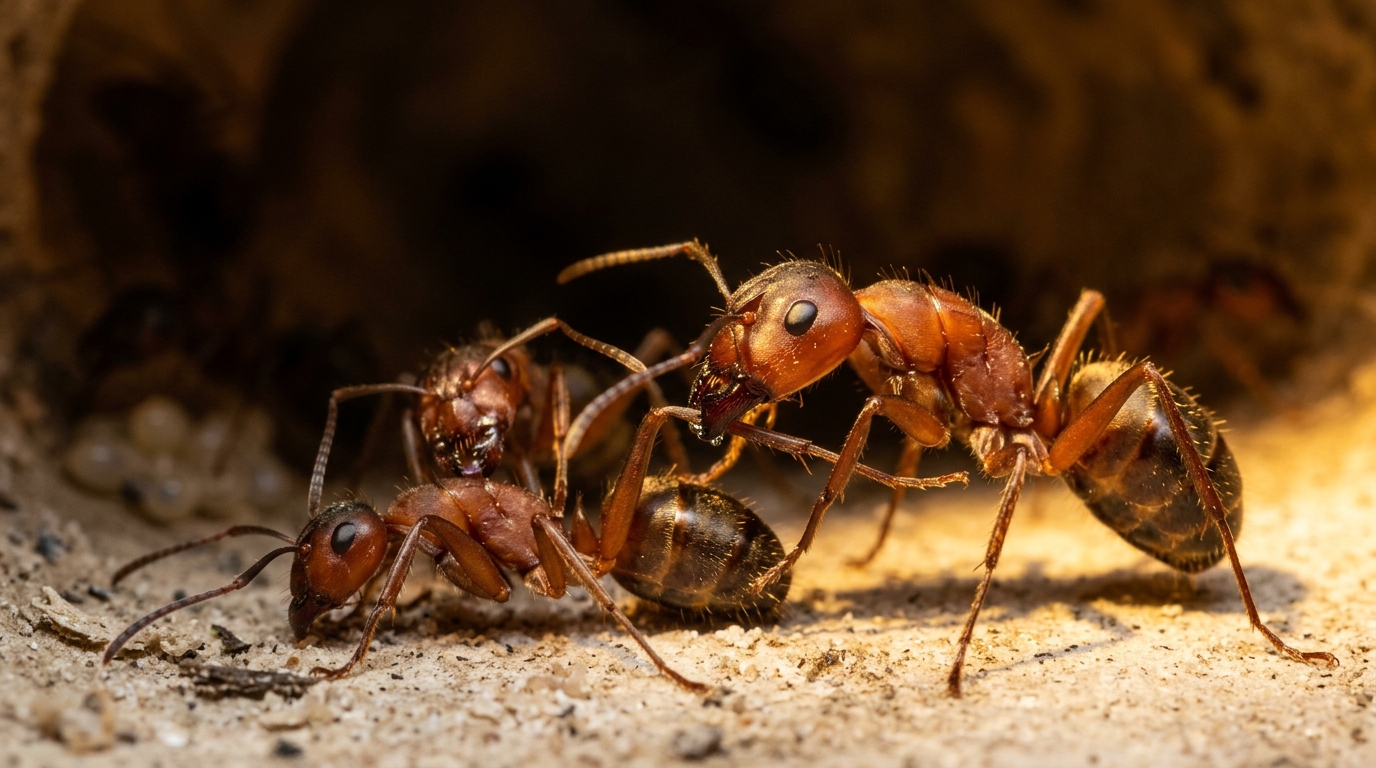
A worker of Camponotus floridanus returns with a femur injury: her sisters immobilize her, then sever the leg with repeated bites over long minutes. This surgical act, documented by Erik Frank and his team, drastically changes the insect’s survival prognosis. Without this intervention, barely 40% of injured ants survive; with it, the rate climbs to over 90%.
- The workers of Camponotus floridanus amputate the leg of a sister wounded at the femur, but merely lick a tibial wound, as the infection spreads too quickly for an amputation to be beneficial.
- This species, having lost its metapleural disinfection gland, has developed this collective surgery as a mechanical response to the absence of chemical tools.
- According to Erik Frank’s study published in Current Biology, amputation raises survival from below 40% to above 90% for femur wounds, while cleaning boosts survival to about 75% for tibia injuries.
- A wound, two treatments: why the femur matters
- From licking to amputation: how ants diagnose the wound
- 40% versus 90%: what Erik Frank’s figures reveal about this collective surgery
A wound, two treatments: why the femur matters
Among Camponotus floridanus ants native to Florida, outcomes hinge on the exact spot where the leg was nicked. A femur wound, at the upper part of the leg, triggers a radical protocol: plain amputation. Nestmates bite at the base of the limb, at the level of the trochanter, until it is completely detached.
A tibial wound, lower on the leg, receives a completely different treatment. Here, there is no question of cutting anything. The ants simply clean the wound with vigorous tongue licks, never proceeding to amputation, even as the infection advances.
This choice is far from arbitrary. Erik Frank’s team at the University of Würzburg sought to understand why Camponotus floridanus responds this way, given that the species has lost its metapleural gland during evolution. In other ants, this gland secretes antimicrobial compounds that disinfect wounds directly. Deprived of this chemical tool, the species appears to have developed a mechanical countermeasure: collective surgery.
From licking to amputation: how ants diagnose the wound
The detail that intrigued researchers lies in how rapidly pathogens spread depending on the wound location. The further down the leg, the faster the flow of hemolymph, the insect’s equivalent of blood. Result: in a tibial wound, bacteria reach the rest of the body in roughly five minutes.
In this case, amputating would be absolutely pointless. The infection has already reached the organism before the sisters have time to intervene surgically. Cleaning the wound remains therefore the only logical option, and that is exactly what the ants do, as if they had internalized this physiological constraint.
For a femur wound, the situation changes completely. The hemolymph flow there is slower, which leaves a window of opportunity to cut the leg before pathogens diffuse. But this operation is not instantaneous: amputation takes at least 40 minutes, and can stretch over more than three hours of continuous biting, according to Erik Frank’s observations. In controlled experiments conducted by his team, this behavior was observed in 76% of femur-wound cases, across a sample of 17 individuals.
40 % against 90 %: what Erik Frank’s figures reveal about this collective surgery
The statistics gathered in the study, published in Current Biology, measure the procedure’s effectiveness. Without any intervention, survival drops below 40% for femur-infected wounds, and falls to about 15% for tibia injuries. These figures speak clearly about the severity of an untreated infection among these insects.
Once amputation is performed, the situation reverses dramatically. Erik Frank cites a success rate between 90 and 95% for femur injuries followed by this radical treatment. For tibia wounds, simple cleaning already raises survival to around 75%, evidence that even without surgery, cooperation among workers changes the outcome.
In summary, the work by Erik Frank, from the University of Würzburg, and published in Current Biology in 2024, shows that ants amputate when the wound is on the femur, and simply clean it when it touches the tibia. A collective diagnosis with formidable precision, achieved without a central brain or verbal communication to orchestrate it.
These studies extend those published in 2023 by the same team on Megaponera analis, the Matabele ant, which treats its wounds by applying antimicrobial compounds directly to the injury. Two species, two strategies, one shared objective: to limit the spread of infections within the colony. Erik Frank also noted that his laboratory is currently conducting similar experiments on other Camponotus species to determine whether this surgical behavior is more widely spread among ants. Perhaps this could redraw our view of collective medicine in social insects.
