
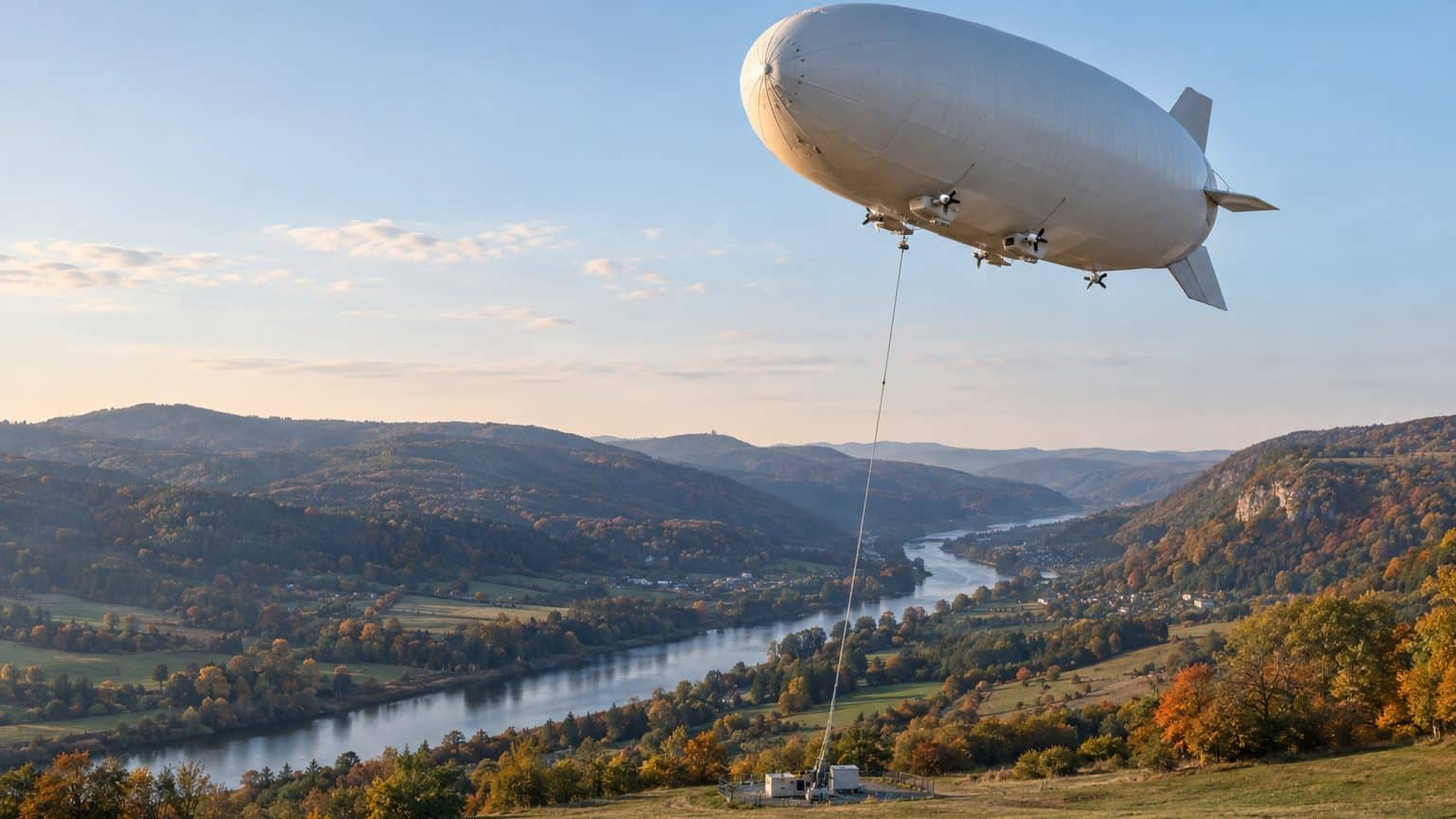
Yibin, in Sichuan Province, saw in January 2026 a 60-meter-long helium balloon, packed with 12 turbines, climb to an altitude of 2,000 meters. Up there, the wind turns the turbines, and the electricity travels down the tether to the ground, where it can enter the grid. This altitude is a little more than six Eiffel Towers stacked on top of each other.
The test yielded 385 kWh, produced in 30 minutes.
- A 60 m helium balloon reached 2,000 m altitude at Yibin in January 2026.
- The test produced 385 kWh in 30 minutes.
- High-altitude wind is roughly six times more energetic than at ground level between 100 and 2,500 m.
Why climb so high when the ground already has wind
Near the ground, the wind is slowed by terrain, trees and buildings. Higher up, it blows stronger and more regularly, which explains why turbines rise on ever-taller masts. Instead of building an oversized tower, Beijing Lanyi Yunchuan Energy Technology opted for a balloon to capture the stable altitude winds. According to ZME Science, between 100 and 2,500 m, the wind power density, i.e., the energy actually harvestable, is multiplied by about 6.
The physics explains this gap: wind power grows with the cube of its speed. A wind twice as fast therefore carries eight times as much energy.
The choice of site is defensible. Yibin is well inland, so the prototype faces neither typhoons nor ocean storms, notes Hackaday. The same site adds that the word “stratosphere” in the system’s name is a bit ambitious, since 2,000 m represents about a tenth of the way.
A balloon that acts as a power plant
The S2000 measures 60 m long by 40 m in diameter. Its 12 turbines are housed inside a double hull. An air channel formed between the main envelope and an annular wing compresses and accelerates the wind before it reaches the turbines. Hackaday questions what turbulence the metal structures in this passage might create.
A single cable holds the balloon and brings the current to ground.
Carried by helium, the craft does not require a massive foundation. That is a major difference with a tower, which demands a deep base and remains in place for decades. Hackaday concedes that larger wind turbines already rotate in parks, but judges that at 60 m by 40 m, the SAWES has some margin before hitting a limit or a record for an airborne wind turbine.
Its full name, Stratosphere Airborne Wind Energy System, shortens to SAWES. It belongs to the family of airborne wind turbines, where balloons and kites have debated the same idea for years: replacing the tower with empty space.
What 30 minutes produced
The test delivered 385 kWh. Spread over 30 minutes, that equates to an average power of about 770 kW, roughly 25% of the prototype’s capacity. The 3 MW advertised is peak power, not what the device produced during the flight.
CNN reports that 385 kWh would power an average American home for about 13 days. In comparison to a wind farm, this is modest: a 3 MW turbine running at full power would produce the same energy in less than 8 minutes.
There remains a gray area about timing. Interesting Engineering, citing the Global Times, states that the platform took about 30 minutes to assemble. Other sources present these 30 minutes as the duration of the productive flight. Depending on the actual time spent producing, the 25% average means different things, and a single test does not settle the question.
Long-term durability
The S2000 succeeds the S1500, designed for 1,500 m. Balloon-based systems must purchase and store large volumes of helium and withstand the structural demands of a large envelope. Power Technology notes that skepticism remains about megawatt-scale power in real-world conditions.
Intended uses remain to be confirmed. Reports mention off-grid sites, such as border posts, or support for ground wind farms to layer multiple production streams.
A half-hour does not reveal what a year would yield.
For the S2000, the current returns to the grid via a conductive cable, with a nominal power of 3 MW. Kite-based systems rely on sail-like materials, which are cheaper and come with lower replacement costs. For Power Technology, the challenge of the S2000 is less about proving that it works than proving the viability of a business model for a large integrated airborne system.
Sources: researchgate.net | power-technology.com
