
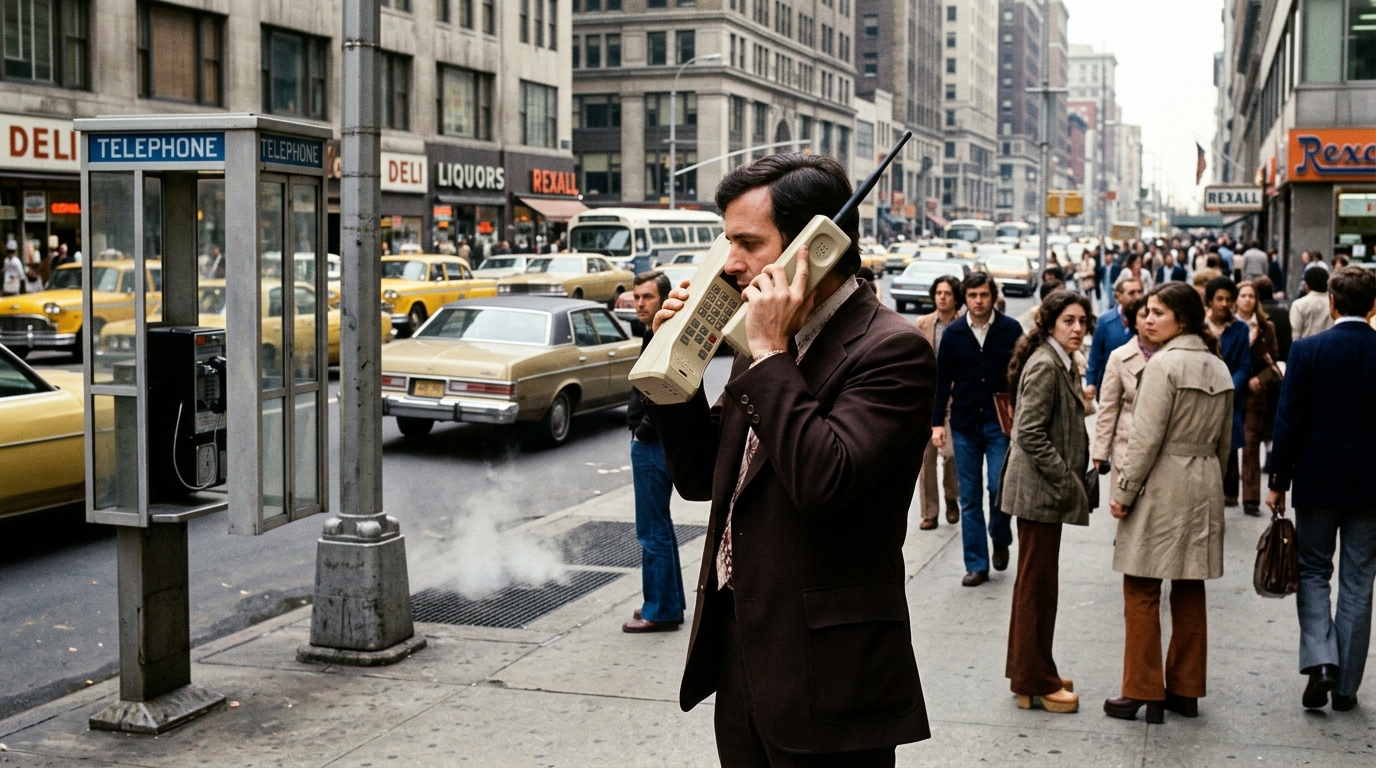
A New York sidewalk, a one-kilogram block of gray plastic in hand, and a call made directly to its main competitor to break the news. The scene reads like a Silicon Valley legend, except it happened long before that term truly existed. It took ten years of relentless research and hundreds of millions of dollars invested by Motorola for that prototype to become a marketable product. And when it landed in stores in 1984, its price turned many heads: $3,995, roughly equivalent to about $12,800 in today’s money. A look back at the turbulent birth of the mobile phone, the device we now regard as a natural extension of our hand.
- On April 3, 1973, Martin Cooper made the very first call on a portable cell phone in New York, dialing his rival Joel Engel of Bell Labs.
- The Motorola DynaTAC 8000X weighed 1.1 kg and offered only thirty minutes of talk time for a ten-hour charge.
- The Call That Changed the History of Telecommunications
- Ten Years of Research for a Risky Technological Bet
- A Launch Price Reserved for a Wealthy Elite
- The Heritage of a Prototype That Became a Cult Object
The Call That Changed the History of Telecommunications
It all begins on April 3, 1973, in the buzzing streets of New York. Martin Cooper, then the head of Motorola’s Systems division, holds a bulky prototype that looks more like a brick than a phone. He dials a number and waits. On the other end is Joel Engel, an engineer at Bell Labs, the research division of AT&T, and above all Motorola’s direct rival in the brisk race toward mobile telephony. Cooper’s message has remained in the annals of technology enthusiasts: he simply informs that he is calling from a truly portable handheld cellular phone. A technological dare that marks, in effect, the true birth of mobile as we know it.
This anecdote, recounted for years in the chronicles of telecommunications history, perfectly illustrates the competitive spirit that animated research labs at the time. Bell Labs had long been working on cellular systems, but it was Motorola that managed to offer the first truly portable device, far removed from the massive car-mounted systems that existed then. Cooper had just proven, in a single phone call, that the future of communication would fit in the palm of a hand.
Ten Years of Research for a Risky Technological Bet
Between that famous 1973 call and the actual commercialization of the Motorola DynaTAC 8000X, more than a decade passes. A delay that might seem astonishing today, as smartphones renew themselves every year, but which mirrors the scale of the technical challenge to overcome. The 8000X was in fact the culmination of fifteen years of cumulative work by Motorola engineers, who had to devise solutions where none existed before: miniaturization of components, management of relay antennas, battery life, and of course obtaining the necessary permissions.
The device was officially unveiled on March 6, 1983, becoming the first portable cellular phone available commercially. But before it could be sold, it also had to clear a crucial administrative hurdle: approval by the Federal Communications Commission, the American body that regulates telecommunications. This approval arrived in September 1983, finally paving the way for commercial launch the following year. A grueling journey that vividly illustrates the difficulty of bringing a totally new technology to market, at a time when nobody really knew whether the general public would accept dialing while walking down the street.
A Launch Price Reserved for a Wealthy Elite
When the DynaTAC 8000X finally hit the market in 1984, the selling price was dizzying: $3,995, roughly the equivalent of nearly $12,800 in today’s money after inflation. It is safe to say that this first mobile phone was not aimed at the general public, but rather at a wealthy business clientele ready to part with the price of a used small car to make calls away from the office.
And that exorbitant price did not even guarantee optimal ease of use. The device weighed 1.1 kilograms, the equivalent of a large paperback, making it a bulky object to carry daily. Worse yet, its battery life remained extremely limited relative to its price: a full charge required about ten hours for only about thirty minutes of actual talk time. A ratio that would make any modern smartphone user smile, but which nonetheless represented a significant technical achievement for its era, given the constraints of miniaturization of the batteries available at the time.
The Heritage of a Prototype That Became a Cult Object
Motorola produced the DynaTAC 8000X until 1994, the year the device yielded to the MicroTAC, which was more compact and lighter. Yet during this decade of production, the phone managed to leave a lasting mark on popular culture. Endearingly nicknamed the brick phone, in reference to its resemblance to a construction brick, the device reached a wider audience than just affluent executives thanks to cinema. Its most famous on-screen appearance is certainly in the 1987 film Wall Street, where the character Gordon Gekko uses it as the ultimate symbol of success and financial power.
What is even more surprising is the actual longevity of these devices long after production officially ended. A Canadian named Kosta Tsiriotakis claims to have placed the very last commercial call on a DynaTAC 8000X in June 2007, just before his operator Rogers Wireless finally shut down its analog network. A delightful anecdote that shows how this object, born from a high-stakes technological bet, managed to traverse decades with a robustness that would make many modern smartphones pale.
From that bulky block brandished in a New York street to the ultra-slim devices we now slide into our pockets, the journey over a few decades is almost dizzying. The DynaTAC 8000X was neither practical, affordable, nor particularly elegant by today’s standards. Yet it carried the founding idea that would change everything: a communication freed from wires and walls. Martin Cooper probably did not suspect, on that April day in 1973, that he had opened the door to a world where making a call would become as natural as breathing.
