
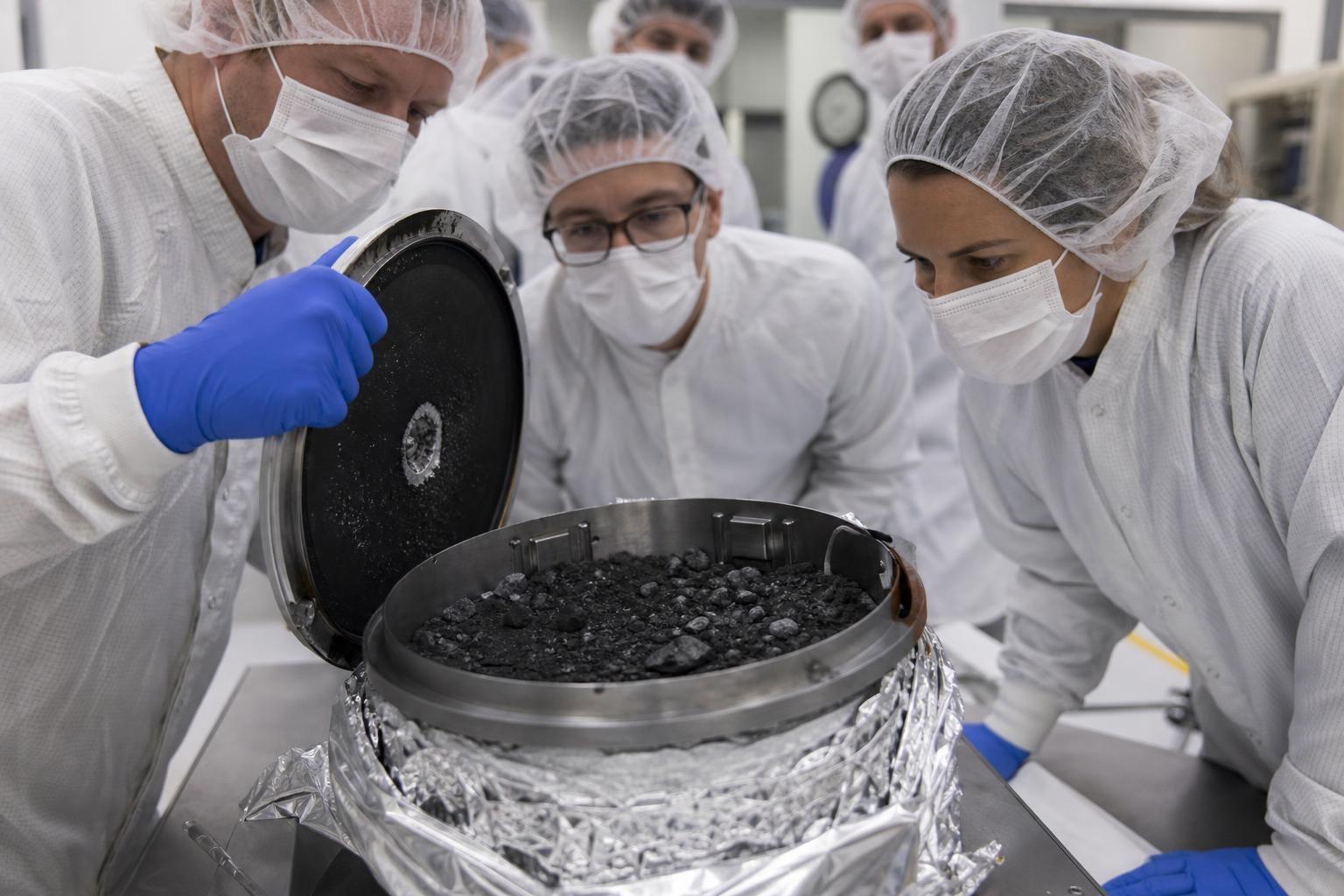
The capsule hit the Utah desert with a whisper, not a roar, and inside waited a mystery. Minutes later, in a nitrogen-purged cleanroom, a scientist peered in and said, “There is more than we expected.” From that moment, the story of a small, dark world became a larger one.
The landing that reset expectations
The return vehicle threaded the sky, its parachute blooming over salt flats like a patient heartbeat. Recovery teams moved quickly, wrapping the capsule against Earthly contamination and rushing it to Houston’s curation facility.
Even before the main container was opened, techs noticed black dust sprinkled where no dust should be. “There is more than we expected,” one researcher murmured, surprised to see grains sneaking past carefully sealed interfaces.
A bounty sealed in deep time
When the primary sampler head was finally accessed, the haul surpassed the mission’s requirement. NASA’s team logged tens of grams at first, then even more after stubborn fasteners yielded to custom tools and patient hands.
What spilled out was a mosaic of fine dust and pebble-sized fragments, matte-black and unexpectedly friable. The sample mass ultimately topped the mission’s goal, delivering an archive richer than planners promised.
- Abundant, carbon-rich organics bound up in primitive grains
- Water-bearing clay minerals (phyllosilicates) formed in an ancient, wet environment
- Sulfur- and iron-bearing compounds, including magnetite and sulfides
- Carbonate veins that hint at low-temperature, water-rock chemistry
- Textures so delicate they crumble at a scientist’s quiet breath
Why these minerals matter
These are not just rocks; they are instructions, written in elements and isotopes. Phyllosilicates record a parent body that saw water, probably for millions of years.
Organic-rich grains suggest a kitchen where prebiotic chemistry simmered in darkness and time. “We’re holding the building blocks of life,” a mission scientist said, “and they still smell like the early Solar System.”
Carbonates lock in clues about temperature, pH, and the availability of liquids. Together, these minerals sketch a past in which asteroids were reactors, not just frozen debris.
Inside the cleanroom, a choreography of care
Every movement happened under nitrogen, with tools sterilized and paperwork as meticulous as a surgical log. The curation team treated each grain as both artifact and witness, preserving context as faithfully as mass.
Some screws on the sampler head refused to budge, a tiny mechanical cliffhanger in an otherwise flawless saga. Engineers devised new fixtures, and, millimeter by millimeter, the head yielded its secrets.
The first measurements were only the beginning, because the container held more than the first scoop. Dust had migrated into seams and corners, turning “spillage” into scientific serendipity.
Numbers that tell a bigger story
The sample comfortably exceeded the mission’s minimum, a quantitative echo of that early-room gasp. Weight is only one metric, but it unlocks decades of comparative work.
With more material, labs can run destructive tests without exhausting precious grains. More mass means better statistics, stronger signals, and room for future, unimagined techniques.
What the asteroid is whispering
This rubble-pile world likely came from a larger parent body shattered long ago, then reassembled by gravity. Its minerals say “warm,” “alkaline,” “reactive,” three words that complicate simple, cold asteroid stereotypes.
The organics are not proof of life, but they are the kind of chemistry life likes. If Earth’s oceans and organics had outside contributors, rocks like these were excellent couriers.
From Utah to a thousand microscopes
Portions will be distributed to partner laboratories, each slice cataloged with almost liturgical precision. Some fragments will be archived for scientists not born yet, a promise to the future’s better questions.
Datasets will flow to public repositories, letting students and experts poke at the same stubborn mysteries. Expect a surge of papers on grains, pores, and the choreography of atoms.
The spacecraft that kept going
While the capsule slept in a padded crate, the main spacecraft fired thrusters and set a new course. Renamed OSIRIS-APEX, it is heading for the near-Earth asteroid Apophis, due to arrive after the 2029 Earth flyby.
The mission will use proximity operations to stir, study, and map, turning a once-in-a-millennium approach into a laboratory in motion. One mission, two asteroids, a generational baseline.
A time capsule, opened carefully
What began as a streak over the desert has become a library of tiny, dark pages. “Pristine” is an overused word, but here it feels earned, as if someone sealed this box in the solar system’s nursery.
There was, in fact, more than NASA expected, not just in grams but in questions. The capsule is open, the work is young, and the oldest answers are only starting to speak.
