
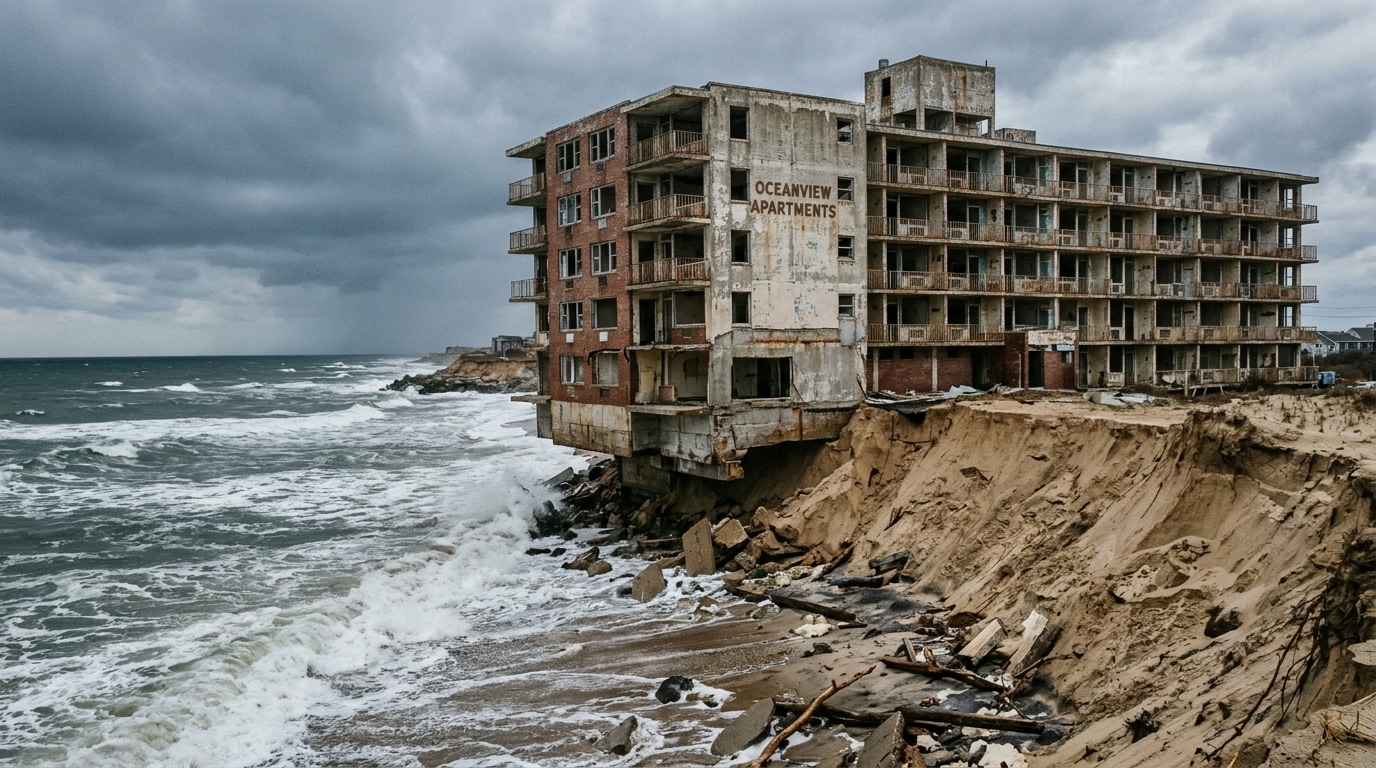
An apartment block built just 200 meters from the ocean that ultimately succumbs to the onslaught of the waves: that is the fate of The Signal, in Soulac-sur-Mer. In barely four decades, the gap between its foundations and the water has shrunk from 200 meters to less than 20 meters. A story that goes far beyond a mere coastal incident.
- Erosion swallowed 180 meters of dune between 1967 and 2023, forcing the evacuation of the 75 co-owners from 2014 without compensation from the Barnier fund
- The Signal building was ultimately demolished in early 2023, after asbestos removal carried out in 2019
- Cerema estimates that 5,200 homes could be threatened by shoreline retreat by 2050, a phenomenon that will affect up to 371 municipalities according to the 2026 decree
- When the sea was only a distant horizon: the building conceived far from the waves
- 180 meters swallowed: the relentless mechanism of extraordinary erosion
- 78 families, a single destiny: the evacuation that seals the end of a seaside symbol
When the sea was only a distant horizon: the building conceived far from the waves
In 1965, the prefect of Gironde issues a building permit for an ambitious real estate project in the commune of Soulac-sur-Mer. Two years later, The Signal rises from the ground: four stories, 78 dwellings, and an unrivaled view of the Atlantic. At the time, no problems were imagined: the edifice stood 200 meters from the shore, a distance that seemed to offer a safety margin ample enough to feel secure.
The co-owners buying an apartment in this building took a bet that appeared reasonable for the era. The dune separating the building from the ocean was seen as a natural, stable barrier, almost immutable. Nothing suggested that this same dune would, a few decades later, become the stage for a dramatic geological retreat.
Yet, beginning in the 2010s, signals of alarm multiplied. The ocean began licking the base of the dune on which The Signal rested. What had been mere theoretical concern became a tangible threat, visible to the naked eye at each high tide.
180 meters swallowed: the relentless mechanism of extraordinary erosion
The Soulac-sur-Mer coastline is not an isolated case, but it is among the most affected in Europe. According to the Ministry for Ecological Transition, the average rate of shoreline retreat in this area fluctuates between 4 and 8 meters per year. A dizzying tempo when compared with other portions of the French coast, where erosion is measured in centimeters rather than meters.
Over several decades, this erosion translated into an average retreat of about 2.5 meters per year, based on data reported by Reuters. But the accumulation of these meters, year after year, ultimately forms a chasm: 180 meters of dune literally disappeared between the building’s construction in 1967 and its demolition. The ocean never slowed its advance; it simply made the outcome inevitable.
In response to this phenomenon, solutions were tested. Mechanical sand relocation, at a rate of 60,000 cubic meters per year, had managed to reduce the retreat rates by a factor of three, but without sustainably securing the two kilometers of coast involved. This is why the Médoc Atlantique intercommunal authority initiated a far more substantial hydraulic recharge: 200,000 cubic meters of sand dredged from the Gironde estuary, at a budget of 2.9 million euros. A response on the scale of the problem, but one that arrived after the loss of The Signal.
78 families, a single destiny: the evacuation that seals the end of a seaside symbol
The winter of 2013-2014 marked a brutal turning point. A sequence of violent storms further weakened the dune to the point that the mayor of Soulac-sur-Mer, Xavier Pintat, was forced to issue a municipal evacuation and prohibition of occupancy order. The 75 co-owners had to leave their homes in a hurry, with no guarantee of ever returning to habitable conditions.
What followed was a lengthy legal battle. The co-owners hoped to secure compensation through the Barnier fund, a mechanism intended to cover natural hazards. But the Constitutional Council rejected their question of constitutional priority, and the Conseil d’État ultimately confirmed that dune erosion does not entitle access to this fund. A hard blow for families who found themselves owners of an uninhabitable property, without financial compensation proportional to their loss.
The ending comes in several steps. An asbestos removal was carried out in 2019, a necessary prerequisite before any demolition. Then, under the authority of Minister Christophe Béchu, the demolition work began in early February 2023 and was completed within a few weeks. The Signal, which had withstood nearly 56 years of Atlantic storms, disappeared permanently from the Soulac-sur-Mer landscape.
This story extends far beyond the local scale. Cerema estimates that around 1,000 buildings could be affected by coastline retreat by 2028, rising to 5,200 dwellings by 2050, with a market value estimated at 1.1 billion euros. In a scenario of prolonged inaction, up to 450,000 dwellings could be threatened by 2100. Acknowledging the scale of the phenomenon, authorities recently broadened the list of municipalities required to adapt their urban planning to coastline retreat: the decree of February 13, 2026 raises this total to 371 municipalities, up from 126 in 2022. The Signal was therefore not a mere isolated accident, but the first visible chapter of a forced adaptation that will affect an increasing number of coastal areas across France.
