
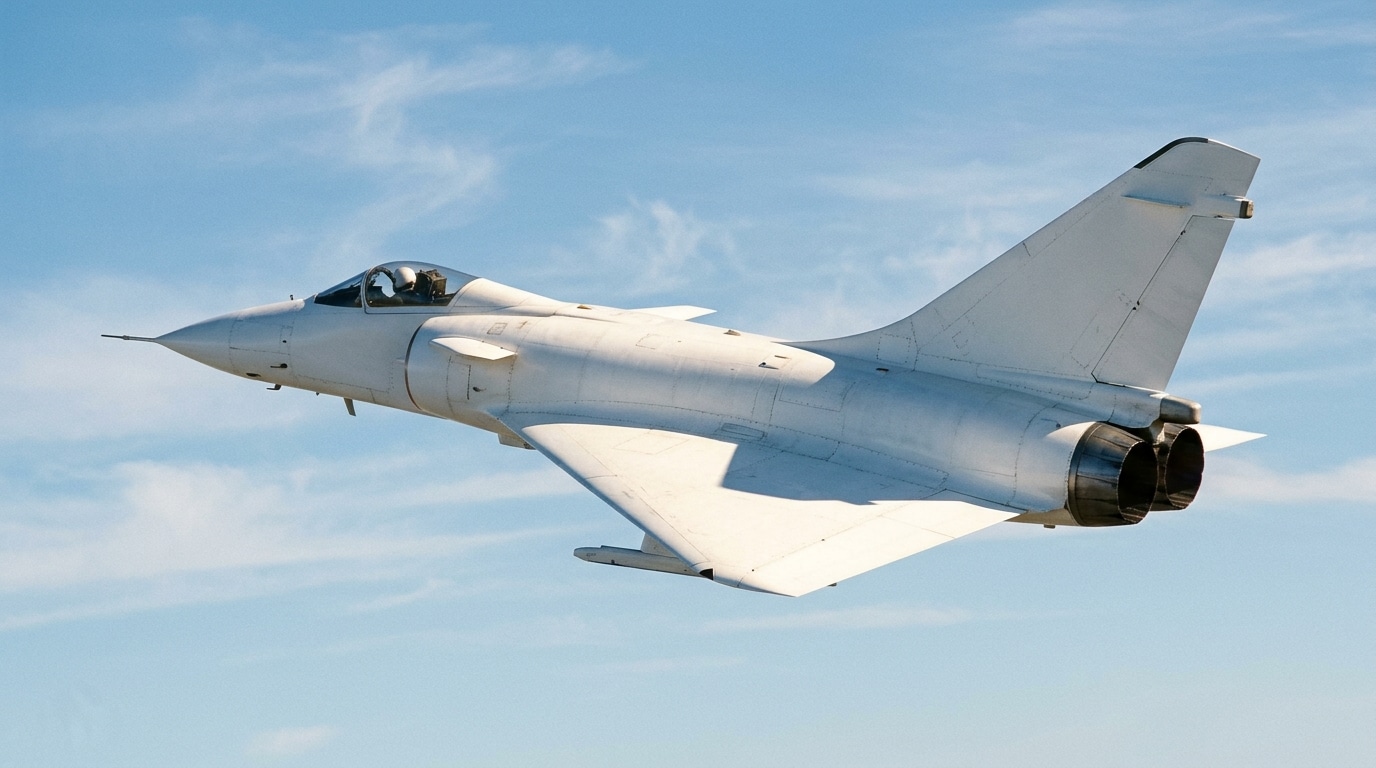
A fighter aircraft twice as large as the Mirage 2000, built without a single order from the State, by an industrialist who bet on his own funds. The Mirage 4000 did indeed exist, it flew, impressed, and then disappeared from radar. What brought the venture to an end had nothing to do with a technical accident.
- Dassault financed the Mirage 4000’s development entirely with its own funds, and it first flew on March 9, 1979 without any orders from the French government.
- Powered by two SNECMA M53-2 turbofan engines, instead of a single unit like the Mirage 2000, the aircraft offered greater power, payload capacity, and range.
- Lacking buyers, especially after Saudi Arabia chose the Tornado and the 1979 Iranian Revolution, the program ended in 1983 and the sole example has been displayed at the Bourget museum since 1992.
- A bold gamble by Dassault without state approval
- Two engines, unprecedented power: the Mirage 4000 against the 2000
- Only one aircraft built, a museum for its sole future
Retour sur un pari industriel hors norme, celui d’un avionneur convaincu de son coup, mais qui n’a jamais trouvé preneur.
A bold gamble by Dassault without state approval
On March 9, 1979, at Istres Air Base, Jean-Marie Saget took the helm of an aircraft still unknown to the general public. The chief test pilot at Dassault Aviation, he was about to take the Mirage 4000 aloft for its maiden flight. This ascent was no minor event: the aircraft had never been ordered by the French armed forces.
This is precisely what makes this program exceptional. Dassault funded the development with its own resources, with the involvement of the French aerospace industry and the State, without any guarantee of a commercial outlet. An audacious, almost cheeky move for an aircraft maker that bet on its know-how rather than on a secured public contract.
The stated objective was clear: to offer a versatile fighter capable of appealing to foreign customers at a time when the export market remained fiercely competitive. A calculation that could have paid off if geopolitical conditions had aligned more favorably.
Two engines, unprecedented power: the Mirage 4000 against the 2000
On paper, the Mirage 4000 resembles a beefed-up version of the Mirage 2000. In reality, it is precisely that. Where the 2000 relies on a single turbojet, the 4000 carries two SNECMA M53-2 turbofan engines, the same units as its smaller sibling, but in twin configuration.
This twin-engine setup dramatically changes the equation. The aircraft gains power, payload capability, and range, at the cost of increased weight and overall size. It shifts from a light, agile fighter to a larger aircraft designed to hit farther and harder.
Visually, the Mirage 4000 also stands out for details that reveal its ambition. Small canard-like surfaces, positioned just above the engine air intakes, enhance its maneuverability. Its bubble canopy, a signature aesthetic trait, offers the pilot panoramic visibility rarely matched among fighters of that generation.
Only one aircraft built, a museum for its sole future
The Mirage 4000, a 1979 prototype designed by Dassault without state orders, was built in only a single example before entering the Air and Space Museum. This precisely encapsulates the destiny of the aircraft: a concentrate of engineering that remained singular.
Commercial hopes collapsed one after another. The Royal Saudi Air Force preferred the Panavia Tornado, while the 1979 Iranian Revolution abruptly ruled out Iran, despite it being seen as a serious potential customer for this type of aircraft. The French Air Force, for its part, chose to concentrate its budgetary efforts on the Mirage 2000, leaving Dassault without a single buyer.
With no commercial perspective, the flight test campaign ended in June 1983. The prototype was mothballed at Istres, where it would continue to perform a few occasional flights until its very last takeoff, on January 8, 1988. In total, it logged 336 flights, a figure that testifies to a serious program, despite its completely non-existent commercial outcome.
In October 1992, the lone Mirage 4000 joined the Bourget’s Air and Space Museum. It arrived wearing a sand-and-brown camouflage scheme, initially designed to appeal to Middle Eastern clients. It would take until 2002, and the work of the IT Mercure association, for the aircraft to regain its original white livery, the one it wore during its early test flights.
The story of the Mirage 4000 perfectly illustrates the risks of the military aerospace industry, where technical quality alone does not guarantee commercial success. An aircraft can fly, impress engineers and test pilots, and yet never find a place in a market governed by geopolitically unpredictable decisions. Today on display at Bourget, this prototype remains a unique testament to an ambitious industrial gamble, that of an aircraft manufacturer who believed in its project to the end, without ever obtaining the commercial recognition it had hoped for.
