
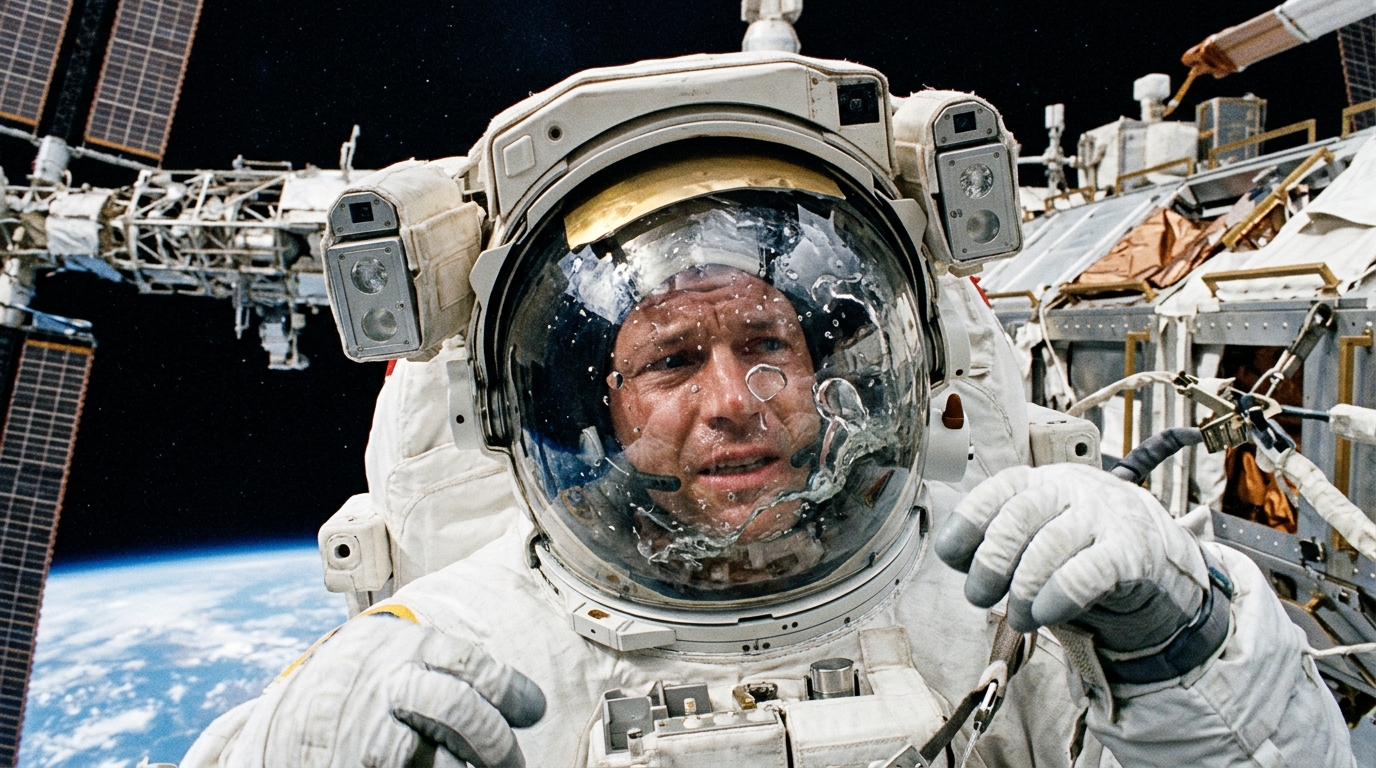
Imagine the scene: you are floating 400 kilometers above Earth, isolated inside a rigid suit that forms your only boundary with the vacuum of space, and suddenly water begins to flood your helmet. Not a trivial drop, no, a veritable stream that creeps slowly but surely toward your eyes, your nose, your mouth. That is exactly what Italian ESA astronaut Luca Parmitano experienced during a spacewalk that has gone down in the annals of space exploration. For a long time, people believed the culprit was found: the drink bag attached to his chest. A logical, almost too simple explanation. Except that NASA’s investigation revealed a far more technical, and frankly more worrying, reality that deserves closer attention.
- During EVA-23, up to 1.5 liters of water infiltrated Luca Parmitano’s helmet, shortening the EVA to 92 minutes and putting his life at risk according to NASA
- The engineers identified the real cause: inorganic deposits clogging the pump–blower separator, diverting the cooling water toward the helmet, not the drink bag initially suspected
- NASA issued 49 recommendations to safeguard future excursions, while praising Parmitano’s composure which potentially saved his own life
- The day Parmitano’s suit turned into a trap
- Tracing the water trail: NASA’s meticulous investigation
- The culprit identified: when invisible deposits clog a vital component
- The lasting impact on spacewalk safety
It all began during the EVA-23, conducted jointly by Luca Parmitano and his American colleague Chris Cassidy, members of Expedition 36 aboard the International Space Station. What should have been a routine maintenance operation of roughly six and a half hours was brutally cut short after only 92 minutes. The reason? Water intrusion into Parmitano’s helmet, to the point that up to 1.5 liters of liquid with a strange taste leaked into the suit during the activity. To give a sense of scale, that’s the equivalent of a large bottle of mineral water pouring into a confined space with no way to escape.
The problem is that in weightlessness, water doesn’t flow as it does on Earth. It clumps, floats, clings to the helmet walls, and eventually envelops the astronaut’s face. Parmitano thus saw his vision blur, his hearing degrade, and his breathing become increasingly difficult. NASA’s Mishap Investigation Board did not downplay the gravity of the situation: it characterized this episode as a potential exposure of the crew member to a life-threatening loss. A sober but unequivocal framing of the danger actually faced.
Tracing the water trail: NASA’s meticulous investigation
What makes this case particularly interesting is that it wasn’t an isolated incident. A week earlier, during EVA-22, a similar but less severe phenomenon had already been observed. On that occasion, between 0.5 and 1 liter of water had been detected in Parmitano’s helmet after the astronaut returned to the airlock. The crew, reasonably, pointed to the drink bag attached to the suit, suspecting a simple leak. A plausible hypothesis on paper, but one that proved completely wrong.
Engineers at NASA thus had to restart the investigation from scratch, examining every component of the spacesuit with almost surgical rigor. This investigative work, carried out after the second, more serious incident, definitively ruled out the water bottle as the culprit and shifted attention to a far more discreet, yet critical for the astronaut’s survival, system: the suit’s cooling loop. That’s where things became truly interesting, and where one understands why this case drew so much attention in specialist circles.
The culprit identified: when invisible deposits clog a vital component
According to NASA’s investigation report, inorganic deposits clogged the suit’s pump–blower separator and redirected water into the helmet. Specifically, this component is tasked with separating water intended for cooling from the air the astronaut breathes—somewhat like a railway switch directing each flow to its proper track. But over time mineral particles accumulated inside this essential mechanism, creating an invisible blockage from the outside. As a result, the water meant to circulate in the cooling circuit was diverted from its normal path, gradually making its way back into the helmet.
This finding hit the technical teams like a small bomb. No one had anticipated that such a discreet component could quietly become clogged and turn protective equipment into a genuine life-threatening threat. It’s a bit like your kitchen coffee filter gradually getting clogged without you noticing, eventually flooding the room. Except here, the room was a hermetic helmet in the vacuum of space, with no window to open for venting.
The lasting impact on spacewalk safety
In light of the severity of the situation, NASA’s final report did not hold back on recommendations: no fewer than 49 recommendations were issued to prevent such a scenario from recurring. Among the measures adopted, there was a strengthening of the pre-EVA verification protocols for the pump–blower separators, as well as increased monitoring for early signs of water intrusion, no matter how small. The less severe EVA-22 incident, which had been too quickly attributed to the drink bag, served as a bitter reminder of the importance of never neglecting the slightest warning signal, even when a simple explanation seems to fit.
It is also worth highlighting an aspect often overlooked in this story: Luca Parmitano’s remarkable composure during his return toward the airlock, as his vision was nearly gone and breathing was difficult. NASA’s Mishap Investigation Board explicitly praised this mastery, stating that it potentially saved the astronaut’s life. A reaction that illustrates how vital the mental preparation of astronauts is, just as much as the technical reliability of their equipment, in an environment where the slightest panic can have irreversible consequences.
This episode, as frightening as it was, ultimately contributed to making spacesuits safer for future generations of astronauts. It also serves as a reminder of a fundamental truth of space exploration: in such a hostile environment, it is often the most discreet components, far from the spotlight, that can tip a mission from routine to catastrophe. A timely reminder for all those who, even today, still suit up to venture into the vacuum of space.
