
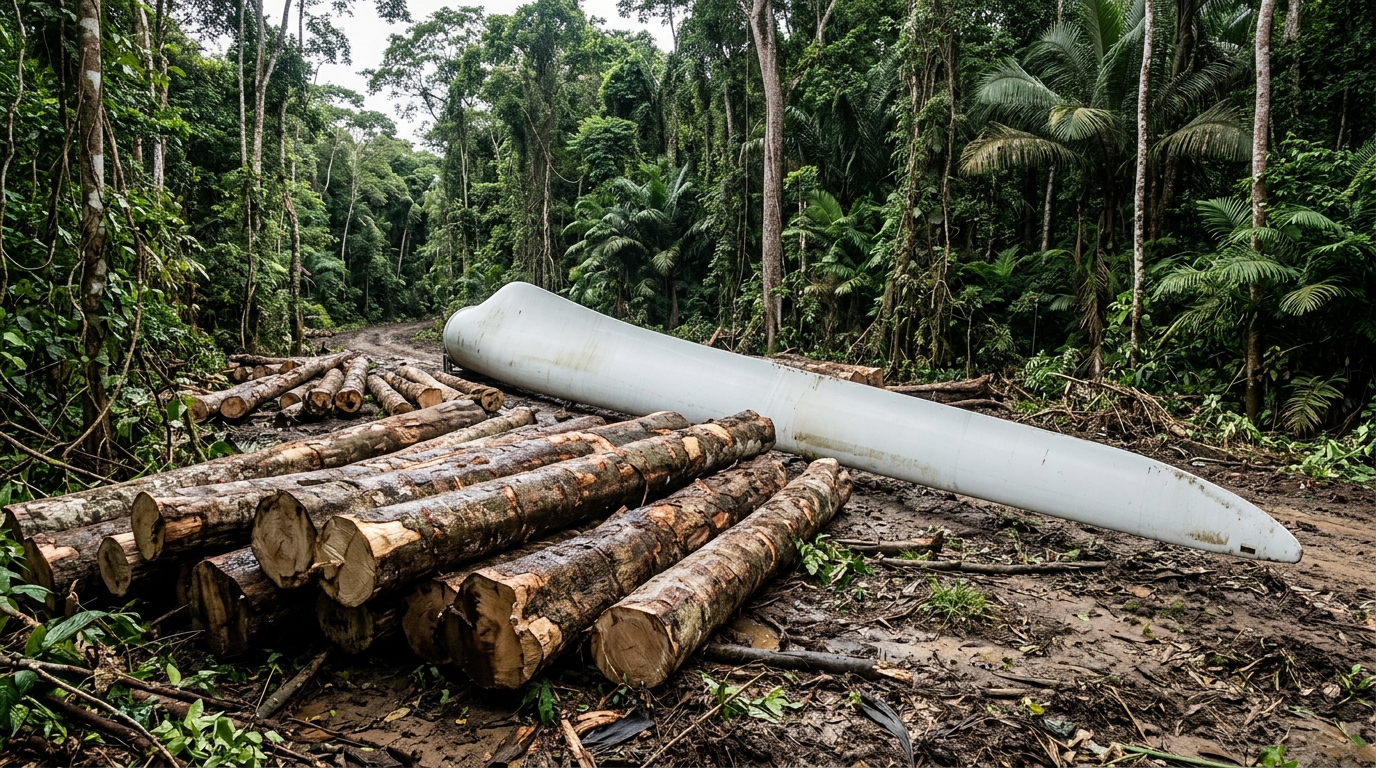
Imagine a wind-swept plain dotted with dozens of giant wind turbines whose blades, as long as football fields, rotate tirelessly to generate so-called clean electricity. What is less known is that these blades often harbor a wooden core—a material so light that it nearly floats on its own—and that this wood comes from a very specific corner of the globe: the equatorial Amazon. When China launched its immense wind-energy program in 2020, demand for this wood surged so rapidly that the consequences were felt even in the most remote corners of the tropical forest, touching an indigenous community that had done nothing to deserve it.
- The Chinese wind program launched in 2020 triggered a surge in demand for balsa, a lightweight wood used in wind turbine blades, with Ecuador supplying roughly 75% to 90% of global production
- Facing this demand, illegal logging of balsa in natural forests rose, impacting lands belonging to the Achuar indigenous community, where trees were bought for as little as $1.50 per tree
- In June 2023, the Achuar Nation of Ecuador officially banned any deforestation for the extraction of balsa on its territory
- An Amazonian tree at the heart of the Chinese energy transition
- 2020, the year the price of balsa rose tenfold
- Illegal loggers into the sacred lands of the Achuar
- An Amazonian people caught between promises and pillage
An Amazonian tree at the heart of the Chinese energy transition
Balsa is not like ordinary wood. Its density is so low that it can be up to ten times lighter than most species used in industry, while still retaining mechanical strength sufficient to withstand substantial stresses. This rare combination makes it the preferred material for the inner structural core of wind turbine blades, where it forms the structural spine between layers of resin and fiberglass. The lighter the blades, the more efficiently they rotate, and the more electricity the turbine produces at a lower operating cost.
Yet this tree grows almost exclusively in a single country. Ecuador accounts for the bulk of global balsa production, a share estimated at about 75% according to some outlets cited by economic press, and rising to as high as 90% according to other sources specializing in the forestry sector. In other words, when global demand soars, a single territory—spanning coast plains and the Amazon rainforest—must absorb the shock.
2020, the year the price of balsa rose tenfold
China launched in 2020 an unprecedented wind-energy development program, designed to secure subsidies ahead of a regulatory change. The result: orders for blades, and thus for balsa, exploded in a matter of months. Between mid-2019 and mid-2020, the price of the wood doubled, a spike sharp enough to draw the attention of many economic observers, including The Economist.
The export figures from Ecuador provide a clear picture of this surge. In 2019, Ecuador had already exported $219 million worth of balsa, about 30% above its previous historical peak dating from 2015. But the following period was even more dramatic: in the first eleven months of 2020, exports reached $784 million, more than triple the previous year. China alone absorbed between 75% and 85% of this volume, becoming by far the country’s largest client on this highly specialized market.
Illegal loggers into the sacred lands of the Achuar
Faced with such a sudden demand, legal supply simply could not keep up. Multinational companies had indeed developed large balsa plantations along the equatorial coastal plains, where the tree grows rapidly and can be harvested sustainably. But between 2017 and 2020, market pressure pushed some buyers to source wood directly from natural forests, well beyond the authorized zones. The amount of illegal balsa seized in Ecuador jumped 180% during the year 2020 alone, a figure that measures the scale of the phenomenon.
This trade did not stay confined to the outskirts of legal plantations. According to a journalist specializing in environmental crimes in Ecuador, illegal balsa exploitation directly contributed to deforestation within the lands of the Achuar indigenous community, whose territories extend across the Ecuador–Peru border, at the heart of one of the planet’s richest biodiversity hotspots.
An Amazonian people caught between promises and pillage
What makes this story particularly bitter is how local communities were approached. Buyers arrived with their trucks directly on Achuar lands, offering derisory sums: barely $1.50 per tree felled. In communities where the monetary economy remains marginal and where residents know little about the mechanisms of the international market, these offers could seem acceptable at the moment, even though they represented only a tiny fraction of the value of the wood once processed and exported to China.
Facing the scale of these abuses and the visible degradation of their environment, the Achuar eventually organized a collective response. In June 2023, the Ecuadorian Achuar Nation, representing the entire community within the country, officially declared that it would no longer permit any deforestation for the extraction of balsa on its territory. A symbolically powerful decision that puts indigenous sovereignty at the center of a debate usually dominated by industrial and climate concerns.
This case nicely illustrates the paradox of certain solutions marketed as virtuous for the planet. Wind energy aims to reduce our dependence on fossil fuels, a goal that no one seriously disputes, but its supply chain, if not adequately supervised, can reproduce precisely the patterns it claims to fight: exploitation of sensitive resources, economic pressure on vulnerable populations, and deforestation of essential ecosystems. The Achuar backlash serves as a reminder of a plain fact too often overlooked: the energy transition cannot be built sustainably unless, from the start, it respects the territories and the rights of those who have inhabited them for generations.
