
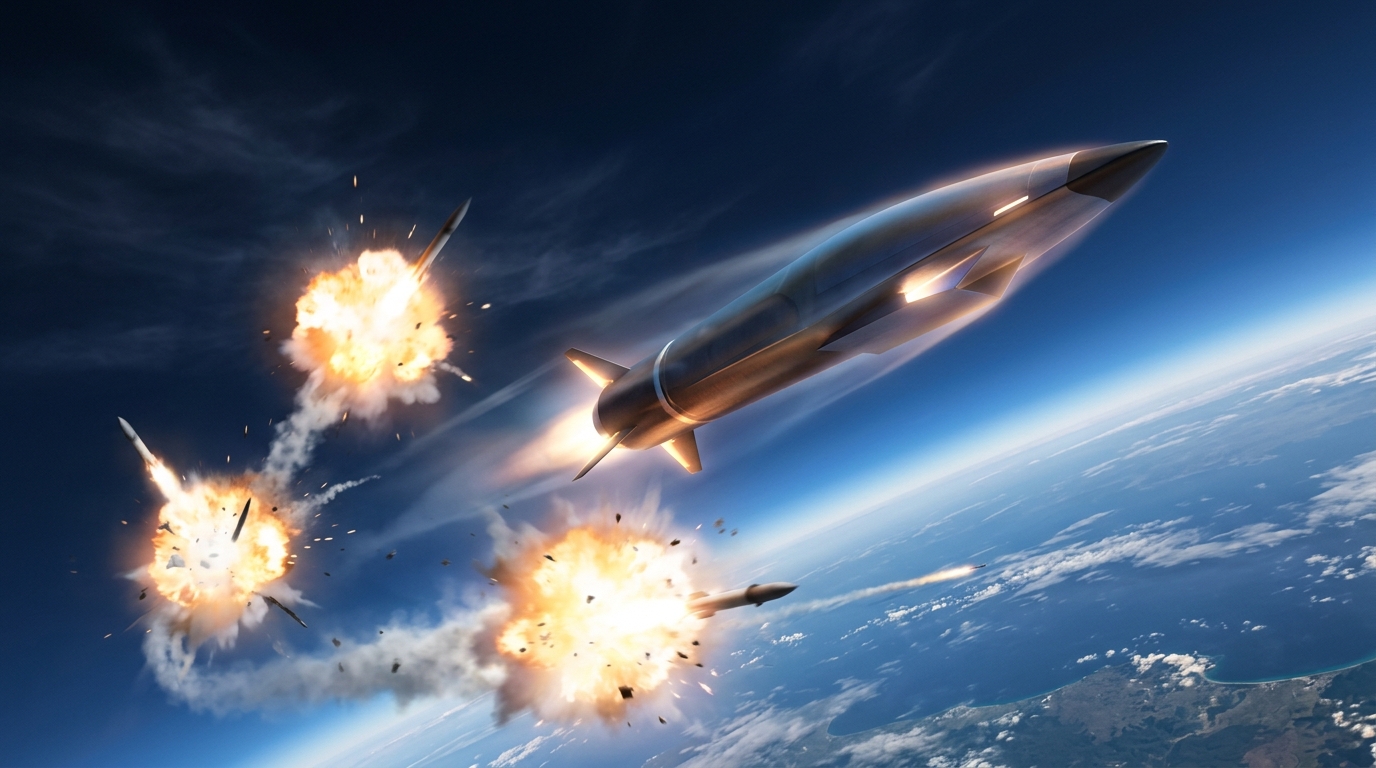
Imagine a shield designed to stop any projectile, no matter how fast or sophisticated it may be. That is precisely the promise the United States has hammered out for decades with its missile defense systems, a device meant to render ballistic attack moot long before it reaches its target. Yet North Korea may have just found a flaw. On Sunday, October 4, 2026, Pyongyang announced it had tested a hypersonic missile under the direct supervision of Kim Jong-un, during an exercise presented as a demonstration of the reliability of its nuclear deterrent. The weapon reportedly covered roughly 1,000 kilometers along a trajectory described by North Korean authorities as shaped like a wave. But beyond this test, it is the Hwasong-19, presented as capable of covering 15,000 kilometers while evading American radars, that unsettles the certainties established since the Cold War. It raises serious questions about the true resilience of the Western missile shield.
- On October 4, 2026, North Korea test-fired a hypersonic missile under Kim Jong-un’s supervision, traveling about 1,000 km on a wave-shaped trajectory.
- The Hwasong-19, first tested on October 31, 2024, would be able to travel 15,000 km while evading American radars.
- Hypersonic weapons like the Hwasong-11E-1, capable of reaching Mach 8 and maneuvering in flight, would complicate interception by missile-defense systems such as THAAD, though none of these capabilities has been independently verified.
- The Hwasong-19, a weapon designed to outsmart American radars
- Why hypersonic speed changes all the rules of interception
- The alleged vulnerabilities of the American missile shield in light of this new threat
- What this announcement changes about the balance of power in the Asia-Pacific
The Hwasong-19, a weapon designed to outsmart American radars
The Hwasong-19 did not spring from nowhere. Its first test dated to October 31, 2024, not this year as recent headlines might imply. During that initial trial, the inert payload climbed to an altitude of 7,687.5 kilometers, with a horizontal range of 1,001 kilometers and a flight time of an impressive 85 minutes and 56 seconds. Those numbers alone illustrate the might of the launcher used: a chassis with eleven axles, compared with nine for the predecessor Hwasong-18, yielding a total length around 28 meters according to several specialized sources. The official KCNA news agency did not hesitate to call it the most powerful strategic missile in the world, a formulation that sounds like a direct warning to Washington and its regional allies.
But what makes this craft particularly worrying for Western strategists is the announced range of 15,000 kilometers combined with the alleged ability to evade U.S. defenses. If these figures were verified, the Hwasong-19 could theoretically reach any point on American soil, potentially rendering part of the deterrence doctrine that had guided policy for decades obsolete. Of course, none of these capabilities has been independently verified, and caution is warranted in the face of communications that serve Pyongyang’s political objectives.
Why hypersonic speed changes all the rules of interception
To grasp the stakes, one must go back to the basics of ballistic physics. A traditional missile follows a relatively predictable parabolic trajectory, much like a rifle bullet whose course can be forecast ahead of time. Current missile-defense systems are specifically designed to anticipate such paths and send an interceptor to the precise interception point. The problem is that hypersonic weapons like the Hwasong-11E-1, unveiled in September 2026 and equipped with a hypersonic glide vehicle, no longer follow those rules. Capable of speeds up to Mach 8—around 9,800 kilometers per hour—this craft can also maneuver during flight, akin to a skier swerving down a slope to dodge obstacles.
This combination of extreme speed and unpredictable maneuverability drastically reduces the window for defense systems, which have only a few seconds to calculate a trajectory, lock on a target, and launch their own interceptor. It is precisely this logic that Pyongyang appears to be exploiting with its new generation of tactical missiles, particularly through variants of the Hwasong-11 series, offered in C, D and E versions since late 2025.
The alleged vulnerabilities of the American missile shield against this new threat
Current missile-defense systems, such as THAAD deployed in South Korea or interceptors stationed in Alaska, were mainly designed to counter traditional ballistic threats, whose trajectories remain predictable during the flight phase when interception occurs. In the face of a hypersonic glide vehicle capable of altering its course during ascent, these technologies could be outpaced, much like trying to catch a fly with a net meant for catching straight-ahead butterflies. This potential vulnerability is what Pyongyang highlights with every new test, aiming to show that its arsenal has gained a technological edge over Western devices.
It is important to note, however, that these assertions come exclusively from North Korea’s state-controlled media, whose reliability is by no means assured. No independent agency has verified either the actual speed reached by the Hwasong-11E-1 or the Hwasong-19’s claimed ability to cover 15,000 kilometers without being detected. Yet even a reasonable doubt about the effectiveness of the American shield is enough to fuel regional tensions.
What this announcement changes about the balance of power in the Asia-Pacific
Kim Jong-un did not merely supervise these tests from a distant office. He personally attended several of the recent launches, sometimes accompanied by his daughter Kim Ju-ae, a staging that is far from inconsequential and clearly aims to embed in the North Korean public the idea of a dynastic continuity secured against Western powers. This multiplication of demonstrations of force—whether hypersonic tests or tactical missile launches—fits into a broader strategy to strengthen Pyongyang’s negotiating position on the international stage.
For the United States and its South Korean and Japanese allies, this technological evolution demands a fundamental rethink of missile-defense investments, potentially accelerating the development of new generations of interceptors capable of tracking maneuvering targets. The balance of power in the Asia-Pacific, already delicate, could thus undergo significant adjustments in the coming years, with a tech race that seems likely to be only beginning.
In the end, whether these capabilities are fully operational or largely exaggerated for propaganda, the announcement of the Hwasong-19 and its theoretical 15,000-kilometer reach at least serves to remind us of a simple truth: no military technology is ever finally settled, and the contest between sword and shield continues to shape the balance of power on our planet, far from the certainties once thought to be final.
