
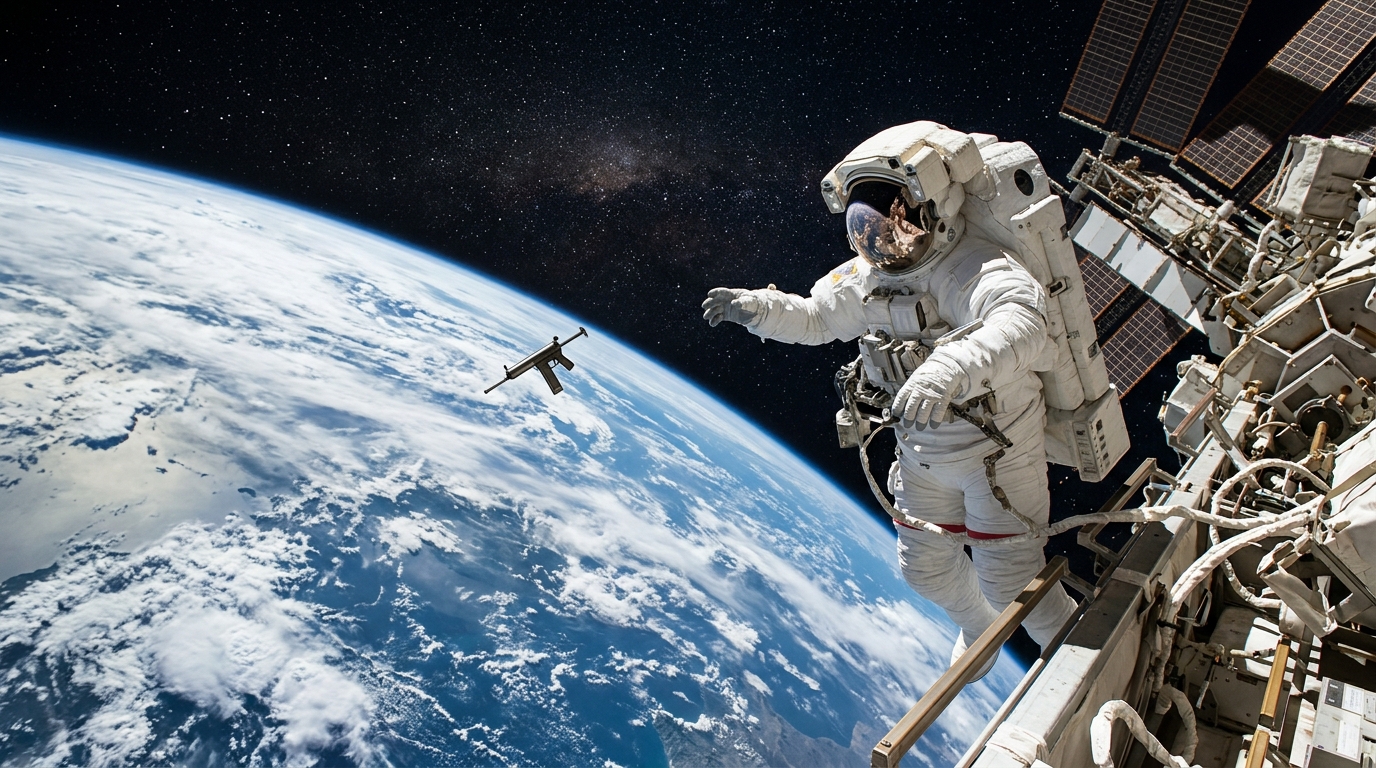
What if a simple clumsy gesture, 400 kilometers above our heads, could turn a toolbox into an artificial satellite? It sounds absurd, almost ripped from a science-fiction novel, and yet that is precisely what happened during a mission of the space shuttle Endeavour. The story deserves to be told in detail, as it perfectly illustrates the fragility of human operations in the vacuum of space, where the slightest lapse can have consequences measured in months, even years.
- In November 2008, during STS-126, a 14-kilogram toolbox slipped from astronaut Heidemarie Stefanyshyn-Piper’s grasp as she was cleaning a faulty grease gun.
- The bag settled into a stable orbit, was catalogued by the Russian Space Forces, and became visible from the ground to amateur astronomers.
- After nine months of orbital drift, the object fully burned up, disintegrating in Earth’s atmosphere in August 2009.
- A grease leak transforms a routine EVA into an orbital incident
- This toolbox becomes, despite itself, a celestial object tracked by amateur astronomers
- Nine months of quiet drift before a spectacular end in the atmosphere
- What this incident reveals about space debris and the vulnerability of EVA operations
A grease leak transforms a routine EVA into an orbital incident
Everything begins during the first extravehicular activity of the STS-126 mission, in November 2008. NASA astronaut Heidemarie Stefanyshyn-Piper is working on the rotation mechanism of one of the International Space Station’s three solar-array assemblies, a maintenance operation that demands precision and focus. But an unforeseen glitch disrupts routine: a refill of her grease gun starts leaking inside the tool bag she is carrying with her.
While attempting to clean the defective tool, the astronaut drops the 14-kilogram toolbox. A fraction of a second of inattention is enough: the object drifts away slowly, yet inexorably beyond the reach of her gloved hand. She recalls having the instinct to lunge to catch it, before realizing that such a move would simply turn a single lost item into two. According to the mission manager at the time, Ginger Kerrick, the bag was probably poorly secured to the suit from the start, which absolves the astronaut of any negligence.
This toolbox becomes, despite itself, a celestial object tracked by amateur astronomers
Once released, the bag does not fall immediately toward Earth. It stabilizes on a clean orbit, following almost exactly the trajectory of the International Space Station. Very quickly, the object draws the attention of space-surveillance services: it is catalogued by the Russian Space Forces, which monitor thousands of orbital debris. But what makes this tale particularly intriguing is that the improvised toolbox becomes, for several months, one of the smallest artificial objects visible to the naked eye from the ground.
Amateur astronomers around the world, equipped with nothing more than binoculars, manage to spot its passage across the night sky. The anecdote spreads: a DIY space tool, slipped from an astronaut’s hands, has become a bona fide satellite, tracked with the same seriousness as any official orbital vehicle. In that autumn period, when longer nights invite looking up, the story resonates: it reminds us that Earth’s near-space is teeming with peculiar objects, sometimes born from a simple accident.
Nine months of quiet drift before a spectacular end in the atmosphere
For nearly nine months, the toolbox continues its silent course around our planet, gradually losing altitude due to the residual drag of the upper atmosphere. There is no signal, no telemetry: only radar tracking reveals its precise position week by week. This slow orbital decay is the fate of all objects in low Earth orbit, whether debris or genuine research satellites.
The denouement arrives in August 2009: the bag eventually penetrates denser atmospheric layers and burns up completely through friction, just like any space debris in later life. Its ephemeral life as an improvised satellite thus ends in a rain of incandescent particles, invisible to most observers but entirely consistent with the fate of millions of similar objects that orbit Earth.
What this incident reveals about space debris and the vulnerability of EVA operations
This episode, as entertaining as it is to recount, highlights a far more serious reality: managing extravehicular activities remains a hazardous undertaking, where the slightest unsecured object can become a danger to orbiting spacecraft. The Endeavour shuttle’s STS-126 mission, lasting a total of 15 days, 20 hours and 30 minutes and comprising four spacewalks, illustrates well the logistical complexity of such operations, where every tool must be secured with meticulous care.
Heidemarie Stefanyshyn-Piper, who would eventually perform a total of five EVAs for 33 hours and 42 minutes spent in vacuum before retiring from NASA in 2009, is not the sole figure involved: this incident remains today cited as one of the clearest examples of how a human action, no matter how trivial, can generate space debris. With orbital traffic continually increasing, vigilance around these objects becomes an ever more pressing issue for the safety of future missions.
In the end, this tale of a misplaced toolbox serves as a reminder, with a touch of irony, that space, vast and silent as it is, bears no forgetfulness: every object that drifts there, even the humblest, eventually tells a story. Between the astronaut’s inadvertent mishap and the fascination of amateur observers who tracked its trajectory for months, the episode beautifully illustrates how delicate the boundary is between a technical mishap and scientific curiosity. And if, the next time you look up at a starry sky, you think of all those discreet debris still orbiting overhead?
