
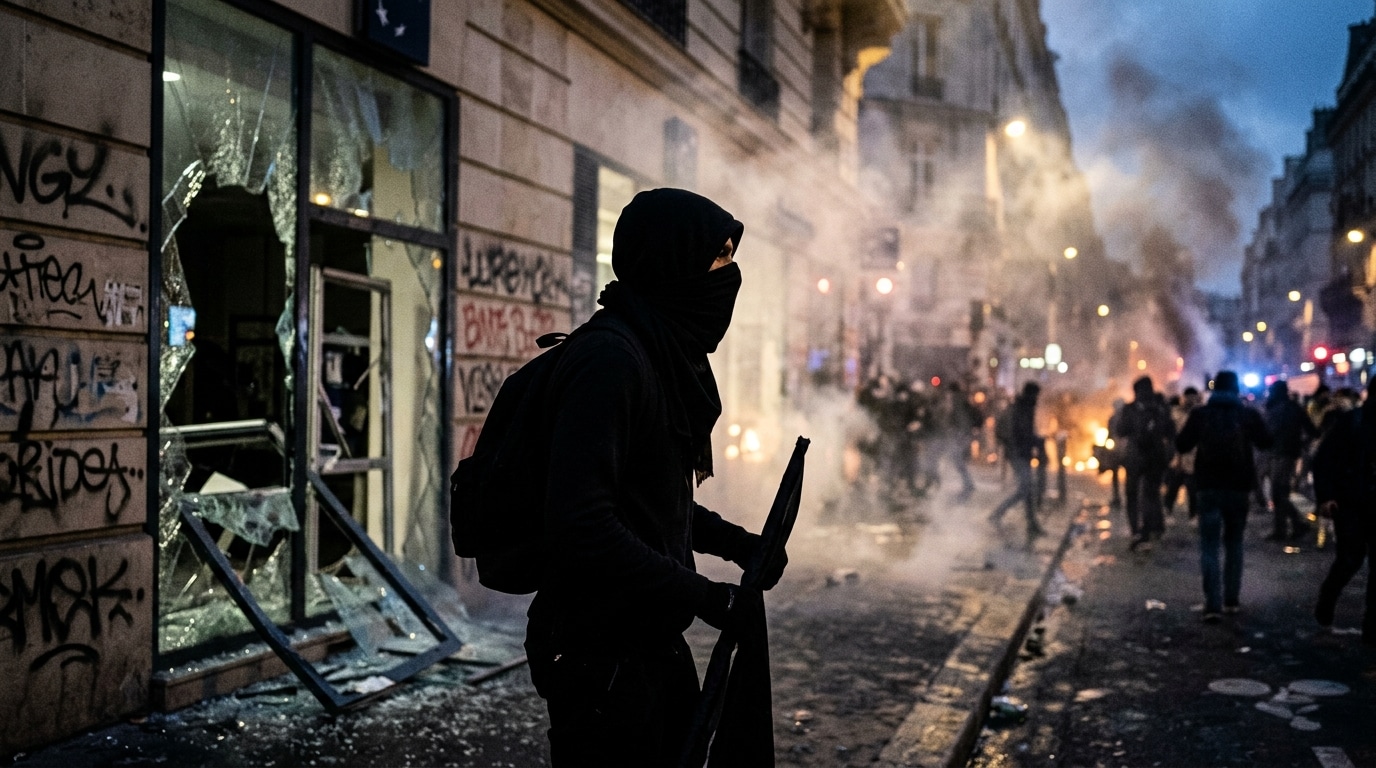
On Saturday, October 17, France is gearing up for another day of mobilization against the high cost of living, with about 500 actions planned. Police unions fear violence, as in Lyon on Tuesday, where nine people were arrested. For researchers, these acts of violence are not blind: their targets follow a precise logic.
- The black blocs mainly target symbols of capitalism (banks, major brands) and the State (police, prefectures), a logic that has remained unchanged since Seattle in 1999
- It is not a structured organization but a spontaneous tactic formed by small affinity groups that dissolve after each demonstration
- The individuals prosecuted for these acts are often educated and hold positions in higher intellectual professions, contrary to the image of the idle vandal
- Banks, brands, symbols: a targeting that is far from random
- No leader, no membership card: how an anonymous crowd acts together
- Why the State and the police remain almost systematic targets
Banques, enseignes, symboles : un ciblage qui n’a rien d’aléatoire
On November 30, 1999, during the “Battle of Seattle,” protesters dressed in black smashed the windows of McDonald’s, Nike, Gap, and several bank branches. Political scientist Francis Dupuis-Déri sees the spectacular entry of black blocs into the anti-globalization movement (Politix, 2004). These brands embodied the globalization of the economy that this movement denounced.
Yet the tactic is older. A note from the research center of the Gendarmerie Nationale Officers’ School (CREOGN, July 2016) recalls that the term originally referred to autonomous groups housed in Berlin-West squats in the 1980s. According to this note, their members reject globalization, capitalism, consumer society, and authority.
According to Dupuis-Déri, these actions carry a message: the storefront of a bank or a police van embodies a system that participants describe as unjust. The targets are chosen for their symbolic charge, and not merely for destruction.
Ni chef, ni carte d’adhérent : comment une foule anonyme agit ensemble
The most common misunderstanding concerns organization. “There is not one Black Bloc, but Black Blocks,” writes Dupuis-Déri: each forms for a demonstration and dissolves with it, with sizes ranging from a few dozen to several thousand people.
A synthesis published in the journal Administration (2021) describes a tactic rather than an organization, arising from the convergence of several affinity groups, bands of friends, or comrades in struggle. The CREOGN note compares this regrouping to a school of fish: individuals aggregated, without a hierarchy.
The figures put forward by the sociologist Isabelle Sommier before a parliamentary inquiry committee of the National Assembly (June 5, 2023) show how variable the size can be. On May Day 2017, the leading procession gathered about a thousand people, including 150 black blocks. On May Day 2018, it counted 14,500, with 1,000 to 1,500 black blocks according to the police.
Another stereotype to be debunked: the profile of the defendants. Olivier Cahn, professor of criminal law, notes that the individuals judged in high-profile trials are often highly educated and hold senior intellectual professions. After May Day 2018, a 29-year-old consultant, educated at Centrale, appeared on the defendants’ bench (franceinfo). These cases tell us nothing about all participants, only about those who are arrested and tried.
Pourquoi l’État et la police restent des cibles presque systématiques
Beyond the shop windows, a second type of target recurs: the security forces and symbols of authority. The CREOGN note, like the Administration review, sees it as a target coherent with the rejection of the State, which these groups portray as authoritarian.
The upheavals remain the work of a minority, even on the largest days. On September 10, 2025, the Ministry of the Interior counted around 197,000 participants in “Block Everything,” with 540 arrests and 415 custody, or about 0.3% of the protesters detained. It noted “numerous radical militants” among the marchers.
In Lyon, Tuesday, October 13, the prefecture counted 11,000 demonstrators (up to 15,000 according to other sources) and noted several hundred hostile individuals. It recorded nine arrests (mortars fired, trash-bin fires, possession of projectiles or prohibited weapons) and five injuries, including four police and gendarmes. Lyon Capitale also noted damage to a Cash Service outlet and a bank branch, as well as an attacked service station.
This Saturday, the Ministry of the Interior spoke of around 500 actions and more than 90 demonstrations being organized. The Unsa-Police union says it senses many people ready to clash with the security forces. The targets, as usual, are not expected to change: banks, brands, urban furniture, and the security forces.
Sources: Politix 2004 (Dupuis-Déri), CREOGN note No. 20 (2016), Administration 2021, National Assembly (Sommier hearing), franceinfo, RTS, Lyon Capitale, Tribune de Lyon, ICI/franceinfo (October 17).
