
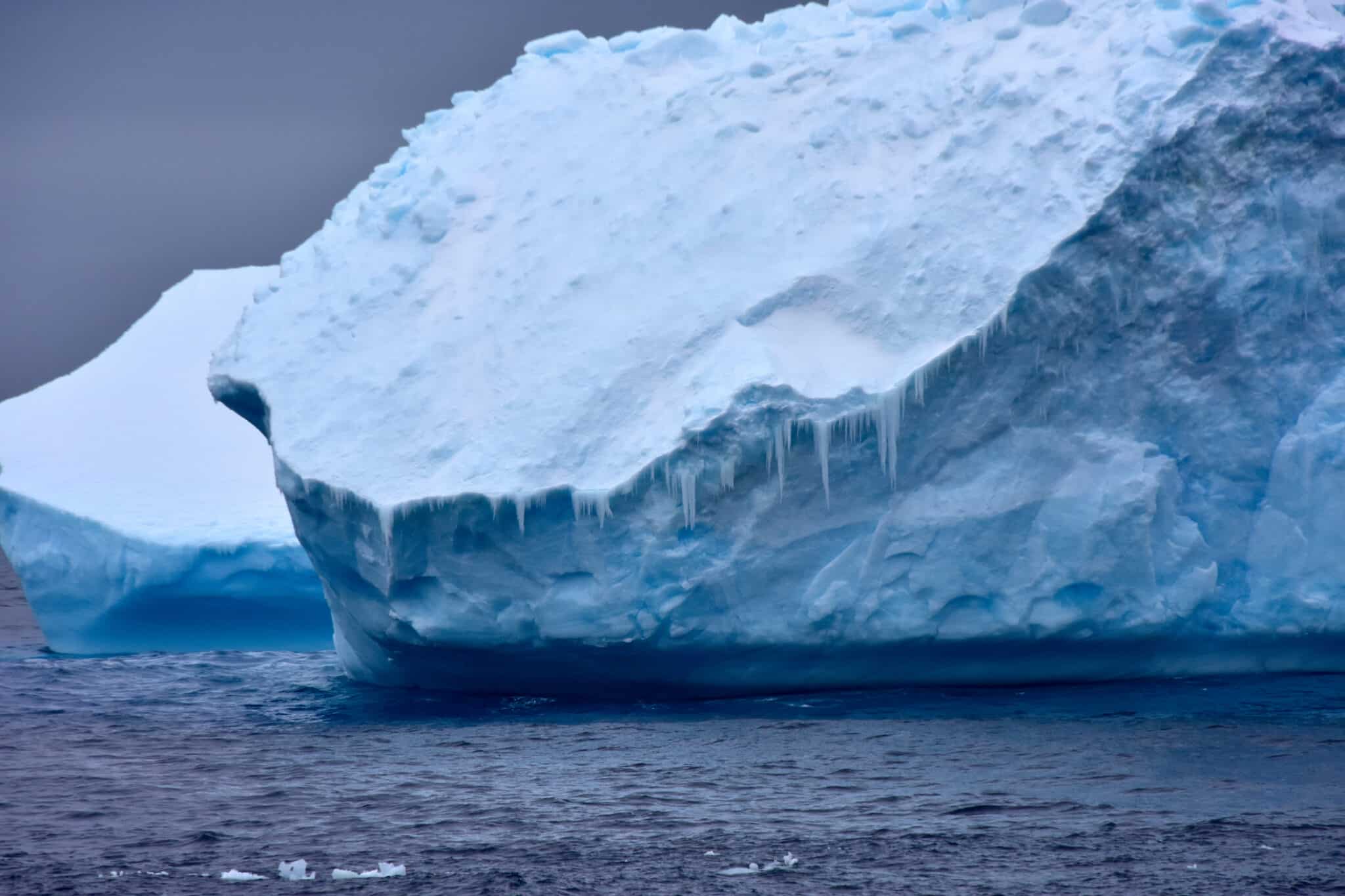
Antarctica, a vast ice desert, appears to be a region with a notably unstable climate. For decades, scientists have been closely tracking the evolution of its ice sheet because of its central role in sea level rise. Yet recent observations reveal a phenomenon that seems to challenge part of what we thought we knew about the impact of warming: between 2021 and 2023, the frozen continent gained ice, despite rising global temperatures. But how can this anomaly be explained?
A General Trend Toward Ice Loss
Before examining this exception, let us recall that, overall, the ice sheet is losing mass. Between 2002 and 2020, the continent suffered a substantial ice loss, at a rate of more than 150 billion tonnes per year, a phenomenon that has accelerated over the years. Part of this loss comes from the melting of the West Antarctic glaciers, whose large ice tongues slowly flow toward the ocean, where they calve into icebergs. This process directly contributes to rising sea levels, a crucial issue in the current warming climate context.
However, unexpectedly, the latest satellite data show that between 2021 and 2023, the situation has changed. A study recently published in Science China Earth Sciences reveals that the ice mass has actually increased, reaching a gain of about 119 billion tonnes per year. This trend may be surprising at first glance, but it is partial and must be interpreted in its global context.
The Role of Precipitation and Extreme Weather Events
This rebound in ice does not mean that climate warming has reversed. On the contrary, it results from a particular meteorological phenomenon: the increase in snowfall. This phenomenon is due to the increased moisture in the atmosphere, a direct consequence of warming. The warmer the atmosphere, the more moisture it can hold, thus increasing the likelihood of extreme weather events such as heavy snowfall. These snowfalls have fed the accumulation of snow on the ice sheet, thereby contributing to a temporary increase in ice mass.
On the surface, this gives the impression that Antarctica has ‘recovered’ some of the lost ice. However, it is important to note that this gain is temporary and does not alter the long-term trend. As Tom Slater, a researcher at Northumbria University, explains, although the rise in snowfall provides temporary relief, glacier melt in other regions of the continent continues to contribute to rising sea levels. This dynamic shows that the gains are far from sufficient to offset global losses.
The Impact of Ice Melt on Sea Level
The main issue with melting the Antarctic ice sheet is that it releases freshwater into the ocean, directly contributing to rising sea levels. Antarctica contains about 90% of the planet’s freshwater. If all this ice were to melt, it could raise sea levels by more than 60 meters, an apocalyptic scenario for coastal areas worldwide. Every data point on the evolution of the ice sheet is thus crucial for anticipating future climate consequences.
In sum, these results underscore the complexity of our planet’s climate. A warmer climate does not translate into linear and simple effects. Extreme events, such as heavy snowfall, can trigger temporary gains, but these do not suffice to reverse global trends. The fight against climate warming remains a significant challenge, and every data point helps us better understand these complex dynamics. The situation in Antarctica continues to bear witness to the profound transformations our planet is undergoing due to climate change.
