
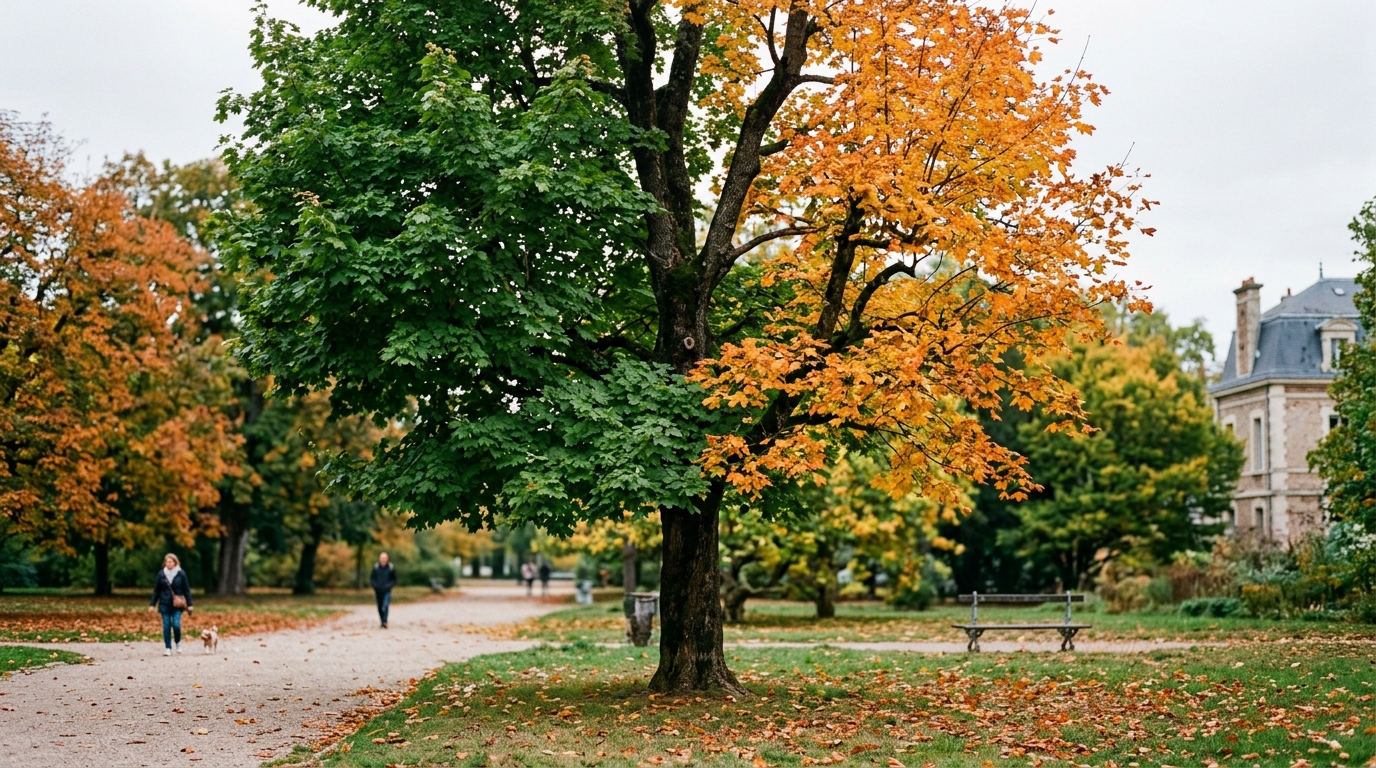
A quick look at some trees is enough to understand: this autumn is unlike any other. On a single branch, green leaves sit beside russet ones, sometimes already fallen to the ground. This contrast is neither disease nor chance. It can be explained by an exceptional sequence of weather, inherited from a summer and an early autumn marked by heat and drought beyond normal. Understanding this mechanism helps anticipate what lies ahead for our forests and gardens in the coming weeks, and to promptly adapt a few simple actions to preserve vegetation.
- The green-to-russet foliage contrast on the same tree results from prolonged water stress, the tree sacrificing certain leaves to limit evapotranspiration
- Sunlight, wind and water stress act unevenly depending on the branches, causing different yellowing rhythms on the same tree
- Summer 2026 was the hottest since 1900 in France, particularly affecting the ash (25% of trees touched) and the chestnut (22%) according to IGN
- One tree, two faces: how to explain this troubling phenomenon
- Sunlight, wind and water stress: the three factors that blur the picture
- What mid-October weather reveals about the coming autumn of 2026
One tree, two faces: how to explain this troubling phenomenon
In many regions, walkers observe an unusual spectacle: the same oak or the same ash displays both foliage that remains green and entire branches already reddened, or even bare. It is not a seasonal illusion, but the direct consequence of a prolonged water stress. By mid-July, the DRAAF Occitanie had already detected wilting and early yellowing on the driest soils. These color changes do not automatically signal a decline: in deciduous trees, they mainly reflect a survival mechanism designed to limit evapotranspiration. The tree closes its pores, reduces water losses, and sacrifices certain leaves to preserve the essentials. In plain terms, the tree is living two autumns at once: a classic climatic autumn on the protected parts, and an accelerated, almost forced autumn on the branches most exposed to water shortage.
Sunlight, wind and water stress: the three factors that blur the picture
This shift in color on a single subject is explained by three parameters that act simultaneously, but unevenly depending on the part of the tree involved. Sunlight accelerates the deterioration of chlorophyll on the sun-exposed southern branches, causing yellowing to occur faster than on shaded faces. Wind, for its part, dries the most exposed twigs even more, reinforcing locally the sensation of water stress and hastening leaf drop. Finally, the water stress itself does not affect a tree uniformly: shallow roots suffer more quickly than deep roots, which explains why some branches shed leaves before others. In October 2026, this unusual combination means that sunlight, wind and water deficit can cause the branches of the same tree to change color at very different paces. A note of caution, however: among conifers, a strong reddening is often a more worrisome sign, potentially indicating irreversible decline, unlike deciduous trees that manage this shock better.
What mid-October weather reveals about the coming autumn of 2026
This phenomenon is not an isolated anomaly but the direct result of a non-standard climate year. Météo-France confirmed that summer 2026 was the warmest ever recorded in France since 1900, with an average temperature of 24.0 degrees Celsius, i.e., 3.6 degrees above the normals. Extreme peaks, such as 43.8 degrees recorded at Palluau, Saintes and Pissos, or 40.3 degrees in Paris, have left lasting marks on the soils. Consequently, in September, the average temperature remained 3.1 degrees above normal, and soil moisture showed a dryness level never observed at this time of year. This accumulation of heat and water shortage sustainably weakens certain species. The national forest inventory published by the IGN confirms: ash tops the list of most affected species, with 25% of trees touched, followed by chestnut at 22%, spruce at 11%, and pedunculate oak at 10%. All these signals suggest a coming autumn 2026 marked by strong contrasts, early leaf fall in some areas, and heightened vigilance for the health of trees in gardens and forests.
This disparity in colors within a single tree is therefore not just a cosmetic detail. It reflects nature’s growing sensitivity to local climatic variations, a signal to monitor closely in the coming weeks and seasons. Observing these branches with contrasting hues also raises awareness of a fragile balance, one that each person can help preserve by adjusting watering and the care of their own trees.
