
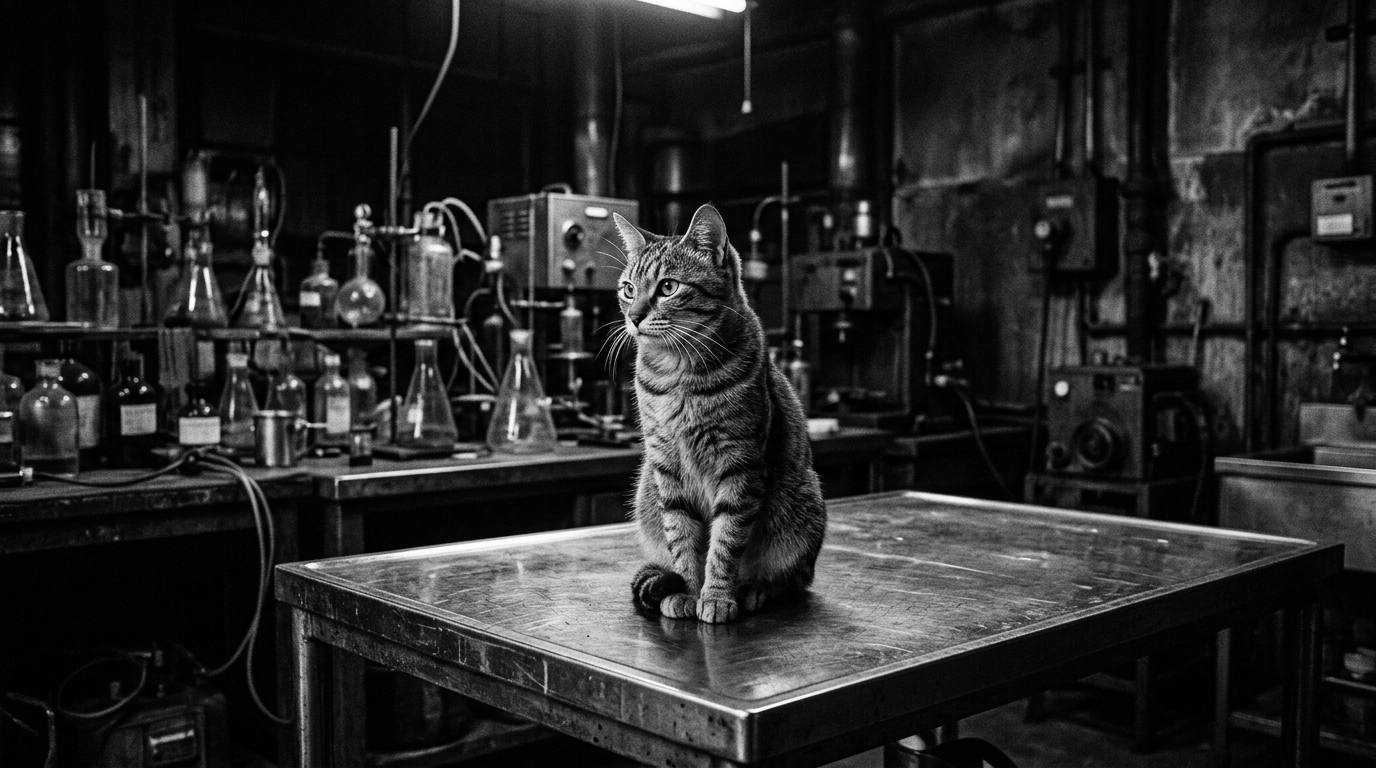
A laboratory cat, two years before the world truly understood what was unfolding in Minamata Bay. While hundreds of Japanese families fell ill without explanation, a discreet animal, fed with the waste from a chemical plant, delivered the answer to a determined doctor seeking to understand. This story, as troubling as it is fascinating, blends scientific rigor, industrial silence, and a truth kept under wraps for nearly a decade.
- In 1959, Dr. Hajime Hosokawa proved that a cat fed with effluents from the Chisso plant developed the symptoms of Minamata disease, caused by methylmercury released into the bay.
- Upon learning these results, Chisso ordered the truth to be hidden and even staged a fake water treatment device to reassure the population.
- Official government recognition would have to wait until 1968, and Hosokawa would publicly testify in 1970, shortly before his death.
- A Numbered Cat and the Minamata Mystery
- Chisso, the plant that dumped mercury into the bay
- The silent experiment conducted on Cat No. 400
- When the company chose to hide the truth from residents
- Minamata, a bitter lesson on industrial silence
A Numbered Cat and the Minamata Mystery
In the 1950s, the small port city of Minamata, in southern Japan, witnessed the emergence of a strange illness. The inhabitants gradually lose the use of their limbs, their vision becomes blurred, their speech becomes slurred. Some fall into uncontrolled convulsions. Local doctors were at a loss for what they called, at that time for lack of a better term, Minamata disease. Soon, suspicions focused on the sea that borders the city, and more specifically on the fish and shellfish that make up the main diet of the fishermen and their families.
It is in this context of uncertainty that a doctor, Hajime Hosokawa, director of the hospital affiliated with the chemical plant Chisso, decides not to wait for official conclusions. He has an intuition, almost an obsession: what if the source of the illness is not simply the sea, but what the factory was discharging into it day after day?
Chisso, the plant that dumped mercury into the bay
The Chisso plant is no minor player in the region. A true economic lifeblood of Minamata, it employs a large portion of the population and has produced acetaldehyde for years, a chemical used in the plastics industry. The production process relies on mercury as a catalyst, and the plant’s wastewater, laden with toxic residues, ends up directly in the bay.
What no one clearly knew at the time was that this mercury transformed, once in the marine environment, into methylmercury, a particularly formidable organic form that accumulates in the flesh of fish. By eating these fish, the residents of Minamata ingested, unknowingly, a powerful neurotoxin. The plant, for its part, continued production, without slowing its discharges, even as the first cases of the disease had already been recorded for several years.
The silent experiment conducted on Cat No. 400
Convinced that Chisso’s wastewater was involved, Hosokawa decided, on his own initiative and without formally informing the company, to carry out a simple yet decisive experiment. In the summer of 1959, he began feeding two cats with effluents taken directly from the plant outlet. One of these animals, registered under the number 400, would become, despite itself, the central piece of a case that would take years to come to light.
After a little over two months of exposure, Cat No. 400 began to present the same symptoms as the Minamata patients: tremors, coordination problems, and unsteady movements. The tests conducted on the animal confirmed what Hosokawa had feared: this was indeed an organomercury poisoning. The scientific proof, the link directly tying the plant’s discharges to the disease, now lay in the body of a single laboratory cat.
When the company chooses to hide the truth from the residents
Loyal to his employer, Hosokawa reported his findings to Chisso’s management. The reaction was swift: he was ordered to stop the experiment immediately and to keep silent about his conclusions. Rather than stopping its discharges or alerting health authorities, the company chose to conceal. Worse still, by the end of 1959 it installed a water-treatment device called the Cyclator and staged a public demonstration designed to reassure the population, even though this system did not remove methylmercury from the relevant effluents. Essentially, a staged display to buy time.
Meanwhile, researchers from Kumamoto University independently managed to identify organic mercury as the chemical cause of the disease, designating Chisso as the probable source. But the company countered by funding studies meant to muddy the waters, going so far as to defend the theory that residents had merely eaten spoiled fish. It would take until 1968, more than a decade after the first cases, for the Japanese government to officially acknowledge the plant’s responsibility.
It was only in 1970, from his hospital bed, that Hosokawa would publicly testify about the Cat No. 400 experiment and how Chisso had silenced the affair. He would die three months later, leaving behind a testimony that completed the case against what the company had tried to bury for years.
Minamata, a bitter lesson on industrial silence
The story of Cat No. 400 is not merely a curious scientific anecdote. It illustrates how the truth, even when established through rigorous experimentation, can be smothered when economic interests are at stake. The findings obtained by Hosokawa and Kumamoto’s team would not be wasted: a few years later, during a similar outbreak in Niigata, the same researchers would apply their methods and identify the cause of the illness far more quickly.
Minamata remains today a case study invoked in numerous debates on environmental and industrial responsibility. The case reminds us that scientific proof, no matter how solid, does not automatically suffice to reveal the truth: those who hold it must be willing to reveal it. And if we think back to that numbered little cat, fed with toxic effluents in a discreet laboratory, we realize how silence, at times, can cost far more than the truth itself.
