
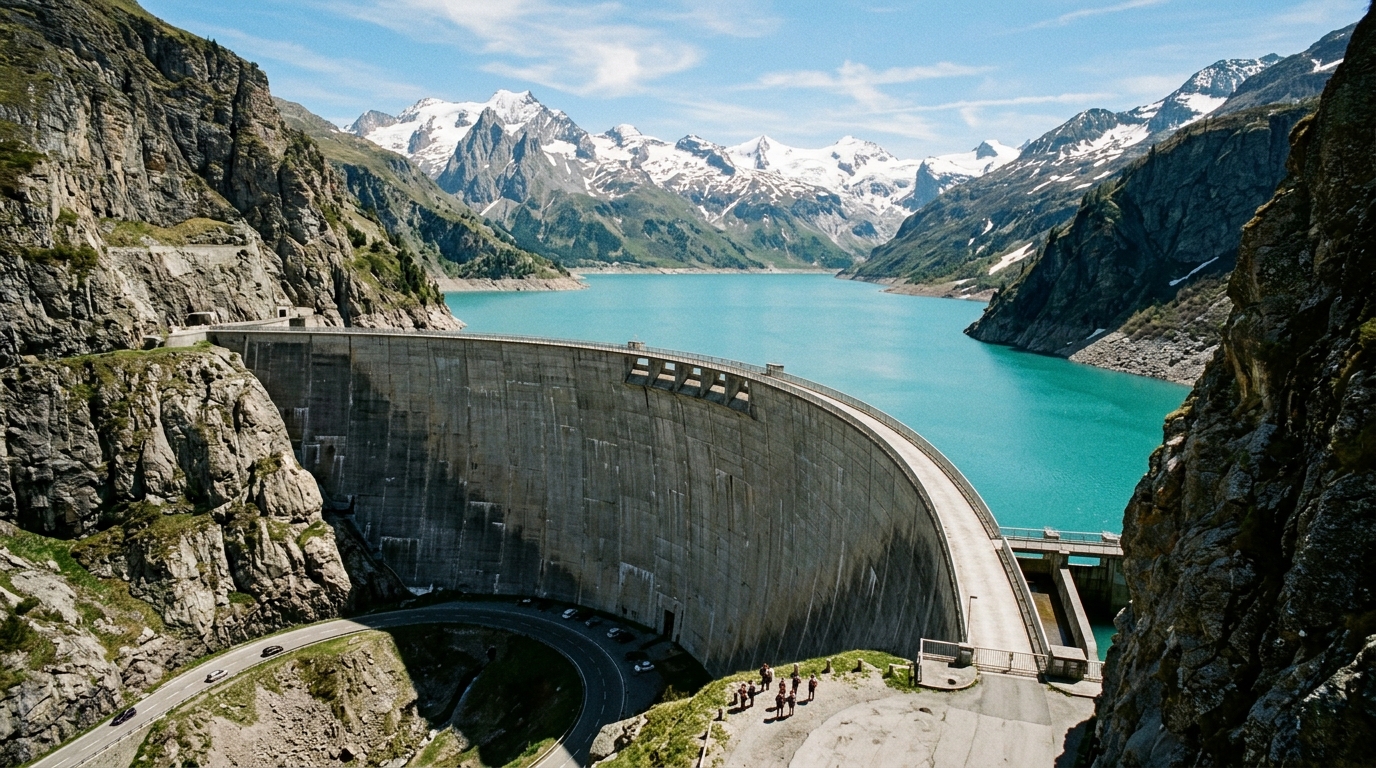
In 1952, an entire village disappears beneath 230 million cubic meters of water. Not a natural disaster, but an administrative and industrial decision: to drown old Tignes in order to erect a dam 180 meters high. The displaced inhabitants feel they stand to lose everything—their houses, their church, and the fields they have tilled for generations. What they do not yet know is that they will, almost inadvertently, give birth to one of Europe’s most frequented ski resorts, a paradoxical symbol where the loss of one world gave rise to another, radically different.
- In 1952, EDF submerged the old village of Tignes beneath 230 million cubic meters of water to build the Chevril dam, standing 180 meters tall.
- The inhabitants, expropriated without room for negotiation and with compensation deemed insufficient, had to relocate higher up in the mountains.
- The relocated families founded Tignes les Boisses and Tignes le Lac, whose altitude and proximity to the Grande Motte glacier gave rise to an internationally recognized ski resort.
- A dam higher than the Eiffel Tower that engulfs a century of history
- Residents driven from their homes with no option to say no
- From black water to golden slopes, the improbable rebirth of a submerged village
- What Tignes truly owes to its own sacrifice
Un barrage plus haut que la tour Eiffel qui engloutit un siècle d’histoire
Imagine a concrete wall standing 180 meters tall, almost as high as the Eiffel Tower when set on its base. That is precisely what EDF built at the bottom of the Tarentaise Valley in the Alps, to give rise to the Chevril dam. The stated objective, on paper, was straightforward: to generate electricity for a France in postwar reconstruction, eager for energy to power its factories and homes. But behind this technical feat hid a sacrifice that hardly anyone had anticipated on such a scale.
To fill this titan reservoir, the entire valley had to be submerged, and with it the old village of Tignes. A century-old locality, with its church, its hamlets, its fields, and its ancestral habits, would simply disappear beneath the waters. In a matter of months, a century of local history was swallowed, yielding an artificial lake now known as the Chevril Lake, whose level still fluctuates with the seasons, sometimes revealing the ghostly vestiges of the old town when waters recede markedly.
Des habitants chassés de chez eux sans possibilité de dire non
For the families of Tignes, the news struck like a blade. Expropriation was not an option among others; it was a legal obligation, accompanied by compensation deemed broadly inadequate by many residents. Overnight, generations were forced to abandon their lands, their livestock, and their memories, with little real leverage to negotiate with the state and the national company in charge of the project.
The sense of injustice ran deep and enduring. Many families had to reconstruct everything elsewhere, sometimes far from the mountains that had witnessed their birth, in a France still marked by the privations of the postwar years. This forced uprooting, experienced as a grave identity rupture, remains today in the local collective memory as one of the most painful episodes in the valley’s recent history.
De l’eau noire aux pistes dorées, la renaissance improbable d’un village englouti
Yet from this tragedy something unexpected would emerge. The relocated inhabitants higher up in the mountains gradually built two new hamlets, Tignes les Boisses and Tignes le Lac, directly at the edge of the snowy slopes that once dominated their old village. With the rise of winter tourism in the following decades, these altitudes—once merely crossed by flocks—became coveted playgrounds for skiers.
What began as a mere fallback solution gradually became a major asset. The high-altitude location, directly linked to the Grande Motte glacier, allowed the resort to offer skiing nearly year-round, a rare selling point that helped shape its international reputation. Even today, as winter approaches, the final preparations of the ski areas remind us how this land, born from a human tragedy, transformed into a destination coveted well beyond French borders.
Ce que Tignes doit vraiment à son propre sacrifice
With hindsight, the story of Tignes perfectly illustrates that typically French paradox where an act of administrative and symbolic violence ended up generating a dazzling economic success. The old village nonetheless rests at the bottom of Lake Chevril, a quiet reminder of the price paid for this rebirth. Each year, when the water level drops enough, some traces reappear, offering curious onlookers and the descendants of the former inhabitants a tangible reminder of what was sacrificed.
This duality between loss and renewal is not unique to France: other territories have undergone similar upheavals, where an industrial decision permanently reshaped a landscape and its local economy. But in Tignes, the scale of the initial sacrifice, combined with the spectacular tourism success that followed, makes it a particularly striking case study.
In the end, the story of Tignes reminds us that major transformations of the French landscape sometimes arise from unpopular and painful decisions, whose positive consequences only reveal themselves decades later. A question remains worth contemplating: how many other villages, today forgotten beneath a dam’s waters or the ruins of an industrial project, carry in seed the potential for a renaissance that no one has yet learned to recognize?
