
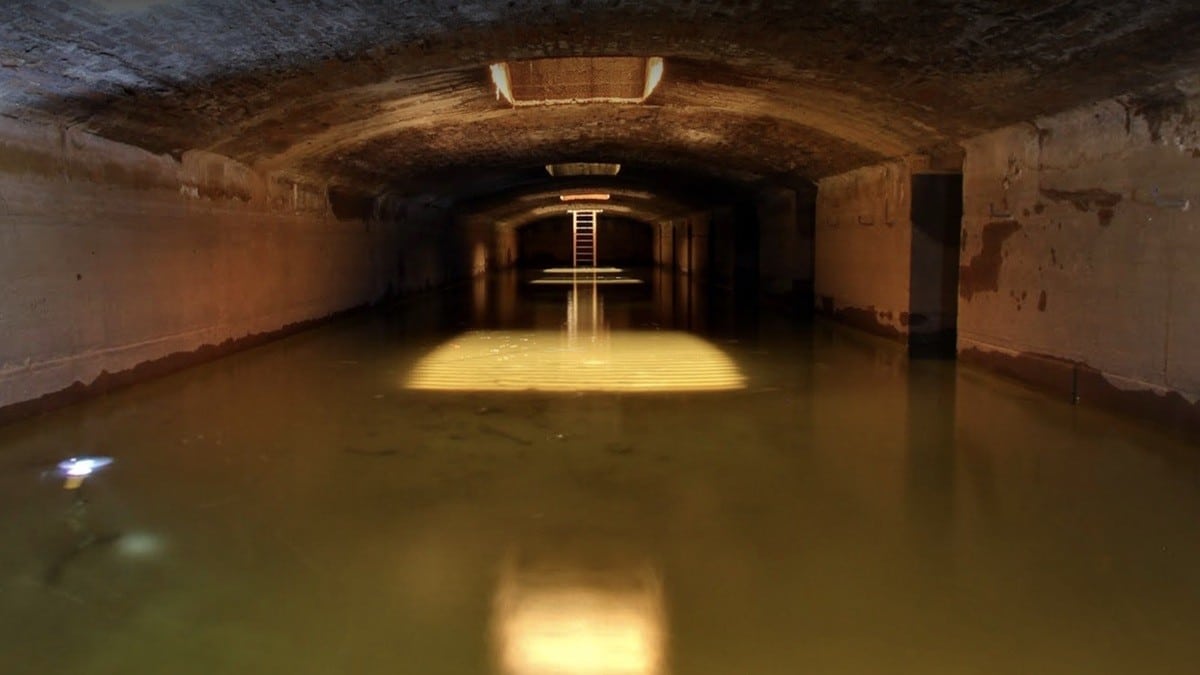
Ten meters beneath the stage where every night the stars of the Opéra de Paris dance, firefighters in diving suits practice moving through total darkness. Not in a municipal pool. In a lake. A real lake, hidden in the bowels of the Palais Garnier for more than one hundred fifty years, and whose very existence most Parisians are unaware of.
Key takeaways
- A 10,000 m³ lake has slept for 150 years beneath the Garnier stage
- The architect Garnier chose to hold water rather than chase it away—a paradox that works
- Paris firefighters train there in near-zero visibility diving conditions
An engineer’s problem, a visionary solution
Charles Garnier was appointed architect of the Nouveau Opéra on June 6, 1861, and less than two months later, the earthworks began, but they immediately had to confront a drainage phase that would last several months. The reason? Excavations uncovered an underground water table fed by streams descending from the heights of Ménilmontant. Water was everywhere, inexhaustible, rebellious.
After steam pumps that ran around the clock proved unable to remove all the water from the site, Garnier conceived a double foundation ingeniously designed to shield the main structure from dampness. The brilliance of the decision lies in its paradox: rather than expelling water, Garnier retained it. Rather than keeping water out of the building, he paradoxically allowed it to enter to fill the tank to capacity.
Soon filled with water, this tanking foundation enabled the infrastructures to contain and withstand the hydrostatic pressure of the infiltrating water, estimated at 2,000 tonnes, and to better distribute the loads of portions of the buildings resting on a relatively poor substrate. A classic Haussmannian building would address foundation problems with concrete and willpower. Garnier solves his with water. It is far from intuitive, and that is precisely why it works.
What the backstage of the fifth sublevel hides
This is where it happens, on the Opéra Garnier’s fifth sublevel, about ten meters beneath the stage. Access is made possible by a small narrow staircase, protected by a barred grille, that disappears into the darkness. Nothing in the visible architecture of the building hints at what lies beneath these steps.
A vast room roughly 50 by 20 meters, three meters high, scattered with columns. The water fills the space up to 50 centimeters below the ceiling; it is exceptionally clear, provided one takes care not to stir the fine layer of sediment coating the floor. Nearly 10,000 cubic meters of water sit there calmly: the equivalent of four Olympic pools, in total darkness, ten meters under the stage.
The water level is kept constant thanks to an ingenious pumping system. This is not a dead lake; it is a managed lake. The groundwater is under constant surveillance, because it is the guarantee of the building’s stability. If the level were to fall permanently, the foundation of the entire building would be unbalanced. The lake is not a romantic vestige: it is an active structural component, as important as any surface pillar.
The firefighters in the dark, and the carps watching them
The reservoir is off-limits to the public and is used by the Paris Fire Brigade for scuba-diving training in conditions of near-total darkness. The environment is difficult to reproduce elsewhere: dark, confined, and relatively deep, it allows divers to prepare for rescue missions in challenging conditions. Responding in a flooded basement, a submerged parking garage, a tunnel drowned after a flood of the Seine—these are the scenarios for which this cistern has served as a training ground for decades.
What is even more surprising is what lives there. This lake is not as barren as one might think: carp have been introduced and have adapted perfectly. They help maintain a biological balance, limiting algae and micro-organisms. According to some technicians, a catfish of about 1.3 meters, nicknamed Nessie, would even have taken up residence there, in a nod to the Loch Ness Monster. The legend sometimes has a charming flavor.
Sous l’eau, on trouve toute une petite vie sous-marine composée de barbeaux, poissons rouges, carpes et même d’une anguille baptisée « Neunoeil ». Une légende dit qu’à chaque fois que les pompiers perdent un des leurs, ils lâchent un poisson dans le bassin. Tradition informelle, rite de deuil discret dans un endroit que personne ne voit, il y a quelque chose d’assez beau là-dedans.
When technique becomes legend
Après la construction, ce réservoir sert de base aux pompiers en cas de sinistre. Cette particularité donne naissance à la légende d’un lac souterrain alimenté par un cours d’eau portant le nom de « Grange-Batelière », exploité et entretenu par le célèbre roman de Gaston Leroux, The Phantom of the Opera. Leroux n’a pas eu besoin d’inventer grand-chose : le lac souterrain qu’il décrit, en réalité une énorme citerne, existe bien sous l’Opéra, et il est encore utilisé pour entraîner les pompiers à nager dans le noir.
Le Palais Garnier est inauguré le 5 janvier 1875. Depuis plus de cent cinquante ans, donc, ce réservoir invisible tient le bâtiment debout, nourrit des carpes dans l’obscurité, et accueille des plongeurs en tenue de combat pendant que, quelques mètres plus haut, un public en tenue de soirée applaudit des arias. En plus d’un siècle et demi, l’Opéra Garnier est resté l’une des splendeurs de la capitale, grâce, entre autres, à cette astuce d’ingénieur que personne ne voit et que presque personne ne connaît. C’est peut-être ça, le vrai patrimoine caché : non pas les catacombes qu’on visite, mais les infrastructures silencieuses qui portent la ville sans jamais se montrer.
Sources : timeout.fr | youtube.com
