
And what if simply boarding a plane could cause you to age a little differently from your groundbound neighbors? This idea, which seems straight out of a science-fiction novel, was indeed verified in black and white by two American researchers in the early 1970s. Their testing ground was neither a ultra-sophisticated laboratory nor a particle accelerator, but regular commercial flights—the same ones traveled daily by thousands of travelers. The story of this experiment, as simple in its principle as it is dizzying in its implications, deserves some attention, especially at a time when the precision of time governs absolutely all the technological systems around us.
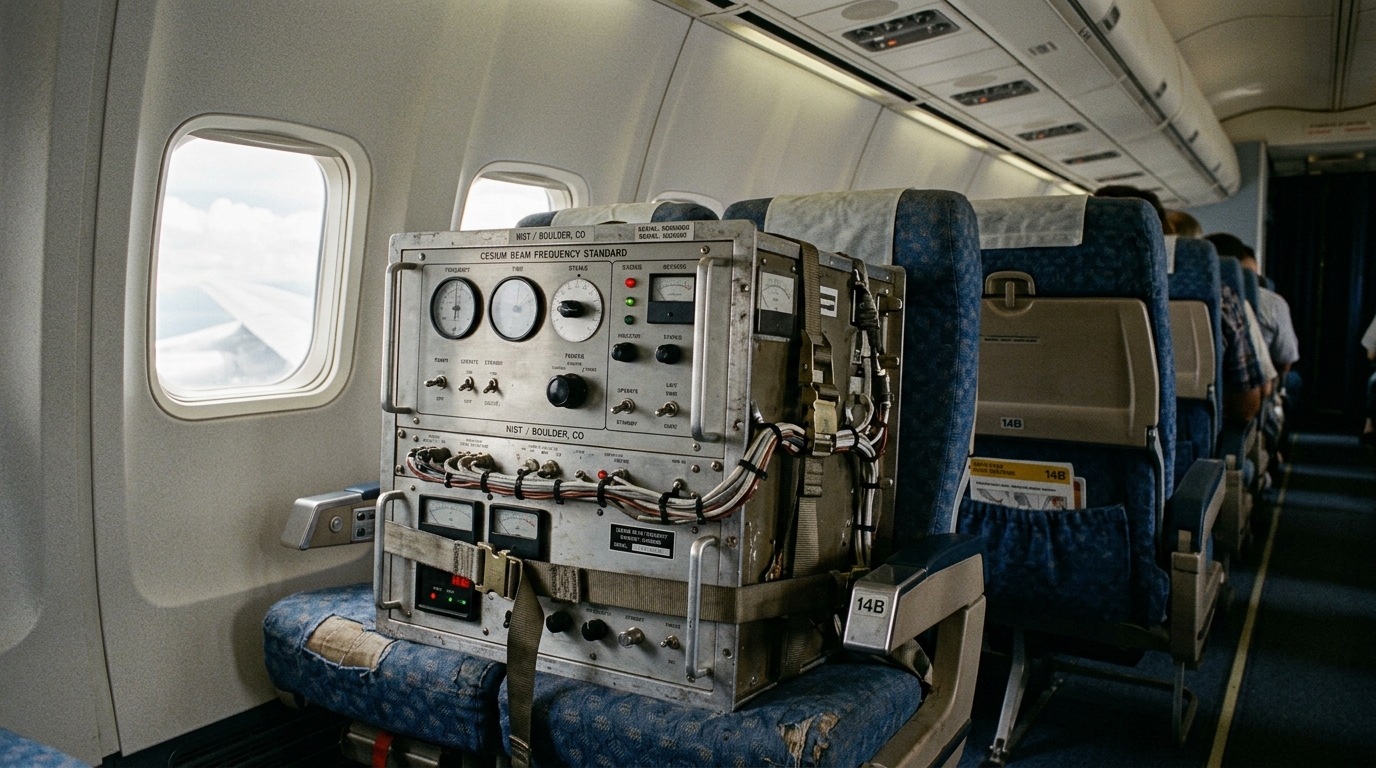
- In 1971, Joseph Hafele and Richard Keating tested relativity by loading four cesium atomic clocks, precision instruments, onto commercial flights in both the eastward and westward directions, with a reference clock left on the ground in Washington.
- The clocks showed a lag of 59 nanoseconds for the eastbound leg and a forward shift of 273 nanoseconds for the westbound leg, in line with predictions that combine speed and gravity according to special and general relativity.
- This experiment confirmed relativistic effects that are now essential to the functioning of GPS, where satellites must continually correct these time offsets to maintain accuracy.
- A crazy experiment born from a scientific bet
- Why time slows down at altitude and with speed
- 59 nanoseconds to the east, 273 to the west: numbers that don’t lie
- What this experiment changed for modern physics
A crazy experiment born from a scientific bet
In 1971, the physicist Joseph Hafele and the astronomer Richard Keating decided to test one of the most counterintuitive predictions of Einstein’s theory of relativity. Their plan was as bold as it was low-tech on paper: to board four cesium atomic clocks, instruments of staggering precision, on regular commercial flights, the same ones that carry families on vacation or busy business travelers. The objective was to loop around the globe once toward the east, then a second time toward the west, while leaving a reference clock stationary on the ground, at the Naval Observatory in Washington.
The bet might have sounded insane for the era: using commercial airliners, subjected to weather and layovers, to test a theory expected to overturn our understanding of time. Yet it is precisely this pragmatic approach that gives the Hafele-Keating experiment its strength. No need for rockets or classified equipment, just plane tickets and unwavering scientific rigor.
Why time slows down at altitude and with speed
To understand what the two scientists were trying to prove, one must revisit the foundations of special relativity and general relativity. The former tells us that time runs more slowly for a moving object compared to a stationary observer: the famous dilatazione temporale—time dilation. The latter adds a further ingredient tied to gravity: the higher you go from Earth, the weaker gravity becomes, and the faster time flows.
A commercial airplane therefore accumulates two opposing effects. On one hand, its speed relative to the ground tends to slow time on board. On the other, its altitude, where Earth’s gravity is slightly weaker, tends to speed it up. But there is an additional subtlety that many forget: the Earth itself spins on its axis. An eastbound aircraft adds its speed to that of the Earth’s rotation, while a westbound aircraft subtracts it. As a result, the two routes are not physically symmetric at all, even though they cover nearly comparable ground distances.
59 nanoseconds to the east, 273 to the west: numbers that don’t lie
Once the four clocks were brought back down to the tarmac and compared with their ground twin, the verdict arrived, and its precision was spectacular. On the eastbound flight, the onboard clocks showed a lag of 59 nanoseconds relative to the reference clock. On the westbound flight, the opposite occurred: the clocks advanced by 273 nanoseconds. These are minuscule shifts, invisible to the naked eye, yet perfectly measurable thanks to the extreme sensitivity of atomic clocks.
These figures aren’t mere measurement quirks: they matched almost precisely the theoretical predictions calculated in advance by Hafele and Keating by combining the effects of speed and gravity. In other words, nature met the Einstein equations on schedule, presenting itself with a delay that was exactly calculated.
What this experiment changed for modern physics
Far from being just a laboratory curiosity, this demonstration had very concrete consequences for our daily lives. The GPS system we use every day, whether to commute to work or to find our way on a hike, must continually correct the relativistic effects on the clocks aboard its satellites. Without these adjustments, calculated positions would drift by several kilometers in just a few hours, making the system unusable.
Hafele and Keating’s experiment also opened the way to a new generation of tests of relativity, increasingly precise, conducted with increasingly capable atomic clocks. It underscores a fascinating truth: time is not an absolute, universal quantity, but a magnitude that intimately depends on the speed and position of the observer. An idea that is hard to grasp intuitively, but one that airliners, measurement instruments, and a healthy dose of scientific curiosity managed to prove without leaving Earth’s atmosphere.
Nearly fifty years after that improvised circumnavigation, the experiment continues to fascinate with its apparent simplicity and the depth of what it reveals. It reminds us that the deepest truths of physics are not always hidden in gigantic, pricey machines, but sometimes in a simple plane ticket and a handful of clocks stowed in the hold. So next time you fasten your seatbelt before takeoff, you may momentarily rethink that tiny time offset that operates beneath your feet without you ever feeling it.
