
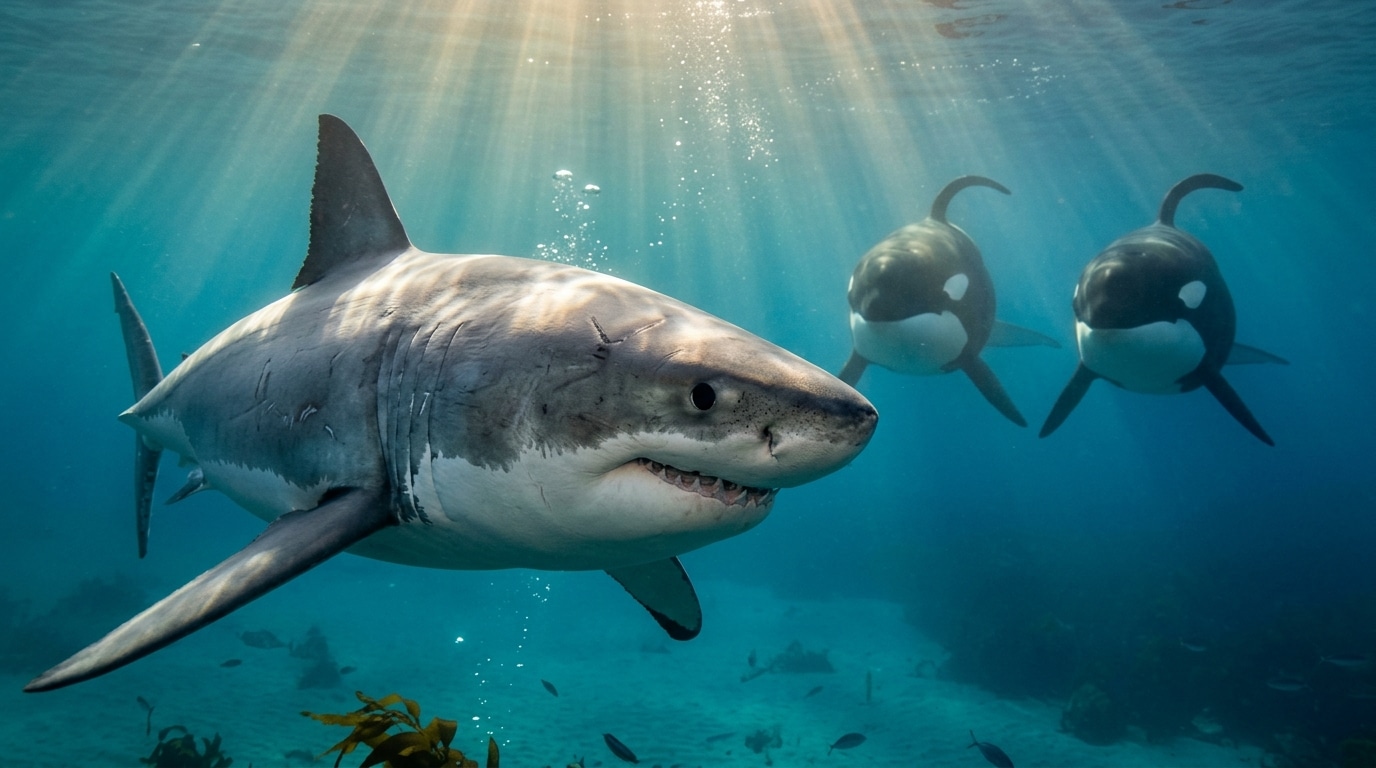
Two orcas. Only two. And yet, it is an entire population of great white sharks that has packed up and left. In Gansbaai, South Africa, this site once regarded as one of the best places in the world to observe the legendary predator has emptied of its historic inhabitants. The cause? A pair of killer whales, specialized in shark liver.
- Two male orcas, Port and Starboard, identifiable by their sagging dorsal fins, have been preying on great white sharks since 2017 by ripping out their livers, rich in fats.
- The disappearance of great whites triggered a trophic cascade in False Bay, benefiting Cape fur seals and sevengill sharks at the expense of small fish.
- The lethal fishing program of KwaZulu-Natal Sharks Board is discussed as a possible aggravating factor in the decline of great white populations along South Africa’s coasts.
- Gansbaai, the former global Eldorado of the great white shark
- Port and Starboard: two killer shark-orcas that upended the balance
- A total and lasting desertion that upends an entire ecosystem
Gansbaai, the former global Eldorado of the great white shark
For decades, Gansbaai wore a nickname that spoke volumes about its reputation: the world capital of the great white shark. Tour operators offered cage diving that was nearly guaranteed, as encounters with these iconic predators were frequent.
The site benefited from precious natural assets. A seal colony, prime prey for great whites, and nutrient-rich waters that attracted an entire marine food web. Gansbaai lies about 80 kilometers east of False Bay, another hotspot for these predators, forming a kind of privileged corridor for the species along the South African coast.
This abundance seemed almost immutable. Researchers had monitored populations for years, year after year, without foreseeing the upheaval that would strike the region. An upheaval with a name, or rather two: Port and Starboard.
Port and Starboard: two killer shark-orcas that upended the balance
It all begins in 2009, near Lüderitz, in Namibia. Two male orcas are spotted for the first time. They are nicknamed Port and Starboard, in reference to their dorsal fins sagging to the left and right, a physical trait that makes them instantly identifiable, somewhat like a fingerprint.
After 2015, the duo starts visiting the waters of Gansbaai, but also those of Port Elizabeth, the Cape, and False Bay. Their presence quickly coincides with a string of macabre events. Between February and June 2017, five great white shark carcasses wash ashore on Gansbaai beaches, all bearing the same distinctive injuries and, disturbingly, four missing their livers.
The liver is not chosen at random. In the great white, this organ can account for a substantial portion of body mass and constitutes an extremely fatty energy reserve. For an orca, it is somewhat like a high-calorie gourmet meal, far more valuable than the rest of the carcass.
A study published in 2022 in the African Journal of Marine Science cataloged eight great white sharks stranded since 2017, seven of which had met the same fate. The injuries matched the same modus operandi, that of the Port and Starboard duo. Even more impressive, a study published in March 2024 in the same journal documented, for the first time, Starboard acting alone: the orca neutralized and consumed a 2.5-meter juvenile great white in under two minutes, before bearing the liver in its mouth in front of a viewing boat.
A total and lasting desertion that upends an entire ecosystem
Faced with such a threat, the great white sharks did not tempt fate. Researchers cross-referenced years of observations conducted in False Bay, Gansbaai, Mossel Bay, and Algoa Bay with data from longlines and drumlines offshore KwaZulu-Natal, as well as line-fished catches. The finding is unequivocal: the historical population of Gansbaai has indeed deserted the site.
A study from the University of Miami, published March 25, 2025 in Frontiers in Marine Science, documented the consequences of this phenomenon in False Bay, where a comparable collapse was observed. The authors drew on a monitoring program spanning more than twenty years, which allowed them to precisely trace the decline and then the disappearance of great whites in that area.
The repercussions cascaded through the entire food chain, a phenomenon ecologists call a trophic cascade. In the absence of the great white shark, its primary regulator, Cape fur seals and sevengill sharks rose in relative abundance. The problem: these two species then over-pressed populations of small fish and small sharks, which declined accordingly.
Researchers remain cautious about the exact causes of the decline in False Bay. They do point to a known aggravating factor: the lethal shark-control program conducted by the KwaZulu-Natal Sharks Board, whose documented removals could be sufficient to trigger regional declines on their own. Between fishing pressure and the direct threat from the orcas, the great white shark seems trapped along the South African coast.
What strikes in this story is the mismatch between cause and effect. Two individuals, two orcas visibly identifiable by their distinctive fins, were enough to empty one of the planet’s most iconic sites for observing the great white shark of its inhabitants. A stark reminder that in nature, balance can hinge on a thread far finer than we imagine, and that fear, both among predators and prey, can redraw the map of an entire ecosystem.
