
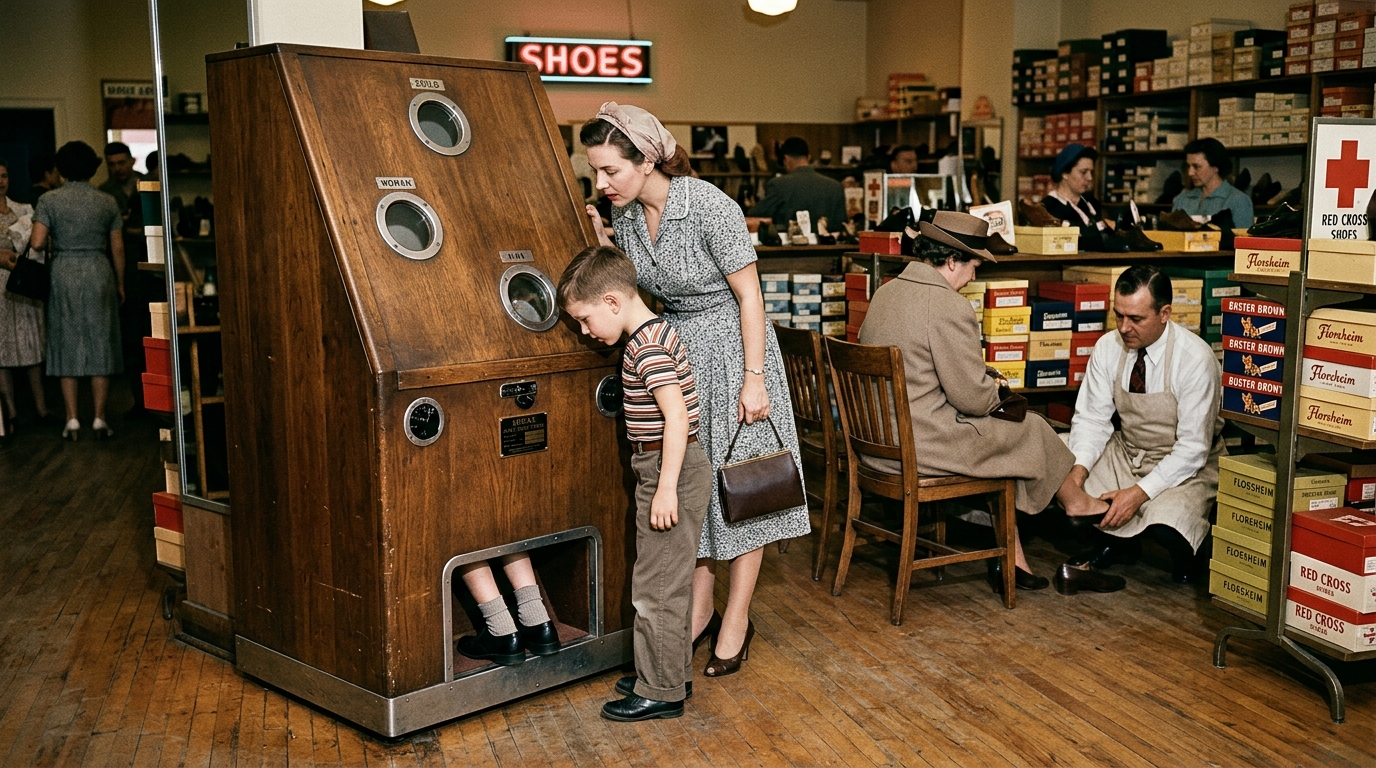
Before 1957, in thousands of shoe stores across the United States, trying on a new pair for back‑to‑school often meant slipping your feet into a strange wooden box and watching, fascinated, your own bones through a peephole. Not citing any scientific study here, just a fact today well documented by American health archives: these devices, called X‑ray fluoroscopes, emitted radiation at levels that would make any radiologist shudder today. While children marveled at seeing their toes move inside their brand‑new shoe, the salesperson repeated the gesture dozens of times a day, standing behind the counter, literally bathed in the rays. An almost retro‑futuristic science‑fiction-esque story that actually happened, on both sides of the Atlantic, and that says a lot about our sometimes casual relationship with emerging technologies.
- Invented in 1919 by Jacob Lowe to examine wounded soldiers’ feet, the fluoroscope was co‑opted in the 1920s as a marketing tool for shoe stores.
- A 1948 study in Detroit found that more than 20% of tested devices emitted between 16 and 75 roentgens per minute, far exceeding the recommended weekly limit of 0.3 roentgen.
- Pennsylvania banned these devices as early as 1957, but seventeen states still permitted them in 1970, the last known working unit reported in Boston at the start of the decade.
- When fitting a child meant stepping into the X‑ray
- Inside the belly of the machine: how the fluoroscope really worked
- Behind the counter, the exposure that never stopped
- 1957, Pennsylvania sounds the end of the game
When fitting a child meant stepping into the X‑ray
To understand the origin of this peculiar invention, we must look to the days after World War I. In 1919, a certain Jacob Lowe filed the original patent for the device after using fluoroscopy to examine wounded soldiers’ feet without removing their combat boots. A practical idea born in a military context, but it would soon take on a completely different destiny. By the 1920s, the device was seized by the retail trade, and shoemakers saw a powerful marketing argument: why rely on a seller’s mere judgment when you can literally see whether the shoe is the right size? The device became a genuine commercial fashion phenomenon, a gadget irresistible enough to draw shoppers of all ages into stores, far from its medical origins.
Between the 1930s and 1950s, these fluoroscopes became a fixture as ordinary as a cash register in American shoe stores. At their peak, it is estimated that about 10,000 machines operated in the United States, with another 3,000 in the United Kingdom and about a thousand in Canada. A popular success that shows how the allure of new technologies could, at the time, easily outweigh scientific caution.
Inside the belly of the machine: how the fluoroscope really worked
Concretely, the principle was a small, improvised radiography setup. The child would place a foot into a lower opening of the cabinet, a tube would emit X‑rays that passed through the shoe and the foot, and the image of the foot’s skeleton would appear on a fluorescent screen, visible through one or more viewports atop the device. The seller, the parent, and even the child could observe, in real time, the toes’ position relative to the toe of the shoe. A dramatic spectacle for the era, almost magical, giving the impression that cutting‑edge science was being used for something as routine as buying shoes.
The problem was that these machines were not designed with modern safety standards for devices emitting ionizing radiation. There was little substantial protection governing intensity or duration of exposure, and crucially, nothing prevented repeating the procedure for the same customer or performing it dozens of times per day for staff. A 1948 study in the Detroit area found that more than 20% of fluoroscopes tested in storefronts produced between 16 and 75 roentgens per minute, while the recommended maximum weekly exposure at the time hovered around 0.3 roentgen. The gap is dizzying, and it explains why this seemingly innocent practice would provoke serious concern from health authorities.
Behind the counter, the exposure that never stopped
If customers spent only a moment at the viewing tube, the situation was markedly different for the clerks. Day after day, they activated the device for every customer, sometimes several times per shoe try‑on, piling up a cumulative exposure far above that of any casual buyer. Ironically, the person intended to help customers choosing shoes ended up absorbing the heaviest radiation dose, standing just a few inches from the tube all day long.
The risks identified at the time were not trivial: dermatitis, cataracts, and in the longer term, cancers linked to prolonged exposure. By the early 1950s, several American professional bodies began to raise the alarm, including the ACGIH, the American College of Surgeons, the New York Academy of Medicine, and the American College of Radiology. Their message was clear: these devices, far from being harmless commercial curios, posed real health hazards for both customers and the people who handled them daily. The Food and Drug Administration eventually followed suit, recommending in 1953 that these machines should no longer be used on children, a population judged particularly vulnerable to ionizing radiation.
1957, Pennsylvania sounds the end of the game
However, it would take several more years for a binding decision to be made. It was finally in 1957 that the state of Pennsylvania became the first jurisdiction in the world to outright ban the use of fluoroscopes for shoe fitting. A pioneering move that marks a turning point in how public authorities began to regulate the commercial use of radiological technologies, previously left largely to private initiative.
Yet this ban, symbolic as it was, did not immediately end the practice nationwide. Surprisingly, seventeen states still allowed these machines in 1970, a sign that collective awareness sometimes lags behind concrete, uniform action. The last known unit in operation reportedly stood in Boston at the start of the 1970s, quietly closing a peculiar chapter in the history of retail commerce and public health.
This story of the shoe fluoroscope today functions as a useful reminder: an alluring and spectacular invention is not automatically a safe leap forward, especially when it escapes robust regulatory oversight. As our lives are now threaded with technologies hailed as revolutionary, this anecdote from another century invites us to maintain a measured skepticism toward dazzling promises.
