
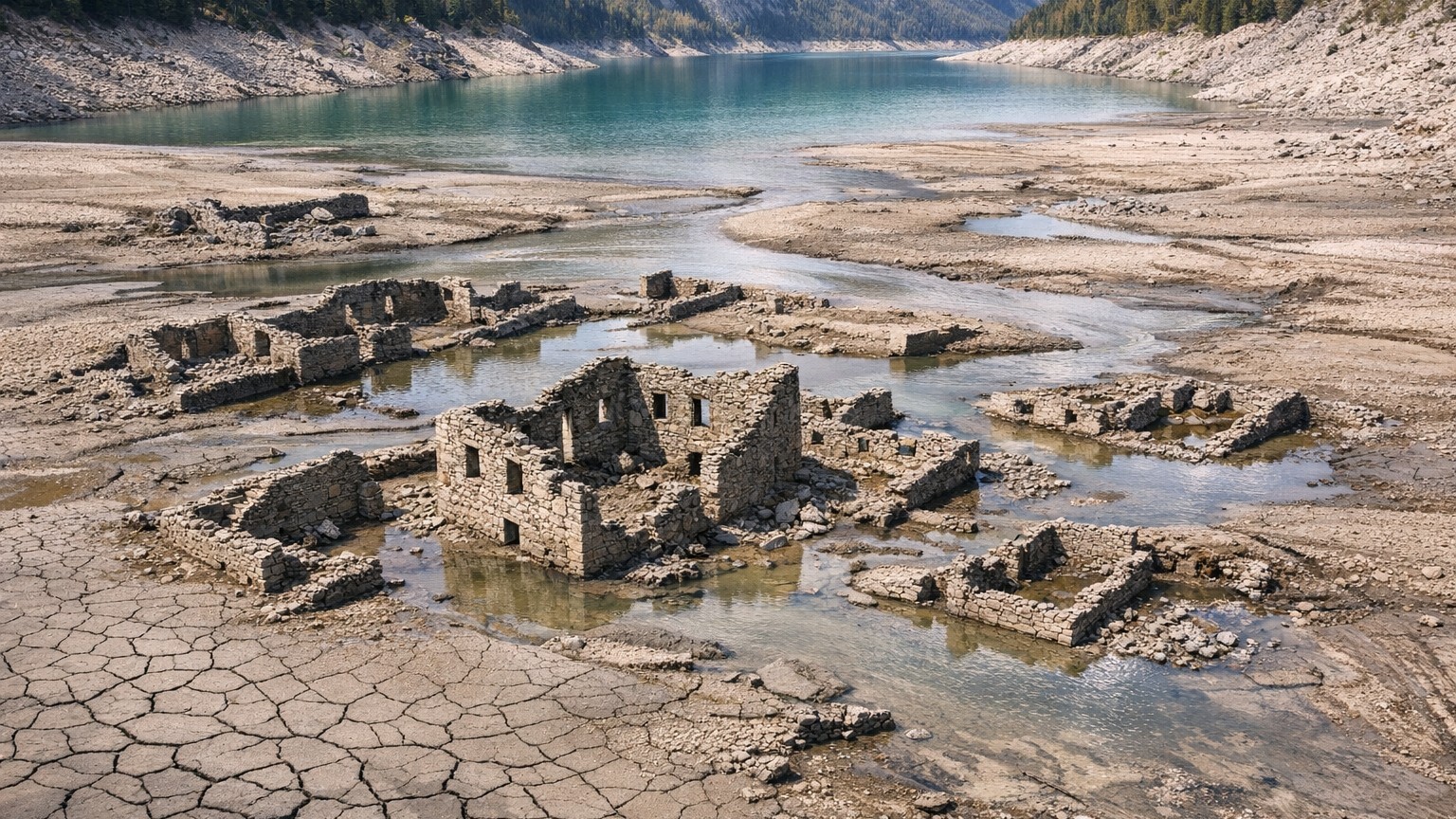
Stone walls rise from a bed of cracked silt. A century-old bridge. Bare foundations, eaten away by the mud yet still standing. In April 2024, these images circulated on social media as if they were an apparition: at the bottom of a lake nearly dried up in Savoie, stone walls emerged from a cracked mud bed, with a century-old bridge, foundations, the outlines of a life suspended since 1952. This isn’t fiction. It’s the old Tignes, a Savoy village swallowed by Lake Chevril, which refuses to vanish completely.
Key takeaways
- Why was an entire village deliberately submerged under water in 1952?
- How did 387 inhabitants try to resist before being expropriated in a matter of days
- What remains at the bottom of the lake when the waters retreat every ten years?
A village submerged to feed France with electricity
In 1952, the construction of a hydroelectric dam 180 meters high swallowed the old village of Tignes and its 400 years of history under 235 million cubic meters of water. To put this figure into perspective: it equates to 94,000 Olympic swimming pools. The project began in 1945 in a postwar context where France faced a vital need for electricity, and the works started in 1948 required the participation of 5,000 workers laboring day and night in extreme conditions at an altitude of 1,790 meters. At the time of its completion, it was the tallest dam in Europe.
The old village of Tignes comprised 150 Savoyard traditional houses, some dating back to the 16th century. The Saint-Jacques church, a jewel of Savoy Baroque art built in 1679, featured frescoes and altarpieces of remarkable artistic value. Before the flooding, the services of the Monuments Historiques managed to save certain precious elements, including the extravagant Baroque main altar and several statues, which are today displayed in the new church of Tignes-le-Lac. The rest was dynamited, then swallowed up.
A fierce resistance, crushed by the State
387 inhabitants were forced to move, not without attempting to block or slow down the works. The commune pursued administrative, then judicial actions, with little success. Yet the resistance was real and relentless. To quell it, the State deployed resources: CRS trucks surrounded the village, houses were dynamited, and the keys to the town hall were ripped from the mayor by the prefect of Savoie.
On April 21, 1952, the prefect of Savoie issued a notice to the residents of Tignes: anyone who had not definitively left the site by April 27 would not receive any eviction compensation. A six-day ultimatum. Three-quarters of the Tignards refused to sell their properties and were expropriated as a result. A bulldozer cleared the path to the cemetery, followed by gravediggers tasked with moving the dead. Even the deceased were expropriated.
Their resistance was followed by the media of the time, such as Paris-Match, which screamed on the front page on March 22: “The tragedy of the week, Tignes.” Each family received on average 3 million francs at the time, a sum deemed insufficient by many. National pride on one hand. Collective trauma on the other. On July 4, 1953, President Vincent Auriol inaugurated the dam.
The resurrection, every ten years
Since its opening in 1953, the Tignes dam underwent a complete decennial draining of its water reservoir, during which the ruins of the submerged village reemerged to carry out a general inspection of the equipment and its vault. These moments possessed something of a ritual as much as a technical operation. The drain in March 2000 allowed many Tignards, including a few descendants of old Tignes, to organize a mass in the ruins of the submerged church. A ceremony outside of time, in a space officially dead for half a century.
The elders would then descend in procession toward the ruins of what had been the village. On this occasion, a delicate green mantle began to creep back, the bed of the Isère resurfaced, a few vestiges of the disappeared village reappeared, and emotion surged. There are still a few walls, but there is a thick layer of mud (at least a meter). In short, the bottom of the lake is a broad, mucky expanse with a few ruins protruding and a small lake left between the dam and the old village. Not spectacular in a tourist sense. Moving, for those who know what rests there.
During the last drain in 2014, the ruins of the old Tignes reappeared for several weeks, drawing more than 30,000 visitors fascinated by this poignant testimony of local history. A figure that says everything about the attraction of these submerged heritages: people travel en masse to see walls coated in mud. Not for their beauty, but for what they represent.
An increasingly uncertain resurrection
Every ten years, during the decennial inspection, the dam was drained to allow an inspection of the wall. But it seems there will be no more decennial draining, as inspections are now conducted with underwater robots, limiting service interruption. The last drained inspection took place in April 2014.
In April 2024, a partial draining for maintenance reproduced the phenomenon: the lake was partly emptied and some ruins, having withstood the water and mud, reemerged. Partial, not complete. Sufficient to rekindle the emotion on social networks, but without the plunge into the past that full draining allowed. It is the paradox of this site: the more technology advances, the less likely the village is to resurface.
The old Tignes belongs to a France that few know, that of the 44 valleys inhabited and submerged to enable the construction of hydroelectric reservoirs. Each valley has its own story of expulsion, its lost archives, its displaced dead. The artificial lakes created by dams swallowed villages and hamlets, mainly in the Alps, the Massif Central, and the Jura. Tignes remains the best documented and most publicized case. Perhaps because its inhabitants resisted strongly enough for memory to endure. Perhaps also because its stones, they themselves, still refuse to surrender completely.
Sources: glisseavecplaisir.blogspot.com | journee-mondiale.com
