
Vaccination coverage refers to the share of a target population that has received the vaccine recommended for them, a key indicator of collective protection against seasonal viruses. Each autumn, this figure tells a repeating story: millions of eligible French people miss their vaccination appointment because of lack of time, information, or simply a lack of motivation. This year, however, with Covid-19 already circulating actively on the territory, health authorities have chosen to disrupt habits with a strategy that leans on logistical simplicity. The question remains: will this reorganization be enough to close a vaccination gap that now totals millions of missing doses?
- From October 13, people aged 65 and over and at-risk groups will be able to receive the flu vaccine and the Covid-19 vaccine during the same visit, one in each arm
- Vaccination remains fully covered for targeted groups, including both the vaccine and the injection
- By late September, indicators already showed a clear rebound in respiratory illnesses, with a 22 % rise in emergency visits for suspected Covid-19 within one week
- A vaccination shortfall of 4.8 million doses against the WHO target
- A same-day double injection to save time starting October 13
- A virus circulation already active that reinforces the urgency of vaccination
- What this express campaign reveals about the limits of preventive vaccination in France
A vaccination shortfall of 4.8 million doses against the WHO target
What Health Protection France notes leaves little room for doubt: influenza vaccination coverage remains markedly insufficient in France, despite annual campaigns. In the previous season, only 49.6 % of at‑risk individuals in metropolitan France were vaccinated against influenza, a figure that has struggled to gain traction for several years. Elderly people, vulnerable groups, and even health professionals—who are on the front line—display protection rates judged too low by health authorities. This gap, measured against international recommendations from the World Health Organization, now amounts to an estimated 4.8 million vaccinations short of the target. A number that can be dizzying and that partly explains why both flu and Covid-19 continue to weigh heavily on the healthcare system each rentrée (back-to-school period).
A same-day double injection to save time starting October 13
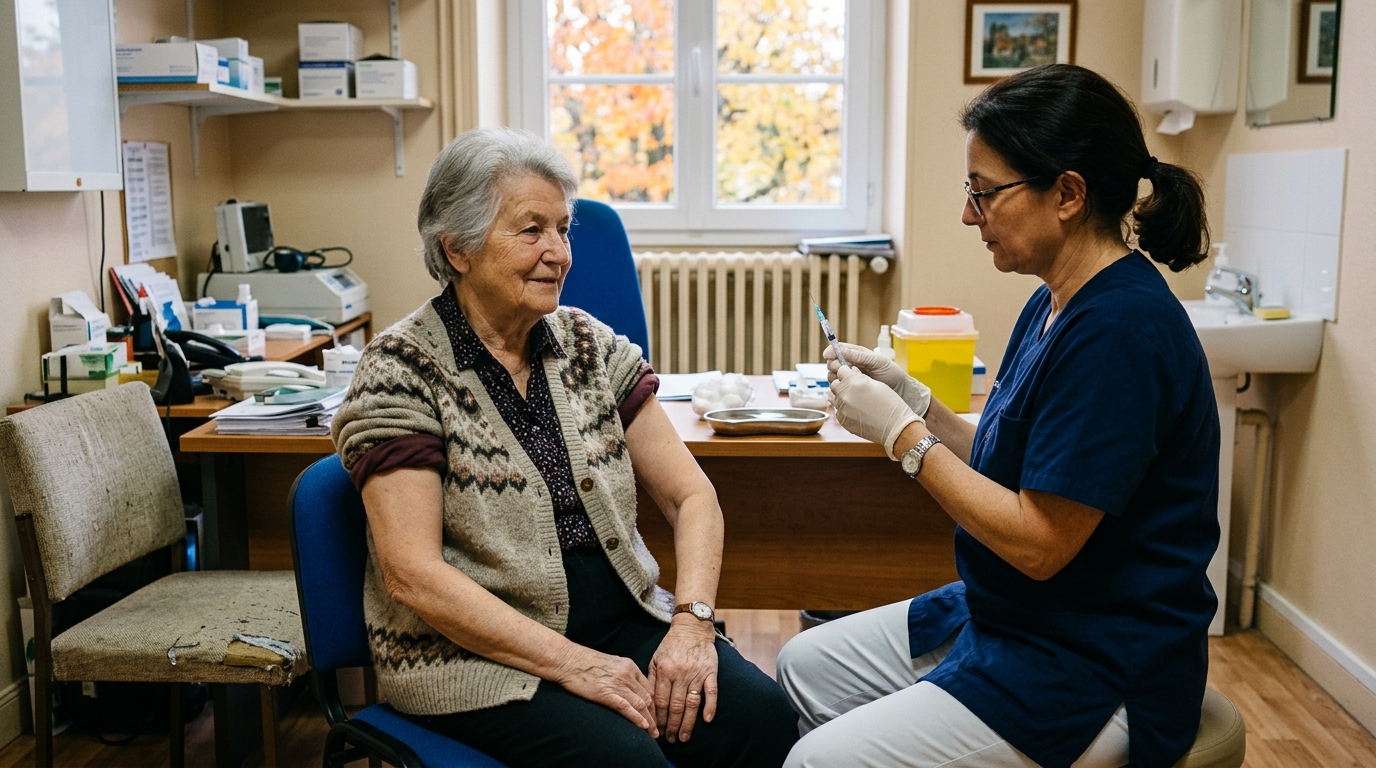
Facing this persistent lag, the 2026-2027 campaign bets on a welcome simplification. From October 13, vaccines against Covid-19 and influenza can be administered during the same visit, one in each arm, for those aged 65 and over and for at‑risk groups. No more two separate appointments with a doctor or pharmacist: a single session may now suffice to cover both vaccines. Regarding influenza vaccines, five options are offered this season, including two specifically reserved for people 65 and older, Efluelda and Fluad. No mRNA influenza vaccine is among the available choices this year. For Covid-19, the Comirnaty formulation targeting the Omicron XFG sublineage will be distributed, alongside Nuvaxovid XFG and the newcomer, mNEXSPIKE. The following groups are specifically eligible for this dual vaccination:
- People aged 65 and over
- Pregnant women
- Immunocompromised individuals or those with certain comorbidities
- People with severe obesity (BMI ≥ 40 kg/m²)
- Residents of medico-social establishments
- Health professionals and people who frequently interact with vulnerable populations
Good news for wallets: vaccination remains fully covered (100%) for these targeted groups, with the Health Insurance voucher covering both the vaccine and the administration.
A virus circulation already active that reinforces the urgency of vaccination
While the campaign kicks off on October 13, the viruses themselves did not wait for the official launch. By the end of September, Health Protection France indicators already showed a clear uptick in respiratory illnesses across all age groups. In emergency departments, visits for suspected Covid-19 rose by 22 % in a single week, more than 114 additional visits. At SOS Médecins, consultations for suspected Covid-19 climbed by 19 %, with 173 more interventions, while influenza or flu-like syndrome among adults rose by 26 %, i.e., 719 additional acts. The Meuse and Lozère are among the regions most affected. According to epidemiologist Antoine Flahault, this wave may have begun in mid-August and could continue through December, a pattern observed in Europe, the United States, Canada, and Asia as well. Wastewater surveillance, conducted at 54 treatment plants, confirms this rising trend. All in all, back-to-school dynamics—schools, offices, and crowded transport—had already done their part before vaccination slots opened.
What this express campaign reveals about the limits of preventive vaccination in France
Beyond practicality, this one-visit, two-vaccine approach invites broader reflection on the barriers to vaccination in France. Simplifying access appears to be the path chosen by authorities to reach fragile populations who, year after year, slip through the cracks. This edition also marks a further step with the progressive rollout of the mandatory influenza vaccination for certain professionals, signaling that a simple recommendation does not always suffice to persuade. Yet the road ahead remains long: a shortfall of 4.8 million doses cannot be recouped in a single season, no matter how well organized. Future campaigns, for influenza as well as Covid-19, will likely need to continue innovating to convert good intentions into concrete actions, especially in the face of viruses that never truly pause.
Between logistical simplification and already-established viral circulation, this 2026-2027 campaign appears to be a bet on time gained. One arm for influenza, one arm for Covid-19, and perhaps, finally, a few fewer missed appointments in waiting rooms.
