
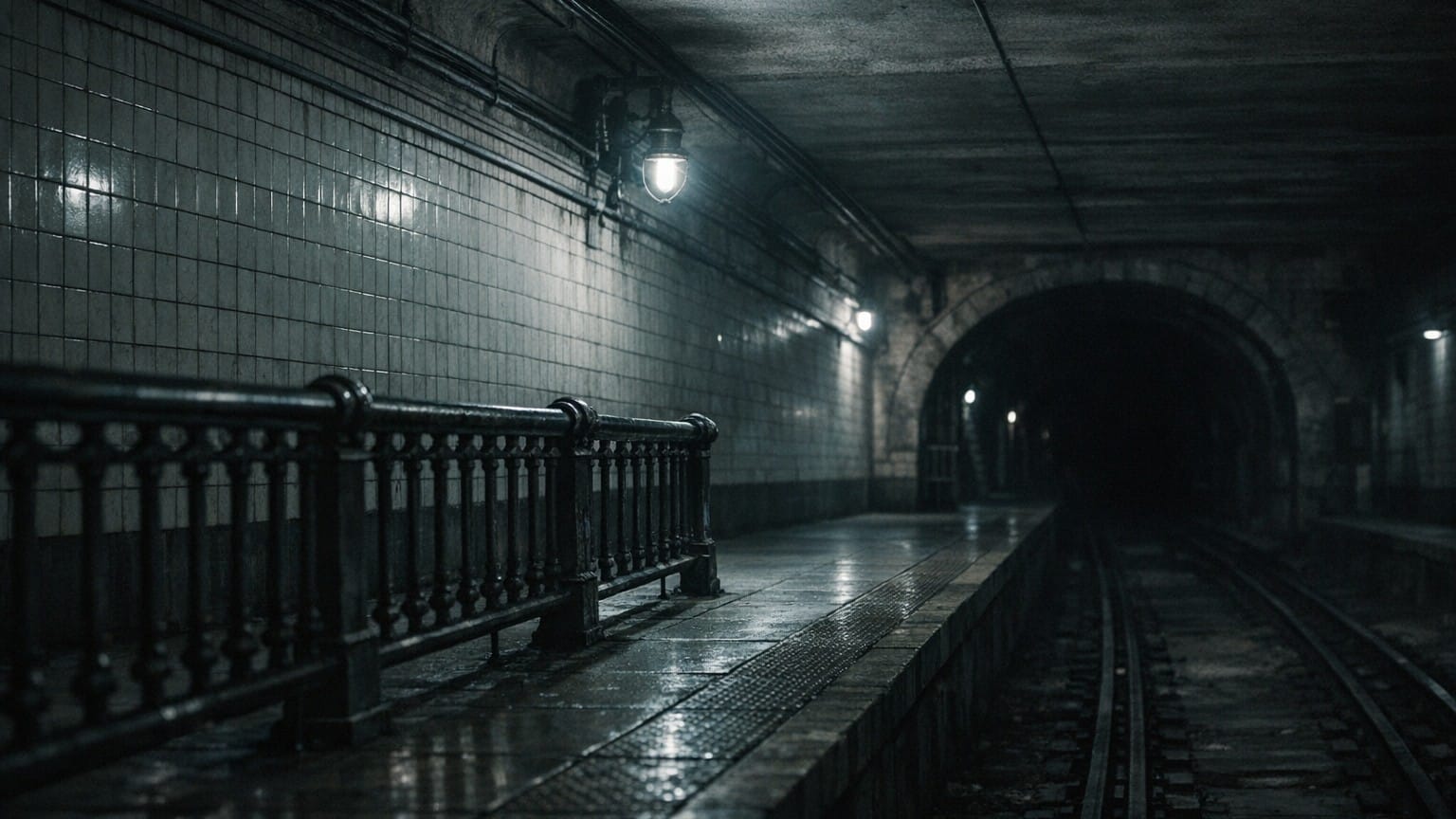
A tiled platform, indicator panels screwed into the void, the muffled echo of trains passing by without ever stopping. Haxo Station, buried beneath Boulevard Sérurier in the 19th arrondissement, holds an all-time record in the history of the Paris metro: built in 1921, it has never welcomed a single traveler. Not one. A century of underground existence, strictly a phantom since its birth. Every day, hundreds of thousands of Parisians ride just meters above it without a trace of suspicion.
At a glance
- A metro station built but never used: not a single traveler since 1921
- Why a technically finished project remained sealed underground for a century
- Paris hosts 13 ghost stations with very different destinies, some of them turned into film studios
A station built to never serve
Haxo sits on the connecting track between lines 3 bis, at Porte des Lilas, and 7 bis, at Place des Fêtes. The original idea was rational, almost banal: in the 1920s, the aim was to link the two stations by a shuttle, which would ultimately never come to fruition. A technical interchange project, conceived at a moment when Paris sought to densify its network at full tilt.
The complexity of the works and the extra costs failed to justify themselves against the modest expected ridership on this portion of the line. Not useful enough, not profitable enough to bring this station to life, its opening was first postponed and then abandoned altogether. The construction was nonetheless nearly complete. A simple shuttle service, non-stop, was launched from 1921, but was soon abandoned due to a lack of passengers and, by extension, a lack of profitability.
What sets Haxo apart from all other abandoned stations in the capital is its radical level of incompletion. The station has never seen a single journey, and its exterior access points were never built. Direct consequence: there is no surface exit. Everything happens underground, in a sealed-off corridor of the metro. A station without a surface entrance. No stairs toward the sky. A space that has existed, from day one, only for itself.
The Paris underground that no one sees
This hidden and mysterious heritage would number 13 Parisian closed stations, underground spaces inaccessible to the general public and which tell a portion of history. Among them, not all share Haxo’s fate. Some at least witnessed the bustle of an inauguration, the noise of crowds, before being condemned. The Arsenal station, for example, opened on December 17, 1906 during the extension of line 5, then closed on September 2, 1939 due to the mobilization of CMP workers for World War II. At Arsenal, the subways pass but do not stop. Inaugurated in 1906, this station was erased from the maps. The platforms, today veiled in a thick layer of black dust, have not welcomed travelers for eight decades.
The mechanism of mass closure is dated with precision. Most of these stations, closed in September 1939, were never brought back into service. In Paris, the Compagnie du chemin de fer métropolitain de Paris, the predecessor of RATP, lacked staff. The war froze the network, and that freeze never truly thawed. Stations that were too close to one another, deemed dispensable, simply disappeared from the maps, as one erases a name from a list. While the stop has not appeared on the map since September 1939, it was only in the 1970s that the Champ-de-Mars station vanished from the metro map. Thirty years of invisibility.
These ghosts have a second life
Not all stations descended entirely into oblivion. Arsenal, never reopened because it was too close to neighboring stations, is used by the RATP for training maintenance staff in electronic equipment. It serves for testing lighting systems, fittings, or scenery. A laboratory-station, invisible to ordinary mortals.
The neighbor of misfortune to Haxo, the Porte des Lilas-Cinéma station, followed a brighter trajectory. It would become a well-known place for cinema lovers: a station dedicated to film or commercial shoots, serving notably as a set for The Fabulous Destiny of Amélie Poulain. The signs and station names are repurposed for each film. For example, “Tuileries” for Paris, I Love You, “Abbesses” for Amélie, or “Gare de l’Est” for A Wonderful Life. About five films shoot there each year. An underground studio under a closed roof, a stone’s throw from the actual line in service.
Haxo, by contrast, remains in an in-between state. A ghost station in the strict sense, a platform without an audience, a place visible only from service trains. It mostly serves as a playground for graffiti artists and as a storage space for metro trains outside operating hours. Far from the glamour of a movie set. One anecdote sets it apart, though: it was used as a filming location for a horror movie in the 1980s. Logical, in the end, for a place where no one has ever set foot.
How to approach it, even if only once
The frustration felt by heritage enthusiasts is real: these ghost stations do not appear on RATP plans and are inaccessible to the general public. To gain access to Arsenal on exceptional occasions, one must be accompanied by RATP personnel for safety reasons. As for Haxo, the station, which has no exterior access, remains for a century the only one in the network to have hosted no traveler. The only exceptions: a few visits organized by associations.
The station is a near-mandatory stop on nocturnal tours by railway enthusiasts and on trips organized by the ADEMAS association, accessible to all during the Journées du Patrimoine (Heritage Days). It is there, once or twice a year, that the wall between visible Paris and buried Paris cracks for an instant. It can be visited during Heritage Days, aboard a Sprague-Thomson metro car. An antique carriage, a track that no one normally uses, and suddenly the station appears: intact tiling, empty platforms, cathedral-like silence twenty meters beneath the asphalt of the 19th arrondissement.
The RATP has been queried several times about the future of these spaces. In 2014, Nathalie Kosciusko-Morizet, then a UMP candidate for the mayor of Paris, proposed turning these decommissioned stops into “places of conviviality.” A project that the RATP still regards as “unrealistic,” given the multitude of safety rules that govern the tunnels. A fusion of lines 3 bis and 7 bis is nevertheless being considered, which would use the existing tracks to form a new line. Haxo could then open after the creation of an access from the public street. A century of waiting to perhaps, at last, welcome its first passenger.
Sources: outgomag.com | france3-regions.franceinfo.fr
