
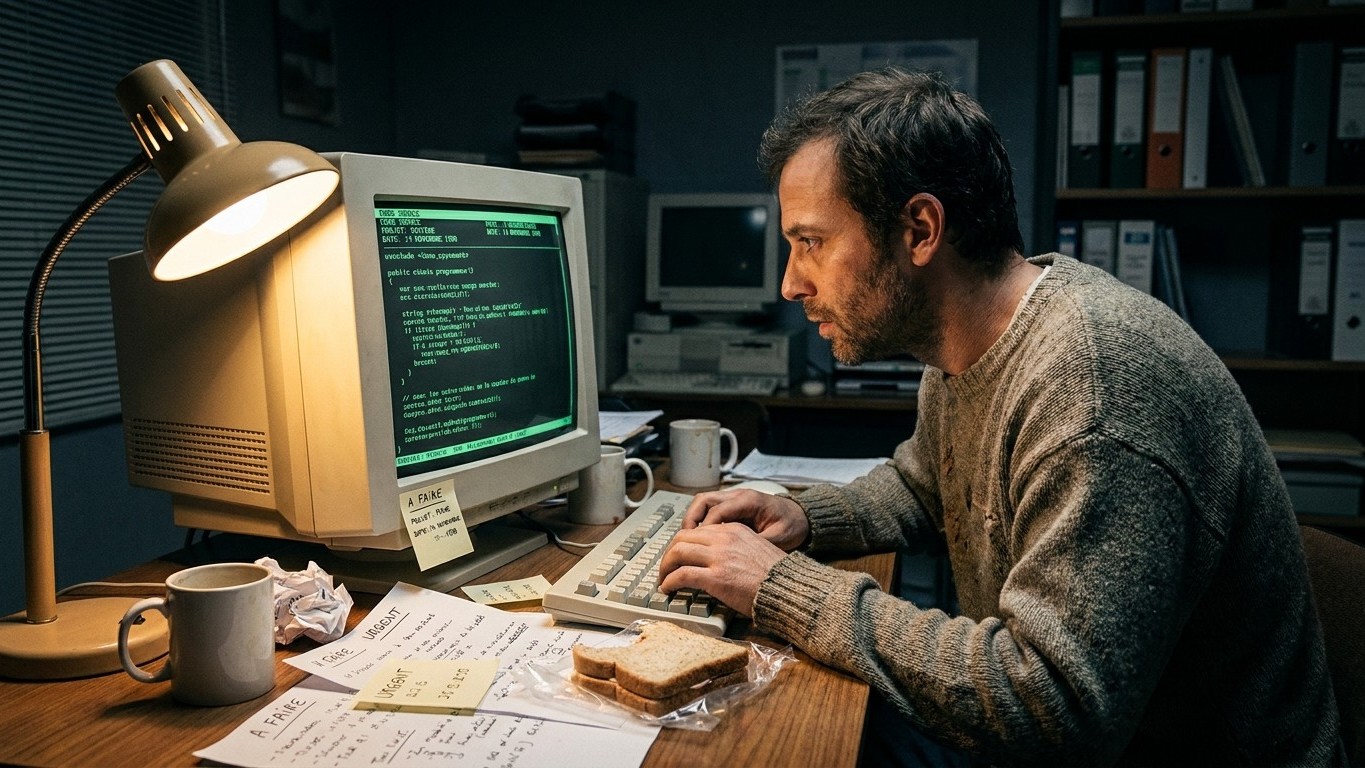
At midnight on January 1, 2000, nothing happened. No plane plummeted from the sky, no nuclear plant spiraled out of control, no ATM spit out customers’ money by mistake. And yet, in the months leading up to that night, governments and companies worldwide had spent staggering sums to avert a catastrophe scenario that they themselves had, quite literally, programmed decades earlier.
The root of the problem lay in a coding habit that became a collective trap. As early as the 1960s, computer engineers chose to code dates with two digits to represent the year (“72” for 1972), thereby saving precious memory resources. At the time, no one imagined these lines of code would still be running thirty years later. In the 1970s and 1980s, computer memory was a costly commodity. A megabyte of RAM could cost thousands of dollars. Developers optimized every variable, every datum, every bit. Two digits instead of four seemed innocuous. It was primarily a logical saving in a world where every byte counted.
Key takeaways
- Why would a mere saving of two digits in 1960 terrify the world in 1999?
- How far were governments and companies prepared to go to prevent midnight on December 31, 1999?
- Did the preventive measures actually work, or was it a massive waste of resources?
A logical trap laid thirty years in advance
The snag was that a computer programmed to read “99” as 1999 has no reason to understand that “00” means 2000 rather than 1900. IT systems risked conflating the two dates, with cascading consequences for anything that depends on time calculations: banking interest, maintenance schedules, billing systems, air traffic control. A famous example from the era: an invoice issued late in 1999 and still unpaid the following month could have completely bypassed the automatic reminder system, the computer calculating a negative 99-year gap between the two dates. This kind of anomaly, multiplied across millions of different programs in critical sectors, eventually unsettled even the highest echelons of government.
An extraordinary financial mobilization
Facing this risk, the response matched the fear. In total, roughly $100 billion was spent to identify and fix systems vulnerable to the issue in the United States. The U.S. federal administration alone invested $8.5 billion, mobilizing agencies such as the Pentagon and the FAA to secure flights and sensitive operations. The rest of the world did not look away: in the United Kingdom, nearly $40 billion was allocated to these efforts, while Canada’s preparatory costs came in at around $2.5 billion. Worldwide, estimates vary but run into the hundreds of billions: total costs are estimated between $300 billion and $600 billion. To illustrate the scale, some companies dedicated 10–20% of their IT budgets to these efforts for multiple years. Armies of developers retrieved code sometimes thirty years old, written in languages that had fallen out of use, to hunt down every instance of a two-digit year pattern.
What stands out in hindsight is the foresight of certain players. By 1995, major enterprises, banks, and airlines had already begun adapting their IT systems. Five years of preparation for a single night of transition yields a dizzying ratio, yet it also reflected the magnitude of the perceived danger at the time.
The night when (almost) nothing happened
The year-end atmosphere of 1999 did little to calm nerves. A few weeks before the countdown, the arrest of a man at the Canada–United States border, found with explosive materials in his vehicle and suspected of planning to target a U.S. airport on New Year’s Eve, added a tangible layer of anxiety to the IT-driven paranoia. The technological bug and the terrorist threat thus mingled in the millennial imagination, each feeding the other.
Then midnight struck, clock by clock, with no disaster. Some minor incidents were recorded: ATMs briefly refusing cards, websites showing the wrong date, meteorological systems producing abnormal data for a few hours. Nothing more. In France, no disruption was observed in the interior ministry’s IT systems, and NATO had announced a few days earlier that it was confident it could carry out all essential missions without being hindered by failures due to the Y2K bug. A global calm prevailed.
Massive waste or catastrophe averted: an undecided debate
What is clear, however, is that the time-encoding problem did not vanish entirely with the Y2K transition. A large portion of modern computing still measures time in seconds since January 1, 1970, in a format that will also reach its limits in 2038. Today’s computer scientists know this: a memory-saving decision made in the 1960s was enough to shake the world thirty years later. There are no guarantees that the lesson has been fully absorbed.
Sources: lalibre.be | moncarnet.com
