
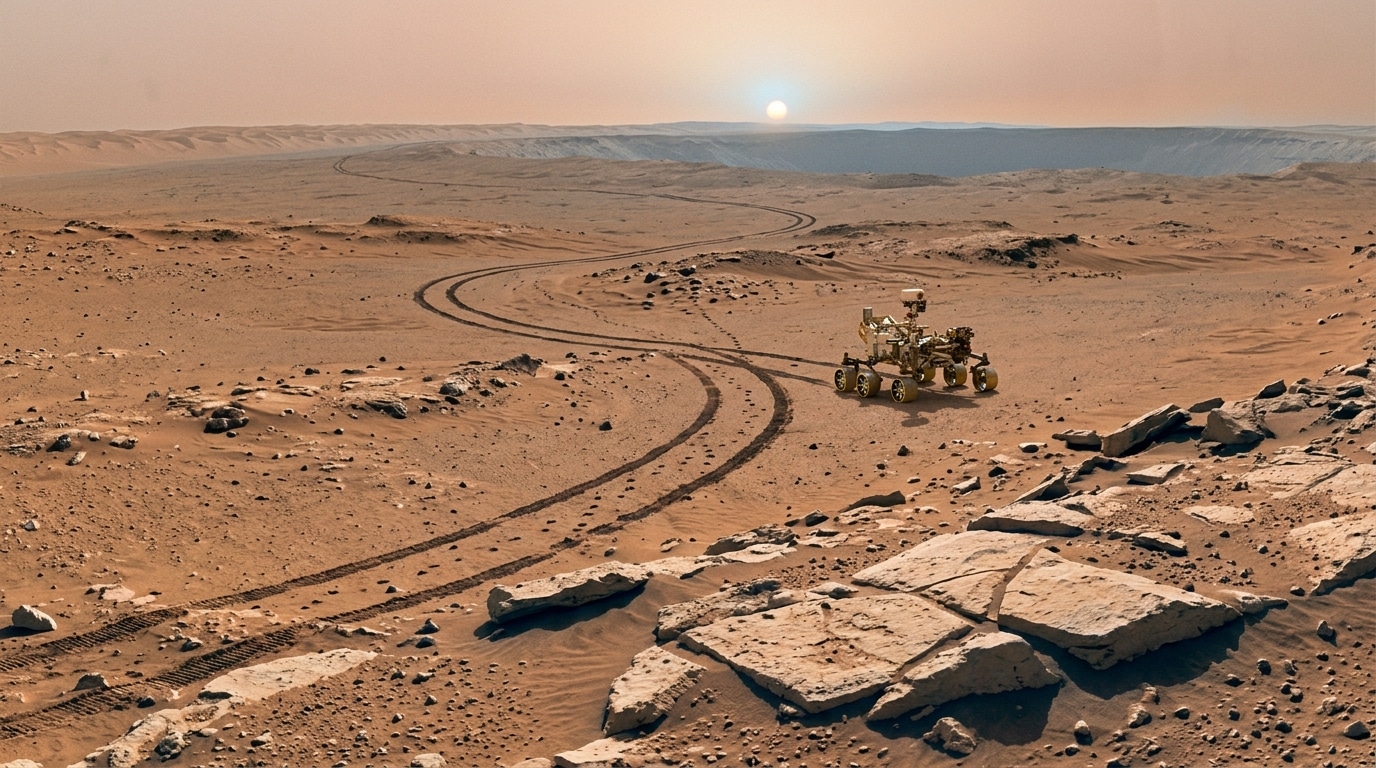
For nearly fifteen years, a small solar-powered robot held a record that nobody expected to see fall so quickly. Perseverance has just erased it, and what stands out most is the method used: it’s no longer a human who laid out the route, but an onboard system capable of choosing its own path on unknown terrain.
- Perseverance covered 45.22 kilometers by its 2006th Martian sol, surpassing Opportunity’s 45.16-kilometer record set over nearly fifteen years; Perseverance accomplished it in about five and a half years
- Thanks to the AutoNav system, more than 90% of Perseverance’s movements are now autonomous, versus only about 5% for Opportunity and Spirit, and the rover can analyze up to 600,000 data points per observation
- The rover continues toward the “Lake of Charms” region, which could harbor some of the oldest terrains in the solar system, with a realistic goal of 100 kilometers in total
- 45.22 kilometers: the number that reshapes Martian exploration
- When artificial intelligence takes the wheel: the secret of unprecedented speed
- Heading toward “Lake of Charms”: Perseverance on the way to the oldest terrains in the solar system
45.22 kilometers: the figure that reshapes Martian exploration
The number may seem modest at first glance. Forty-five kilometers and a few hundred meters is scarcely the distance between two mid-sized towns here on Earth. Yet this journey occurred on Mars, wheel by wheel, across a hostile and rugged terrain.
Perseverance crossed this milestone on its 2,006th sol, the famous Martian day slightly longer than our terrestrial day. The leap was achieved over a drive of just 91.31 meters, a tiny distance that nonetheless sufficed to tilt the records books of space exploration.
The previous holder of the title was named Opportunity. This rover, active for nearly fifteen years on the red planet, had covered 45.16 kilometers before going silent. Percy, as the teams at the Jet Propulsion Laboratory affectionately call it, thus completed the same distance as Oppy in barely a third of the time, namely about five and a half years.
The initial mission plan anticipated a maximum rolling distance of 12.4 miles, or about 20 kilometers. That threshold was not only reached but literally smashed, evidence that the rover is performing better than expected on paper.
When AI takes the wheel: the secret of unprecedented speed
How can one explain such a performance gap between the two rovers? The answer lies in autonomy. Perseverance carries a system called AutoNav, which allows it to independently assess terrain hazards without waiting for instructions from Earth.
Mark Maimone, a longtime rover pilot and deputy team lead for robotic operations on Perseverance at JPL, sums up the challenge: “I want to stress that Opportunity was active for nearly 15 years, while we are not yet five years into existence; we are therefore likely to beat Opportunity’s record three times faster.”
The numbers speak for themselves: more than 90% of Perseverance’s movements are now conducted via autonomous piloting, compared with barely 5% for Opportunity and Spirit in their time. In other words, the rover decides, day by day, where to place its six wheels.
This difference is also explained by the onboard computing power. With each terrain observation, Perseverance analyzes up to 600,000 data points, whereas the tiny Sojourner, the first Mars rover in history, processed only 20. A leap that enables the vehicle to travel up to 412 meters in a single Martian day, a pace its predecessors could never have sustained.
“It’s a genuine technical feat that our latest Martian rover can move fast enough for autonomous driving to be our main way of carrying out long journeys,” Maimone said. Steven Lee, project manager for the Curiosity and Perseverance rovers at JPL, also confirms that all mobility systems remain fully operational, providing reassurance for the journey ahead.
Heading toward “Lake of Charms”: Perseverance on the path to the oldest terrains in the solar system
Beating a record is never an end in itself for a scientific mission. Perseverance continues its course toward a region named Idubi, located on the western rim of Jezero crater, in an area nicknamed the Lake of Charms.
This region could harbor some of the oldest terrains ever explored directly within the solar system. On Earth, erosion and plate tectonics have long erased the signs of our geological youth. Mars, by contrast, has preserved this testimony intact, like a history book left closed for billions of years.
The rover is far from stopping on this good path. The JPL teams have certified that the actuators, those mechanical parts that turn the wheels, could continue to operate optimally for at least 60 more kilometers. The goal of 100 kilometers in total, mentioned by Mark Maimone, now seems entirely realistic.
Nothing, of course, guarantees a smooth ride. Previous missions have all faced their share of mechanical hiccups: a wheel dragged by Spirit after the loss of a motor, an arm immobilized on Opportunity, a drill failing on Curiosity. In each case, the teams managed to adapt the mission rather than abandon it, and it is precisely this scenario that we hope to see again if Perseverance runs into a similar incident.
There remains this vertigo-inducing question: what will be discovered once Lake of Charms is reached? Between a record that fell much sooner than expected and a destination that could reveal the oldest geological archives ever reached by a machine, Perseverance confirms that it has not finished surprising us. And if the odometer keeps turning at the current pace, the 100 kilometers could well be surpassed before we’ve had time to grow accustomed to the previous record.
