
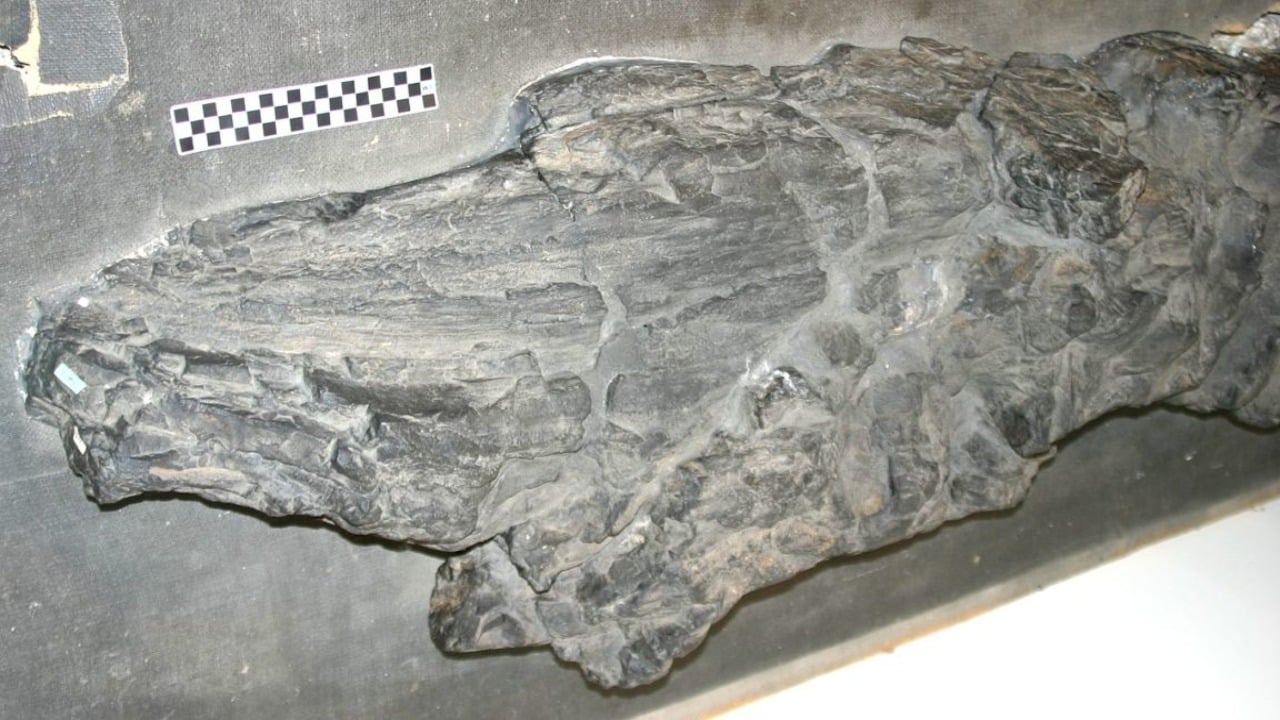
Nature sometimes holds truly fascinating surprises in store for us. One such marvel is the fossil of Prototaxites. Discovered for the first time in 1843, it long sparked debates among scientists. For nearly two centuries, it was believed to belong to a giant fungus. Yet recent discoveries by researchers at the University of Edinburgh challenge that view and open the door to a far more astonishing idea: Prototaxites could indeed represent a completely new form of life, a life form unknown to the biological groups we recognize today.
An Odd Fossil Discovered Over a Century Ago
The Prototaxites is a prehistoric organism that thrived roughly 430 million years ago, during the Silurian period. It captivates not only because of its remarkable size—standing as tall as eight meters and with a trunk about 90 centimeters in diameter—but also because of its enigmatic structure and mysterious nature. When the earliest Prototaxites fossils were unearthed in the 19th century, scientists initially assumed they belonged to the remains of an ancient conifer, a decayed conifer species. That line of thinking made sense since the colossal size and the apparent form of the fossils resembled a tree.
However, more detailed analysis revealed that trees did not exist at that time. Researchers then proposed a new hypothesis: Prototaxites was actually a robust and voluminous species of fungus. The hypothesis seemed plausible because the fossil structure exhibited features common to modern fungi, such as sacs filled with spores.
Further findings reinforced this idea. In 2007, the analysis of carbon isotopes found in the fossils suggested that Prototaxites behaved like a fungus, by drawing oxygen from other living organisms.
A Modern Analysis Upsets Everything
Yet this view could soon be overturned. A team led by paleobiologist Corentin Loron conducted a more in-depth study of Prototaxites fossils, this time focusing on specimens from the present-day Aberdeenshire region in Scotland.
Their analysis revealed something far more surprising. Contrary to previous assumptions, the anatomical and chemical traits of Prototaxites diverged significantly from those of modern fungi. The internal tubes within the fossil consisted of unique structures not found in any current fungus. In addition, some features of the fossils, such as medullary patches and tubes bearing growth rings, did not match anything known in the fungal world.
Even more puzzling, chemical analyses showed the absence of certain sugars and proteins characteristic of fungi, notably chitin, which forms part of the cell walls of modern fungi. This left researchers perplexed: if Prototaxites wasn’t a fungus, a plant, or an animal, what exactly was it?
A Completely New Form of Life?
After months of investigation, the team led by Loron concluded that Prototaxites was unlikely to belong to any existing biological group. They proposed that this organism could be a representative of an extinct group of eukaryotes—a lineage of multicellular organisms with no living descendants today. In other words, Prototaxites might represent a unique and entirely unknown form of life, an evolutionary line that disappeared millions of years ago without leaving traces in the modern biosphere.
This discovery opens up a field of fascinating questions. If Prototaxites belongs to an extinct group, it implies that Earth’s past biodiversity was probably far more complex and diverse than we had imagined. It also raises the possibility that there are other unknown life forms that vanished before we could study them up close.
An Unresolved Yet Captivating Mystery
Although the exact nature of Prototaxites remains a mystery for now, this discovery challenges our preconceived notions about the evolution of life on Earth. If this organism truly belongs to a vanished group of eukaryotes, it signals that primitive life on our planet was far more varied and peculiar than previously imagined. Perhaps, in the future, other unexpected fossils will be uncovered, further broadening our understanding of Earth’s biological history.
Thus, Prototaxites reminds us that science is in constant flux, and that even discoveries centuries old can still conceal fascinating secrets. The fossil of this giant ancient creature may well be one of the many enigmas of life on Earth, inviting us to ask more questions about the forms of life that inhabited our planet long before the species we know today came into being.
