
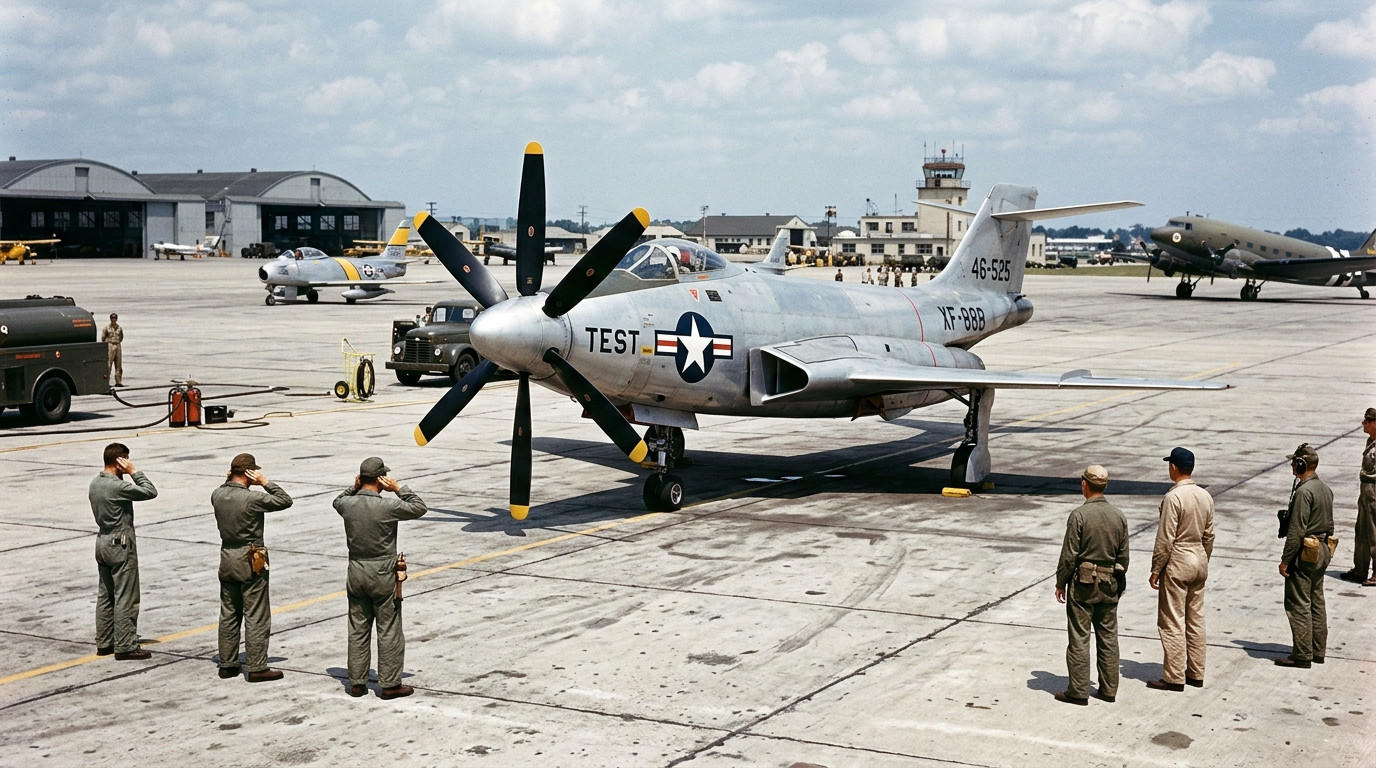
Important note: this aircraft truly existed, it really flew, and what you are about to read is not an urban legend born in the corridors of the Cold War. At a time when the United States and the Soviet Union were locked in a merciless technological contest, the American aerospace industry attempted something quite audacious: to spin a propeller faster than the speed of sound. The result was named the Republic XF-84H, but it would soon be given a far less flattering nickname. Here is the story of a plane that was meant to revolutionize aviation, yet ended up being detested by those who were supposed to fly it.
- The Republic XF-84H was equipped with a three-bladed propeller whose tips exceeded the speed of sound.
- This supersonic propeller generated a deafening noise that caused headaches, nausea, and discomfort among ground personnel, as well as vibrations that made piloting difficult.
- The program was abandoned after only twelve test flights between 1955 and 1956, with no crashes or engine failures, solely due to the noise and vibrations deemed insurmountable.
- A Propeller Faster Than Sound: The Audacious Bet of American Aviation
- A Noise So Violent It Caused Fainting on the Ground
- When Vibrations Become the Pilot’s Number One Enemy
- Twelve Flights and Then Nothing: The Quiet End of a Project Too Ambitious
A Propeller Faster Than Sound: The Audacious Bet of American Aviation
In the 1950s, the U.S. military aviation sector was desperate to bridge two worlds once thought incompatible: the raw power of jet engines and the fuel efficiency of propellers. The idea behind the Republic XF-84H was straightforward on paper: arm a fighter with a propeller capable of turning so swiftly that its tips would breach the speed of sound. In theory, this would deliver remarkable performance while using less fuel than a conventional jet aircraft.
In practice, the machine housed a turbine that drove a colossal three-blade propeller, capable of reaching extreme rotational speeds. Engineers of the era believed they had a miracle formula—a perfect balance of speed, endurance, and efficiency. But what they hadn’t fully anticipated was that surpassing sonic speed with a propeller would unleash physical consequences that no one had truly measured before.
A Noise So Violent It Caused Fainting on the Ground
From the very first tests, an entirely unexpected phenomenon appeared: the noise. And not just any noise. When the blade tips broke the sound barrier, they generated a continuous shock wave, transforming into a deafening, shrill din, very different from the rumble of a conventional engine. This sound, described by witnesses of the era as an almost unbearable sonic tearing, would have been audible for several kilometers around.
This wasn’t merely a nuisance to the ears. Ground crew assisting with the tests reported violent headaches, nausea, and in some cases fainting severe enough to require medical attention. The aircraft quickly earned its nickname: the Thunderscreech, literally the “shriek of thunder.” A sobriquet that, one can imagine, carried little fondness during a period when the technical teams had to contend with this sonic plague at every test.
When Vibrations Become the Pilot’s Number One Enemy
Yet the noise is only the visible—or rather audible—part of the problem. What truly worried engineers were the vibrations generated by this supersonic propeller. They propagated throughout the aircraft’s structure, all the way to the cockpit, where pilots were jolted so intensely that reading the flight instruments became nearly impossible.
Some contemporary accounts recount pilots forced to cut test flights short because the sensation was physically exhausting. It is even said that the aircraft’s reputation became so poor within squadrons that very few pilots volunteered to take the XF-84H controls. A paradox for a plane meant to embody the future of propeller-driven aviation, which in practice was feared by those who were supposed to take it aloft.
Twelve Flights and Then Nothing: The Quiet End of a Project Too Ambitious
Faced with this cascade of problems, the Republic XF-84H program did not endure long. After only twelve test flights, conducted between 1955 and 1956, the American military decided to pull the plug on a project that looked promising on paper. Contrary to what one might imagine, there was neither a spectacular crash nor a fatal engine failure. It was the extreme vibrations and the unbearable noise that ultimately doomed the aircraft, making its operational use simply unfeasible.
The program’s abandonment occurred without much fanfare. No scandal, no public controversy: the project faded away quietly, like many aviation experiments of that era where concepts were sometimes bold, sometimes doomed from the outset. Today, the XF-84H remains a historical curiosity, a footnote in the history of American military aviation, yet a note that continues to fascinate aviation enthusiasts and fans of quirky technological stories.
This Thunderscreech adventure perfectly illustrates the limits that physics can impose, even on the boldest projects. Hitting the sound barrier with a propeller was technically feasible, but the consequences for human comfort, both on the ground and in the cockpit, proved insurmountable for the era. A timely reminder that in aviation, raw performance is never enough if it cannot be reconciled with the real constraints of the human body. So, the next time you hear an aircraft overhead, perhaps think of this forgotten fighter, which could have rattled far more than its own pilots.
