
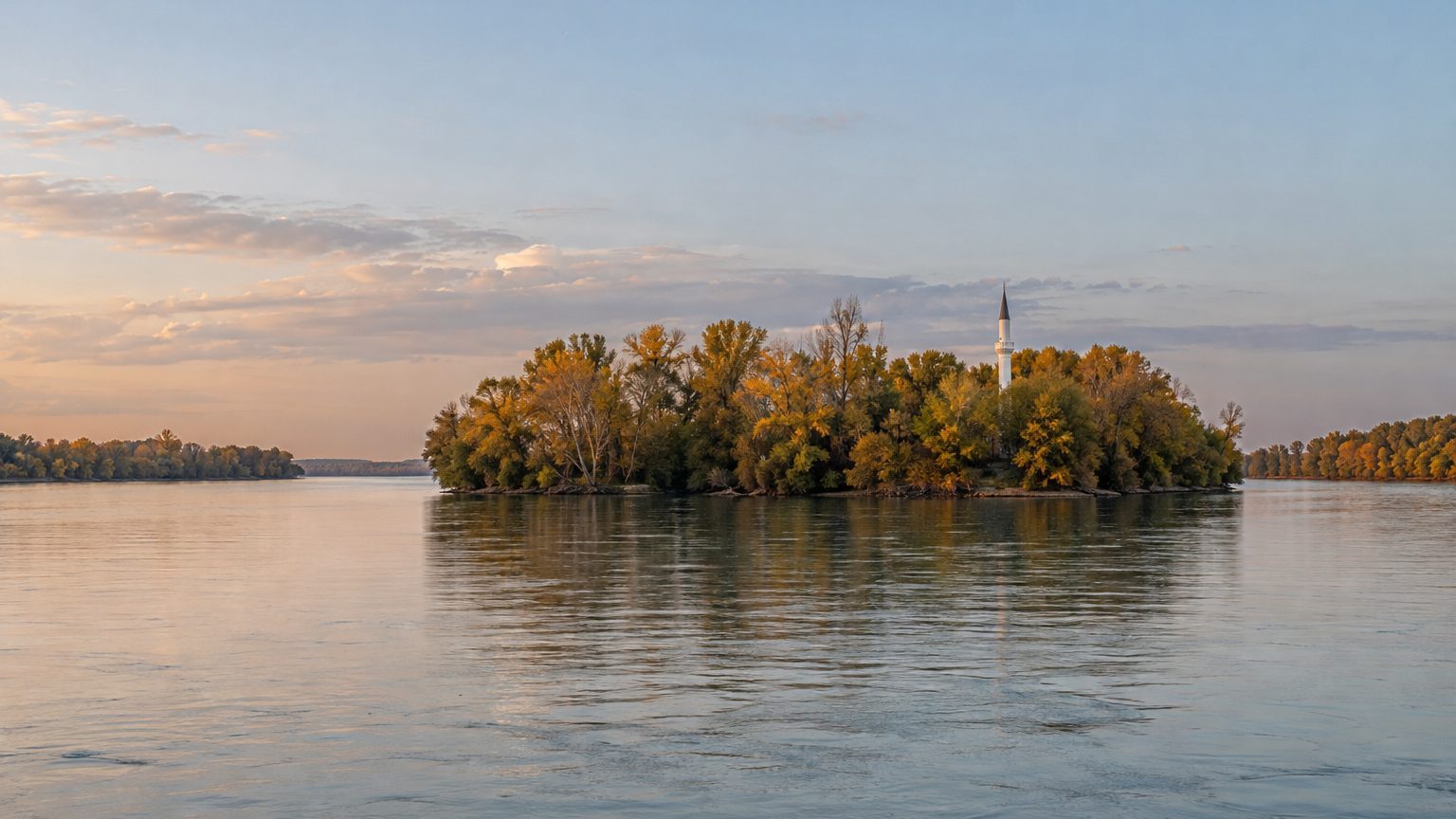
An island 1.8 km long and 400 m wide, set in the Danube, where there were neither taxes nor customs duties and where no one was drafted: Ada Kaleh did indeed exist, in Romania, until the early 1970s. It was not a conflict nor a redrawing of borders that erased it, but an engineering project.
One dam was enough.
The island lay roughly 3 km downstream from Orșova, in the Iron Gates gorge. According to Daily Sabah, it stood only 300 m from the Romanian bank and 400 m from the Serbian bank. Measurements vary from one source to another—about 1.75 km by 0.4 to 0.5 km for Wikipedia, 1.8 km by 400 m for the Turkish newspaper—yet the order of magnitude remains the same: less than 2 km in length. Its name means “fortress island” in Turkish, and the Ottomans nicknamed it, again according to Daily Sabah, “the lock of Hungary and the key to Serbia and Romania.”
- Ada Kaleh was a Danube island of about 1.8 km in length within Romanian territory.
- Its inhabitants were exempt from taxes, customs duties, and conscription.
- The Iron Gates dam submerged it in the early 1970s.
- Part of its buildings, including the mosque, were moved to Șimian Island.
An Oversight in Diplomacy That Became a Status
Before becoming a curiosity, Ada Kaleh was a military stake. The Habsburgs and the Ottomans argued over it for decades, with the Treaty of Karlowitz (1699) and the Treaty of Sistova (1791) enshrining the shifting control. A fortress watched over the river, and it was this fortress that gave the island its name.
Then came the Berlin Congress, in 1878. Diplomats redrew the Balkans, settled the provinces, and forgot the island. It thus remained, de jure, Ottoman, and even privately owned by the sultan.
A fragment of empire, sandwiched between Hungary, Serbia, and Romania.
That oversight produced a regime apart. The inhabitants were exempt from taxes, customs duties, and conscription, and they even voted in the Ottoman elections of 1908, hundreds of kilometers from Istanbul. Austria-Hungary occupied the island in 1913, before the Lausanne Treaty provisions articles 25 and 26, signed on July 24, 1923, ceded it to Romania.
Tobacco, lokum and 637 inhabitants
The 1913 census counted 637 people living in 171 households, roughly the population of a large mountain hamlet. By 1967, there were around 150 households and about 750 residents. Figures for the island’s population at its end range from 600 to 1,000 depending on the source, which makes pinpoint precision impossible.
Life there was modest, but it produced goods that sold well. First tobacco, with up to 37 cigarette brands manufactured on site according to one source, then lokum, figs, rose water, and peaches. Visitors from the Romanian shore would leave with confections and packs of cigarettes that could not be found elsewhere.
At the heart of communal life stood a mosque built in 1903. It housed a carpet gifted by Sultan Abdulhamid II, who left the island in 1965 for the great mosque of Constanța. This relocation occurred a few years before the subsidence, and it shows that the fate of the island had already been sealed in the planning offices.
A Dam Rather Than a Treaty
The Iron Gates I project arose from cooperation between Romania and Yugoslavia, launched in 1964. When the river was dammed, the island ended up underwater. Wikipedia lists 1970 as the year of submersion, while Daily Sabah mentions 1972, the year the dam was completed; thus, we shall adhere to the early 1970s.
Not everything was lost. The mosque, the bazaar, Mahmut Pacha’s house, the cemetery, and part of the casemates were moved to Șimian Island, closer to the shore. A “new Ada Kaleh” was planned there, but it was never completed. The relocation remained partial, and what was saved did not reconstruct a community.
The inhabitants themselves left. Most headed for Turkey or the Dobruja region of Romania, which has a substantial Turkish minority around Constanța. A rural life of just over 600 people (or up to 1,000, depending on the year) scattered within a few months.
The island lies today beneath the waters of the reservoir.
Ada Kaleh was not, after all, the only victim. According to Wikipedia, the Iron Gates project also swallowed old Orșova and at least five other villages, displacing some 17,000 people in total.
Sources: x.com | dailysabah.com
