
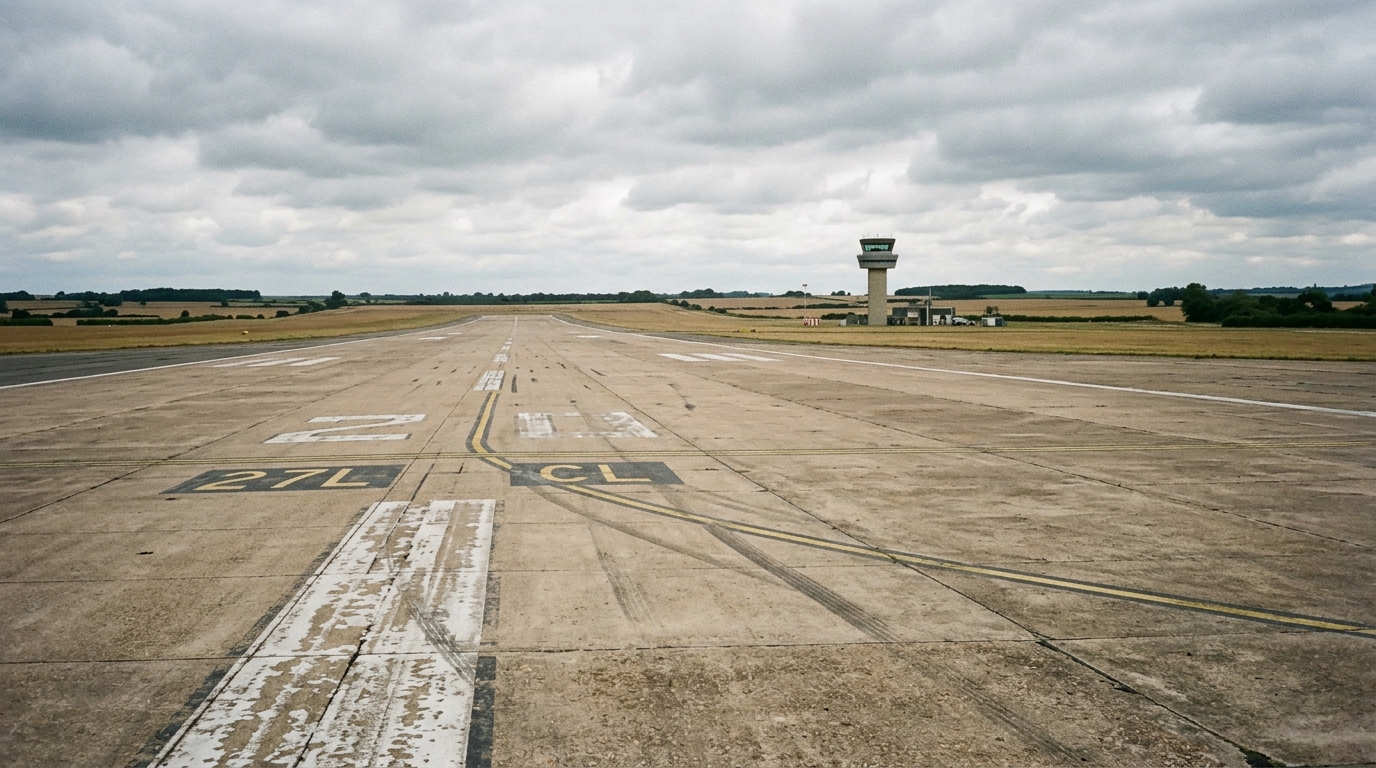
Imagine a brand-new airport, built at great expense, with a vast hall capable of hosting hundreds of seats each evening, and which ultimately sees only a handful of customers per day. It would be an economic fiasco hard to justify. Yet this is precisely the scenario that Vatry airport has endured for more than two decades, planted in the heart of the Marne’s agricultural plains. Supposed to become a major logistics and tourist hub for the Grand Est, it has over the years transformed into a symbol of a missed bet, swallowing substantial public money for passenger traffic that remains, today, derisory. A recent report has just lifted the veil on the true scale of this financial abyss, and the numbers are dizzying.
- Vatry airport cost nearly 422 million euros of public money between 1992 and 2023, according to the Grand Est regional chamber of accounts
- Between 2016 and 2023, Vatry, Metz-Nancy Lorraine and Strasbourg-Entzheim together received 129.2 million euros in public subsidies without achieving financial balance
- The scheduled end in April 2027 of the European framework authorizing state aid threatens Vatry’s survival, deemed among the most vulnerable by 2030 horizon
- An airport born of an overambitious dream amid the sugar beets
- 422 million euros swallowed: the dizzying bill highlighted by the regional audit court
- 60,000 passengers per year: the mirage of traffic that never takes off
- Vatry, emblem of a public funding abyss with no end in sight
An airport born of an overambitious dream amid sugar beets
Back to the early 1990s. The Champagne-Ardenne region, convinced of the potential of its territory, decides to equip itself with airport infrastructure capable of rivaling the major national hubs. The idea is appealing on paper: to leverage a strategic location near major road arteries to develop both air freight and passenger transport. Thus is born Paris-Vatry Airport, in the heart of the Marne’s sugar beet and grain fields, far from any major urban center.
From the outset, the project displayed ambitions that seemed detached from the realities of the local market. One imagines regular connections, interest from low-cost carriers, and substantial cargo traffic. The reality would prove far more modest. If a few carriers did indeed attempt the venture over the years, none managed to establish a durable activity sufficient to make the colossal infrastructures profitable. The airport, designed for much larger flows, ended up operating well below its theoretical capacity, year after year.
422 million euros swallowed: the dizzying bill highlighted by the regional audit court
It is a report from the Grand Est regional chamber of accounts (CRC), released in the spring, that put precise figures on this financial drift. According to this document, prepared at the request of the Regional Council, Vatry airport cost nearly 422 million euros from 1992 to 2023, in constant euros. A figure that makes one dizzy when viewed in relation to the platform’s actual activity.
This amount breaks down into two major envelopes: 240 million euros devoted solely to building the infrastructures, and 182 million euros disbursed as financial subsidies by local authorities, whether for investment or operating support. In other words, it was not only necessary to build the airport: year after year, it had to be kept artificially under financial lifelines to keep it simply existing.
The CRC report did not limit itself to Vatry. The study also covered two other Grand Est platforms, Metz-Nancy Lorraine and Strasbourg-Entzheim. Between 2016 and 2023, these three airports together received 129.2 million euros in public subsidies, of which 59.8 million euros were for Vatry alone. The conclusion of the financial magistrates is unequivocal: none of the three airports reaches financial balance, and all survive solely thanks to regular injections of public aid.
60,000 passengers per year: the mirage of a traffic that never takes off
To measure the gap between initial ambitions and reality on the ground, one figure suffices: in 2023, Vatry airport welcomed only 60,000 passengers. By comparison, some French regional airports see that number of travelers in just a few days. For an infrastructure designed to attract far larger flows, this result illustrates commercial activity that has remained hopelessly anemic since the facility opened.
The CRC explicitly points to this persistent weakness of commercial activity as the main explanation for Vatry’s financial imbalance, just as for Metz-Nancy Lorraine. Attempts to develop regular routes, partnerships with airlines, or diversification into freight never managed to reverse the trend sustainably. Result: the airport’s economic impact, in terms of wealth creation and jobs on the territory, is judged broadly modest by the report’s authors, a harsh finding after more than twenty years of existence and hundreds of millions of euros invested.
Vatry, emblem of a public funding abyss with no end in sight
The most troubling, for Vatry’s future, may lie not in its past but in the mid-term prospects. The CRC indeed mentions the planned end, in April 2027, of the European legal framework that currently authorizes state aid for small regional airports. This rule change, decided at the European level, directly threatens the economic model on which the survival of facilities like Vatry depends, completely reliant on public subsidies to keep operating.
The report also outlines several forward-looking scenarios for each of the three airports studied, projected to 2030. Not surprisingly, Vatry and Metz-Nancy Lorraine are identified as the most at risk, far more exposed than Strasbourg-Entzheim, whose activity remains comparatively more robust. A difficult question then arises for local elected officials: should public money continue to be poured into an infrastructure that never found its audience, or accept, after more than twenty years of effort, that the initial gamble simply did not work?
Beyond the Vatry case, this affair raises a broader question about how large publicly funded infrastructure projects are decided and evaluated. Between legitimate regional ambitions and ruthless economic realities, the story of this Marne airport reminds us that a project can linger for decades, suspended between two worlds: too costly to abandon, too little used to justify. The question remains whether the coming years will finally provide a clear answer to this dilemma, or whether Vatry will continue to fly, barely, above the fields of the Marne.
