
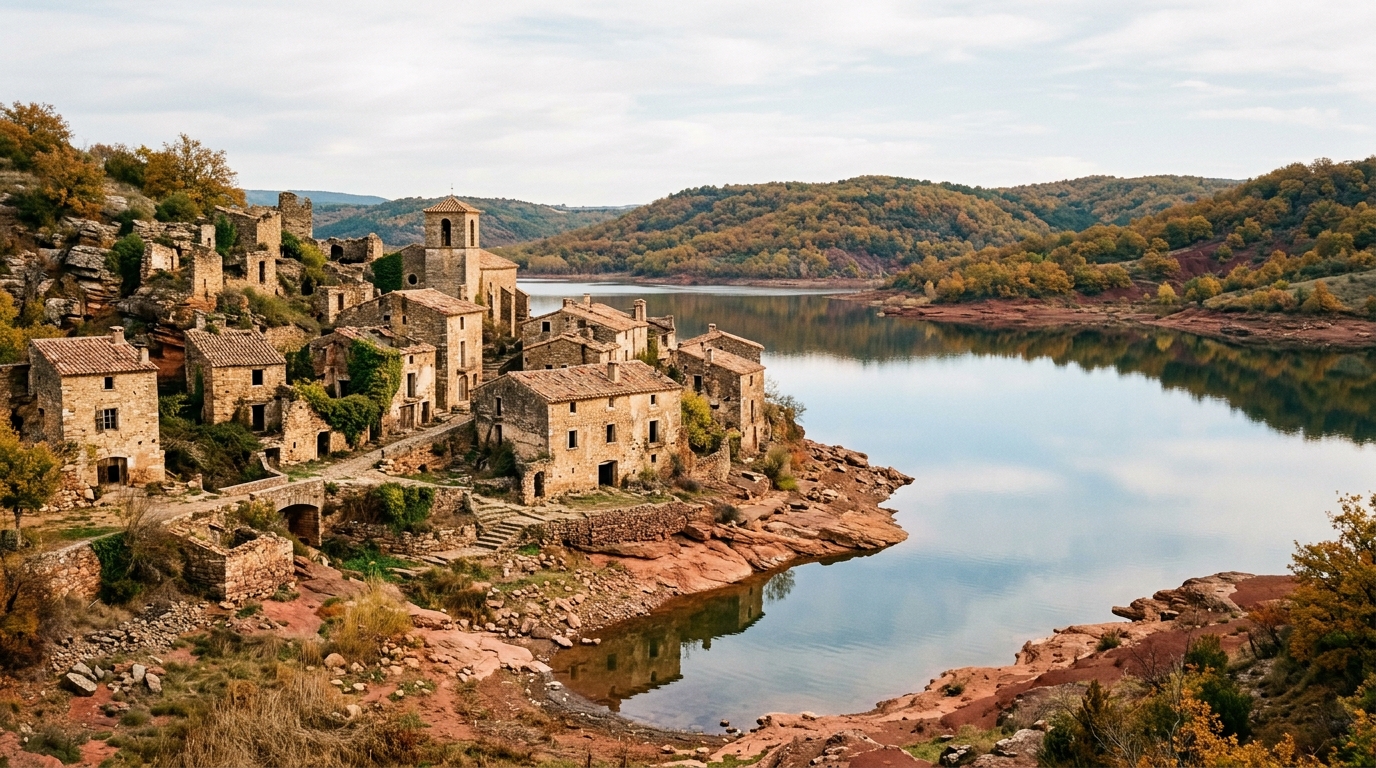
Imagine a village with cobbled lanes, with houses of volcanic stone still standing, yet utterly empty of life for more than fifty years. No war, no natural disaster, no epidemic. Just an administrative decision, taken in the name of progress, that drove its inhabitants away for a lake that, in the end, never drowned them. This is the little-known story of Celles, a small hamlet in the Hérault sacrificed on the altar of a dam, and whose fate tips due to a simple discrepancy of a few metres between a paper project and the reality on the ground.
- The 80 inhabitants of Celles were expropriated in 1959 for a lake deemed inevitable to fill.
- In 1996, the operating level was set at 139 metres, while the village sits between 143 and 144 metres, leaving it dry.
- Joëlle Goudal has, since 1995, carried a plan for an eco-village intended to revive Celles for about twenty families.
- A Dam to Tame a Capricious River
- Celles, a Village Sacrificed on Paper
- 139 Metres, the Level That Changed Everything
- A Village That Refuses to Die Completely
A Dam to Tame a Capricious River
The Salagou was no model of placidity. For decades, its sudden floods ravaged the valley’s farmland, destroying crops and infrastructure according to the whims of the Mediterranean climate. In the 1960s, authorities decided to act: this unpredictable river had to be tamed, and irrigation for surrounding crops secured with a major engineering feat.
Work began in 1964 and finished at the close of the decade. A colossal concrete wall, 357 metres long and 60 metres high, barred the river to form an artificial lake intended to store water. At the time, the project was hailed as a real technical achievement. Yet almost no one grasped what it would mean for the people living just upstream.
Behind the hydraulic calculations and the engineers’ plans, there lay a real village: Celles. Nestled in the heart of the valley, it sat squarely in the area slated to be swallowed by the lake’s future waters. The authorities decided without hesitation: the village would disappear, and its inhabitants would leave.
Celles, a Village Sacrificed on Paper
From the late 1950s onward, the administrative machine was set in motion. In 1959, a public utility declaration was issued, and the eighty villagers of Celles, mostly farmers who had lived off the land for generations, were ordered to depart. Houses, businesses, the church: everything had to be evacuated before the dam’s water rise was scheduled.
The expropriation took place amid hardship. Some refused to leave for a long time, clinging to what they could, others finally negotiated compensation deemed petty in light of what they abandoned. Little by little, the village emptied, shutters were closed one by one, and the last inhabitants turned their backs on their homes with the bitter sense of leaving their village for a cause that exceeded them. In just a few years, Celles became a “dead village,” abandoned to its fate and believed at the time to be doomed to definitive submersion.
Yet a technical detail would upend this pre-scripted scenario. The lake’s level never rose as high as planned in the initial diagrams. Instead of reaching the fateful 150-metre mark, the operating level stabilized much lower, leaving Celles’ houses largely above water.
139 Metres, the Level That Changed Everything
That figure, 139 metres, officially adopted in 1996, would literally alter the village’s destiny. Built at a slightly higher altitude, between 143 and 144 metres depending on the readings, Celles’ homes would never be submerged by the Salagou’s waters. The lake forms indeed, expanding over roughly 700 to 750 hectares with an impressive volume of about 102 million cubic metres, but it stops abruptly at the village’s doorstep, leaving the stones dry and intact.
The paradox is total: an entire village forcibly emptied for a lake that, in the end, spares it physically. The roofs stay standing, the narrow lanes remain paved, but no one lives there officially. Celles becomes a unique case in France, a ghost village not destroyed by water but by an administrative decision that has grown obsolete with time’s passing. Left for years to its own devices, sometimes squatted and later eroded into ruins by wind and time, the hamlet still bears the marks of this prolonged abandonment.
A Village That Refuses to Die Completely
In this autumn season, as Lake Salagou takes on ochre tones and visitors thin out, Celles nevertheless continues to attract the curious and photographers drawn to its atmosphere frozen in time, between volcanic stones and tranquil waters. A few owners are attempting to restore buildings at their own expense, and occasional events are held in this extraordinary setting.
For decades, it has been Joëlle Goudal who has carried the cause of reviving the village. She took over leadership of Celles after her father, Henri Goudal, in 1995, and has tirelessly campaigned to resurrect the hamlet from its administrative ashes. The current project envisions an eco-hamlet, designed to eventually welcome around twenty families with housing, workshops, a micro-farm, and shared spaces. A way to turn an hydraulic miscalculation into an opportunity to live anew, far from the logic that had condemned the village fifty years earlier.
The story of Celles remains marked by this cruel irony: expropriated for nothing, or almost, by a few metres. A village sacrificed in advance, then left standing by the chance of an underestimated water level. Today, between restored ruins and future plans, Celles perhaps tells better than any other place how administration shapes — sometimes wrongly — the fate of entire communities. And if this village suspended between the past and a renaissance were, in the end, the symbol of a second chance?
