
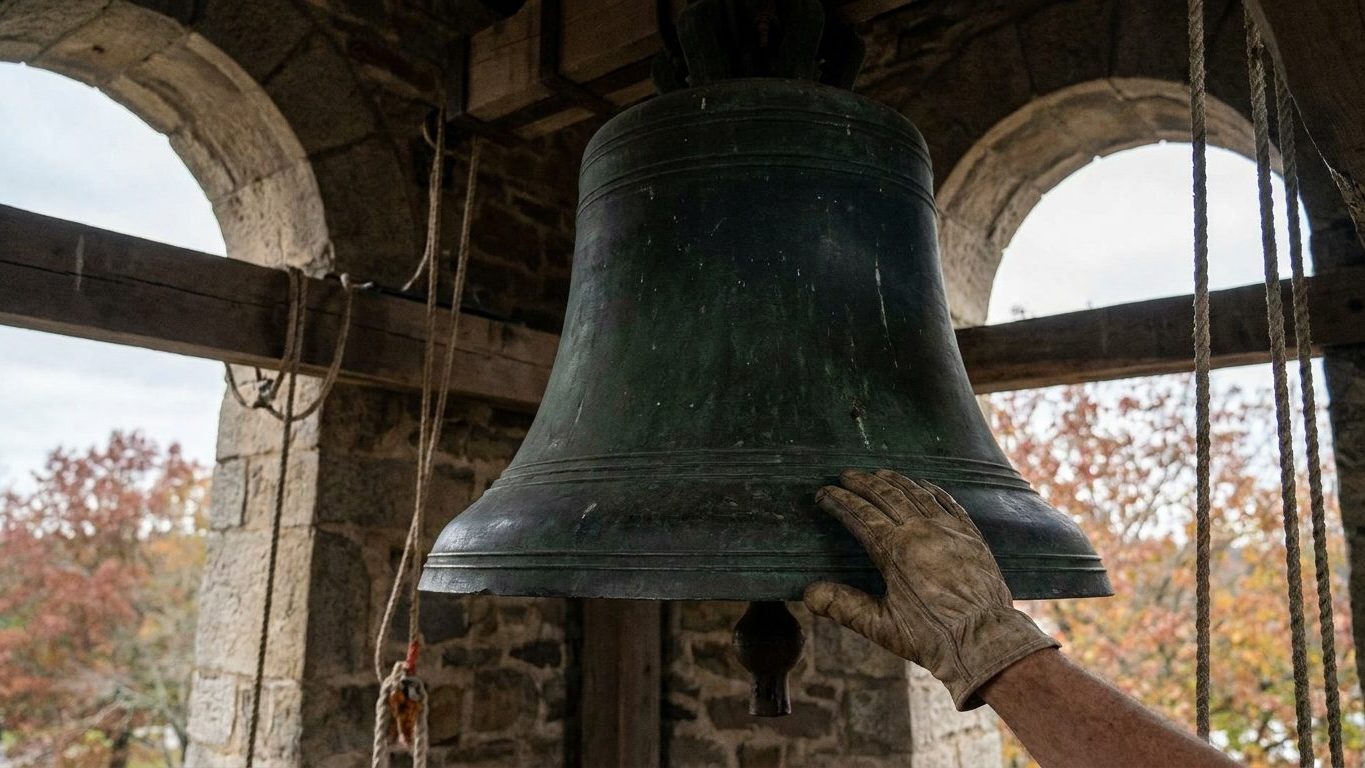
The Savoyarde weighs 18,835 kilograms, almost three elephants, and it has hung in the Sacré-Cœur’s bell tower since the early 20th century. To hoist it up Montmartre hill in October 1895, a team of 28 horses was required. The Paccard foundry, as well as the City of Paris, regard it as the largest bell in France, indeed the heaviest to boot.
Three meters in diameter, precisely 3.03 m.
- The Savoyarde weighs 18,835 kg and measures 3.03 m in diameter.
- It was cast at Annecy-le-Vieux in May 1891, offered by Savoy.
- Its ascent to Montmartre required 28 horses and about a hundred workers.
- It has been listed as a historic monument since June 18, 1999.
A bell offered by Savoy, cast at Annecy-le-Vieux
All begins in Chambéry. It was the archbishop of the city, Mgr Leuillieux, who conceived the idea of equipping the Paris basilica with an exceptional bell, financed by Savoy rather than through a national subscription. The contract was signed with the Paccard brothers, founders at Annecy-le-Vieux, on October 17, 1889.
The casting took place on May 13, 1891. The bronze that emerges from the mold measures 3.03 m in diameter and 9.60 m in circumference, numbers barely conceivable when you consider that the ceiling of a typical apartment tops around 2.50 m. The clapper, the piece that strikes the wall, weighs 850 kg by itself, almost a ton. As for the yoke, the beam that carries it weighs 4,650 kg, enough to match nearly four city cars.
Add them up and the moving mass reaches 25,765 kg. It is this figure, not the 18,835 kg of the bare bell, that describes what the belfry must truly bear when the Savoyarde is raised.
The nickname comes from there, obviously: Savoy offered it, Paris hoisted it. The baptismal name, however longer and far less known, is “Françoise-Marguerite du Sacré-Cœur.” It received it on November 20, 1895, a little over a month after its arrival on the hill.
Four in the morning, 28 horses and torches
The most precise account of the ascent comes from a Dutch periodical of 1895, now digitized in the DBNL library. The departure is at 4 a.m. Twenty-eight horses are hitched to the cart that carries the bell, and about a hundred workers accompany it with torches and lanterns. The convoy reaches the hill after six hours.
A hundred men lit the way in the midst of darkness.
Let’s do the calculation, without claiming the precision of an engineer: 18,835 kg spread over 28 horses gives about 670 kg to pull per animal. And this figure does not count the cart, nor the slope. Montmartre’s incline spares no mercy to heavy draughts, even today for cyclists climbing it empty.
On the date, a note of caution. Several secondary sources, including Paris Zigzag, place the arrival on October 16, 1895 and confirm the 28-horse team. The 1895 periodical, however, only gives the time, not the day.
One reads here and there of 25-horse teams according to contemporary accounts. The figure of 28 is the one retained by the most solid sources, and it is the one that has remained in the neighborhood’s memory.
Installed, housed, listed
Was the bell mounted in the belfry already in 1895? Not immediately. Paccard indicates a definitive installation in 1898, the City of Paris speaks of 1907. The two dates do not agree, which allows only to affirm that it has been in place in the belfry since the early 20th century.
In 1947, it had to be reinstalled. The Savoyarde exerted excessive pressure on the belfry, the framework that carries it, and its mounting was thus altered. A bell of this size does not merely ring: it shakes its own timberwork with every toll.
On June 18, 1999, it was listed as a historic monument. Paccard, who cast it, still presents it as the largest bell in France more than a century after its casting.
The most recent project concerns its ringing mechanisms. According to the City of Paris, on a page updated December 10, 2025, the two ringing wheels and the steel components are undergoing a full restoration. The re-laying of the clapper—i.e., the bell’s return to motion—had been announced for Easter. I have not found confirmation that this return has actually taken place, so it is best to check the basilica’s or the City’s announcements before counting on its tone.
A final vocabulary detail clarifies all these numbers. When we speak of the 18,835 kg of the Savoyarde, we are talking about the bronze alone. Add the 850 kg clapper and the 4,650 kg yoke, and the moving mass rises to 25,765 kg, enough to explain why the belfry had to be accommodated starting in 1947.
Sources: sacre-coeur-montmartre.com | paccard.com
