
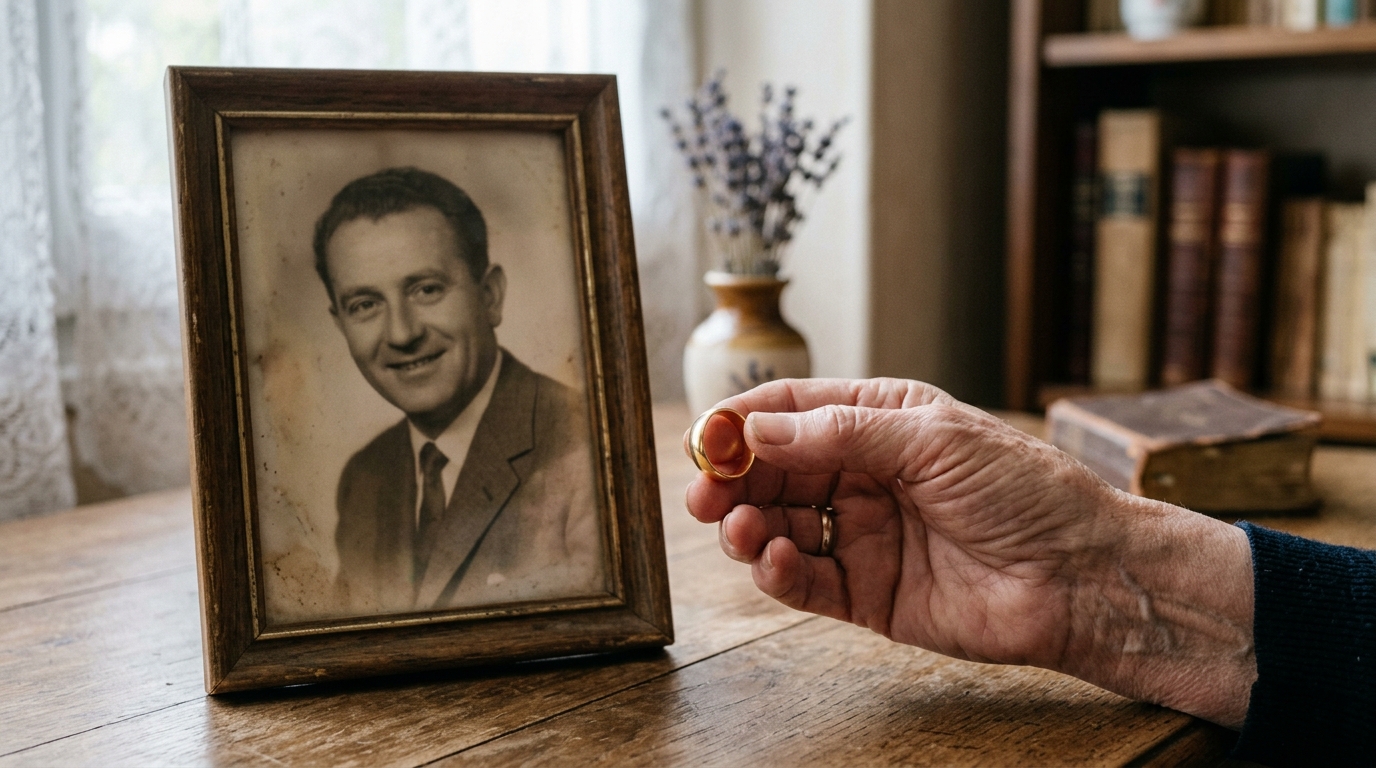
Marrying a deceased person is not urban legend, nor a practice imported from a distant land: it is a legal, French reality, perfectly lawful, yet largely unknown to the vast majority of citizens. Each year, dozens of grieving families knock on the doors of the Élysée to request an exceptional favor, namely to unite in marriage a living person with someone who has died. A discreet provision of the Civil Code makes this possible, and its origin goes back to one of the worst disasters France experienced in the twentieth century.
- The article 171 of the Civil Code, born after the Malpasset dam catastrophe in 1959, authorizes posthumous marriage subject to a personal authorization by the President of the Republic.
- The procedure requires proving the deceased’s consent to the marriage before their death, through a bundle of indicators since the 2011 relaxation.
- This marriage confers the status of widow or widower and entitles the survivor to a survivor’s pension, but it does not entail any rights of succession nor a matrimonial regime.
- The posthumous marriage, a little-known French civil-law exception
- 1959, the Malpasset Dam break and the birth of Article 171
- Presidential accord, solid dossier: how this extraordinary procedure unfolds
- Love, paternity, inheritance: what this beyond-the-tomb marriage really changes
The posthumous marriage, a little-known French exception in civil law
French law is full of surprising provisions, but few provoke as much astonishment as this one. Article 171 of the Civil Code authorizes, under certain circumstances, the celebration of a marriage when one of the future spouses is already deceased. Far from being a mere legal curiosity that has fallen into disuse, this provision is indeed active and requested every year. According to available estimates, roughly fifty posthumous marriages are actually celebrated annually, while another source mentions up to a hundred filings on this basis.
This mechanism is not trivial: it allows a person to officially bear the title of husband or wife, and no longer merely that of a bereaved partner. A strong symbolic recognition, but one that follows very strict rules, because it is certainly not a run-of-the-mill marriage.
1959, the Malpasset Dam break and the birth of Article 171
To understand the origin of this law, one must go back to a tragic December night in 1959. The Malpasset Dam, located near Fréjus in the Var, suddenly failed, unleashing millions of cubic meters of water onto the sleeping town in a matter of minutes. The human toll was severe, and among the victims were several people who were about to marry, sometimes even pregnant with their fiancé who was swept away by the catastrophe.
It was in this harrowing context that the legislator acted with urgency. A text was specially designed and enacted on January 8, 1960, to allow surviving fiancés to legitimize their union and, at the same time, to legitimize the child to be born in the eyes of the law. The first posthumous marriage in French history was celebrated in August 1960 at the Fréjus town hall, uniting Irène Jodar with her fiancé André Capra, carried away by the waters a few months earlier. This founding story perfectly illustrates the original spirit of the law: to offer symbolic and administrative redress in the face of a collective tragedy.
Presidential accord, solid dossier: how this extraordinary procedure unfolds
Unlike a standard marriage celebrated in a town hall with a simple filing, the posthumous union requires the personal blessing of the head of state. Article 171 specifies that the President of the Republic may, for grave reasons, authorize the celebration of the marriage, provided that a sufficient accumulation of facts unmistakably establishes the deceased’s consent to this union before death.
This formulation long posed difficulties. Before a reform in 2011, one had to prove that official steps had already been taken, such as the publication of bans or a marriage file filed at the town hall. Since this liberalization, it suffices to demonstrate, by a convincing bundle of indicators, that the matrimonial project truly existed: exchanged messages, testimonies from relatives, preparations started. The final decision remains a discretionary and sovereign power of the President, who reviews each file on a case-by-case basis, with no obligation to justify a refusal. Another notable development: the 2013 law opening marriage to same-sex couples made it possible for the first time for a posthumous marriage to unite two men, thereby broadening the scope of this historic mechanism.
Love, paternity, inheritance: what this beyond-the-tomb marriage actually changes
Once presidential authorization is granted, the town hall proceeds to the ceremony, and the legal effects are immediate: the surviving person instantly acquires the status of widow or widower. This detail is far from incidental, since it can, in some cases, entitle them to a survivor’s pension, and above all, it provides official recognition of the emotional bond that linked the two individuals.
However, beware not to misjudge the patrimonial scope of this particular marriage. The Civil Code is clear on this point: no rights of intestate succession arise for the surviving spouse, and no matrimonial regime is deemed to have existed between the two. In plain terms, this marriage has no automatic financial or inheritance consequences. It is primarily a symbolic and moral act, a way for French law to acknowledge a love interrupted by fate, without disrupting the patrimonial balance of the existing heirs.
Behind this rare provision lies a true philosophy of law: one that leaves a space, even a tiny one, for the recognition of feelings in the face of the irreversibility of death. A text born from the pain of a catastrophe, which over the decades has become a discreet yet living symbol of the French legal system’s ability to adapt to the most intimate tragedies. Food for thought the next time one believes they have explored every corner of the Civil Code.
