
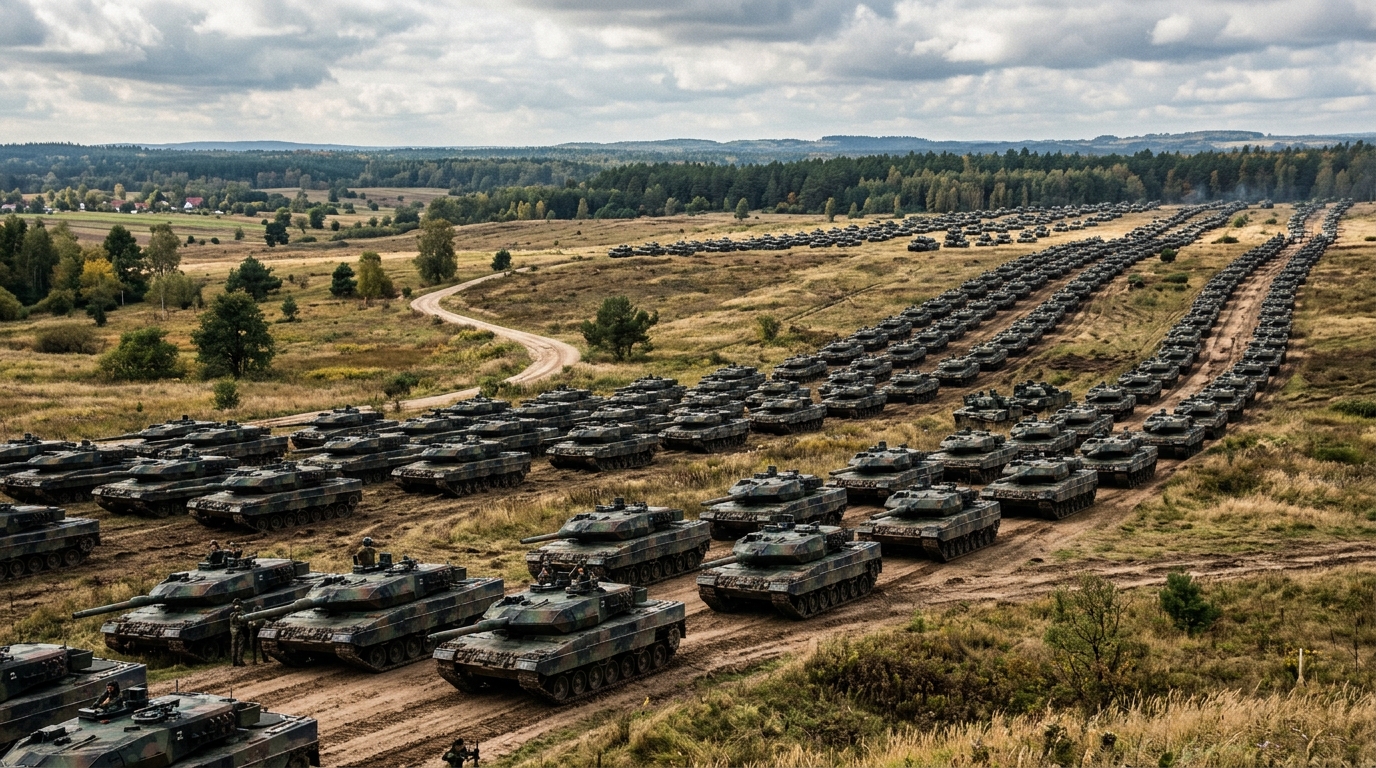
No atomic bomb, but an army of iron. Poland has chosen another form of deterrence against Russia: accumulating tanks at a pace Europe hadn’t seen since the Cold War. By 2030, Warsaw would field more armored vehicles than Germany, Italy, the United Kingdom, and France combined.
- The Poland targets 1,100 tanks by 2030 and 1,600 by 2032, up from a little under 800 in 2024
- Poland will devote 4.7% of its GDP to defense in 2025, a level well above its European neighbors
- This reinforcement rests on purchase contracts for American M1 Abrams tanks and South Korean K2 tanks
- 1,600 tanks by 2032: Poland aims for an unprecedented Cold War-era record
- More armored vehicles than Berlin, Paris, Rome and London combined
- Abrams, K2: the contract race that is swelling Poland’s fleet
1,600 Tanks by 2032: Poland Aims for an Unprecedented Cold War–Era Record
The figures are dizzying. Poland counted just under 800 tanks in 2024. It now targets 1,100 units by 2030, then 1,600 by 2032, roughly double its current fleet.
To finance this buildup, the country will devote 4.7% of its GDP to defense in 2025. This level of investment is well above that of its European neighbors, signaling a clear ambition: to become the leading land force on the continent.
Amélie Zima, a specialist in European and transatlantic security at IFRI, describes these volumes as unprecedented since the end of the Cold War. A formulation that nicely captures the scale of change taking place in Eastern Europe.
Only Greece and Turkey currently have more tanks than Poland.
More armored vehicles than Berlin, Paris, Rome and London combined
To gauge the scale of the phenomenon, it suffices to compare national fleets. France fields 225 Leclerc tanks, the United Kingdom around 300 Challenger 2s. These figures appear modest next to Polish ambitions.
By adding Germany, Italy, the United Kingdom, and France’s tanks, the total comes to 950 units. By 2030, Poland would surpass, on its own, the sum of the armored forces of these four major European powers.
This shift illustrates a change in paradigm. For decades, Western major armies have relied on quality and versatility rather than mass. Poland, by contrast, bets on quantity as the security guarantee.
Abrams, K2: the contract race that is swelling Poland’s fleet
This buildup of armored vehicles does not come out of nowhere. Poland has been signing tank purchase contracts for several years, notably with the United States for M1 Abrams and with South Korea for K2 tanks.
This diversification of contracts accompanies the rapid growth of the Polish fleet.
The stated objective remains the same: to build a force sufficiently deterrent to discourage any attempt at a Russian invasion. In the absence of nuclear deterrence, Poland relies on a massive and visible conventional deterrent.
This Polish choice raises questions about the future of European defense. While some rely on cutting-edge technology in small quantities, others bet on sheer numbers. It remains to be seen which of these strategies will prevail amid persistent tensions in the eastern part of the continent.
