
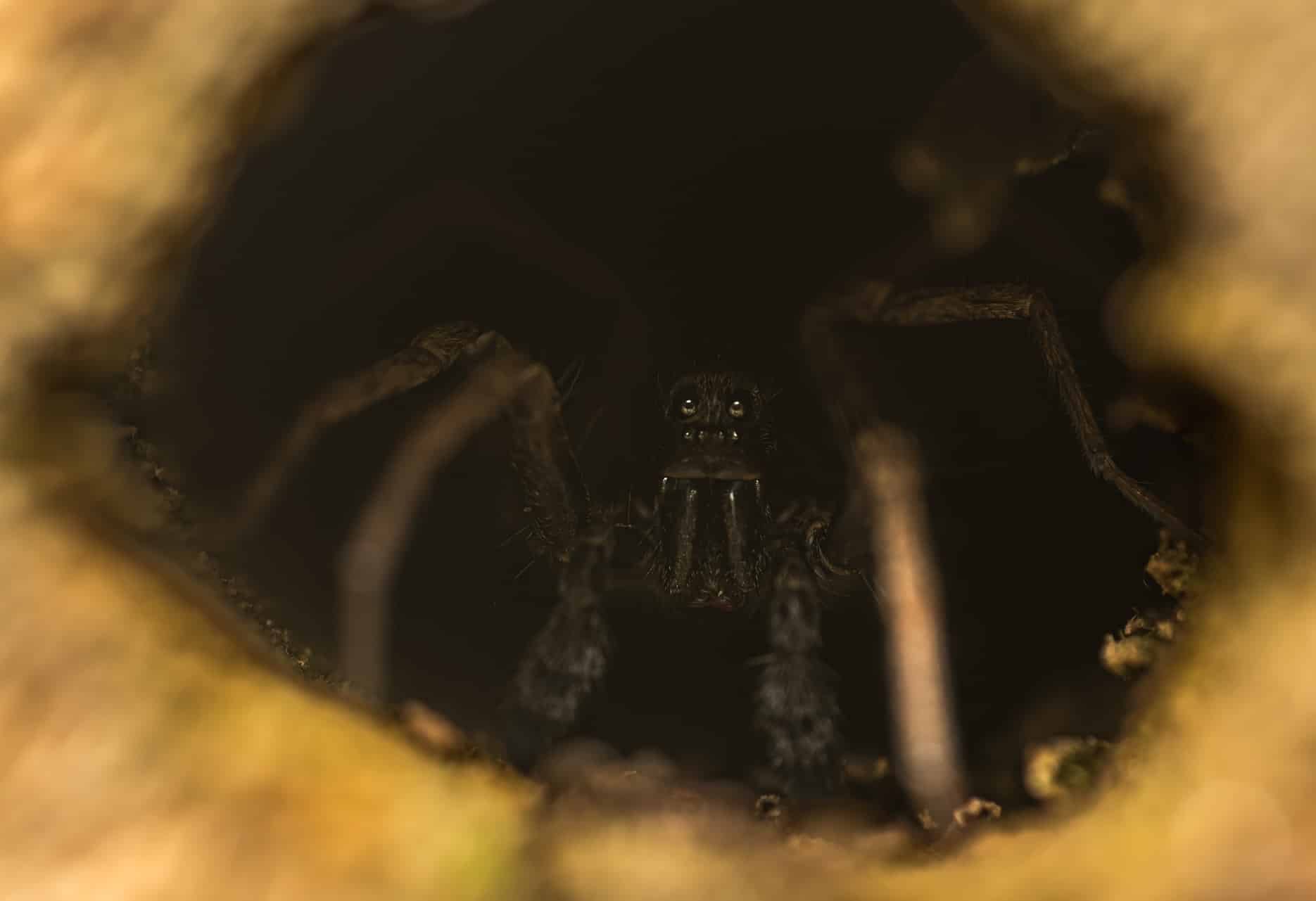
According to traditional phylogeny, the largest arachnid of all time is probably a scorpion, not a spider. However, relatively recent work suggests we should reassess the evolutionary relationships of chelicerates. In this scenario, the largest arachnid to have ever lived was likely far larger than you.
Arachnids are a class of chelicerate arthropods. This group includes, among others, spiders, scorpions, mites and harvestmen. However, the question remains open.
Officially, chelicerates are indeed subdivided into smaller groups, with arachnids forming one group, while the horseshoe crabs (order Xiphosura) and sea scorpions (order Eurypterida) constitute two other groups. This is the phylogeny traditionally accepted. Yet, a published article suggests that the latter two groups could, in fact, be nested within the arachnids.
In detail, this new phylogeny, based on molecular analysis, emphasizes that the terrestrial chelicerate groups (spiders and scorpions) preceded the marine groups (horseshoe crabs and sea scorpions). However, although this claim is supported by genetic evidence, it is at present incompatible with the fossil record.
The Largest Living and Extinct Arachnid
Under the traditional view of the arachnid family tree (ignoring the horseshoe crabs and sea scorpions), the largest living arachnid is a spider.
There are two contenders. The Goliath birdeater (Theraphosa blondi) is regarded as the most massive. Together, the cephalothorax and the opisthosoma (the body excluding the legs) can measure up to twelve centimeters. Add the legs, and you reach a total leg span of about 28 cm with a weight of around 170 grams on the scale.
However, if one considers only size, the largest spider could be Heteropoda maxima, a Sparassidae species. Endemic to Khammouane Province in Laos, it has a leg span of roughly 30 cm. Despite its size, this spider was discovered only in 2001.
When we dive into the fossil records, we find that, by the logic of the accepted phylogeny, the largest arachnid ever discovered was probably not an arachnid at all, but a scorpion. Brontoscorpio anglicus, which lived during the Silurian-Devonian period (between 350 and 450 million years ago), could indeed reach nearly a meter in length. It should be noted, however, that the sole known specimen of this species was described from a single free finger, namely the pedipalp on the right side (one of the two blades of its right pincer, visible below).
Sea Scorpions Larger than Humans
If we now take into account sea scorpions and horseshoe crabs, the largest living arachnid is no longer a spider, but rather a horseshoe crab. According to a 2017 study in the Journal of Asia-Pacific Biodiversity, the largest living species, Tachypleus tridentatus, can indeed reach a length of nearly 80 cm.
If we now consider the entire fossil record, the title would probably belong to a member of the eurypterids, the sea scorpions that are now extinct. Indeed, fossils suggest that many of these ancient marine predators would rival humans in size. The largest species of this group was Jaekelopterus rhenaniae, a species discovered in 2007 whose claws measured up to 46 cm in length. From these claws, researchers estimated that its body length was approximately 2.5 meters.
