
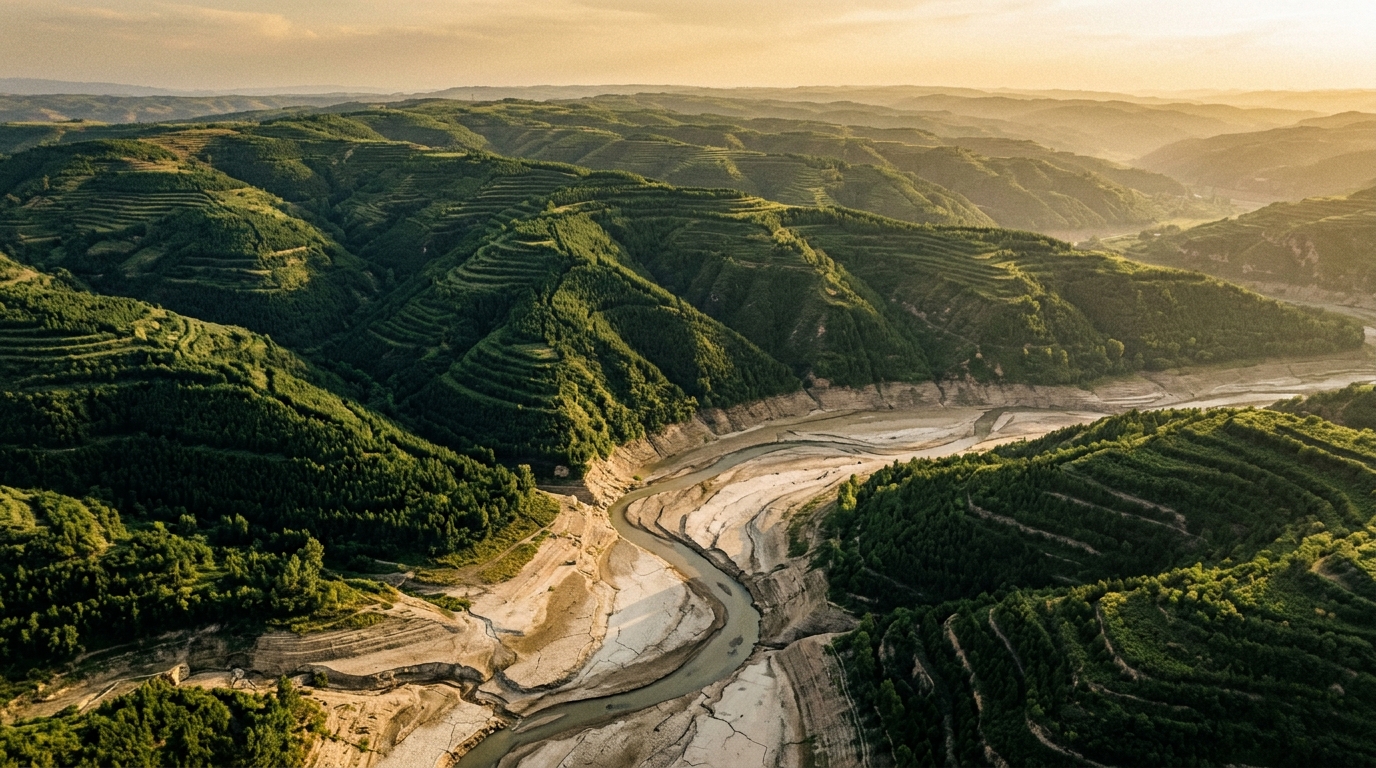
Imagine a country that decides to plant trees on an area the size of the United Kingdom, solely to keep its hills from sliding down under the rain. This is precisely what China embarked on since the late 1990s, with a reforestation program of unprecedented scale. On paper, the operation reads like an ecological success story: slopes once bare and gullied have been clothed in green, erosion has retreated, the Loess Plateau’s landscapes have literally changed their appearance. Yet, when you look closer, in this era when water resource management is increasingly discussed worldwide, a more troubling reality emerges: this providential forest has a voracious appetite for water, and the entire north of the country pays a quiet price for it.
- Launched in 1999 after devastating floods, the Grain for Green program converted farmland into forests to combat soil erosion on the Loess Plateau.
- The trees, endowed with deep roots and dense foliage, consume far more water through evapotranspiration than the crops they replace, reducing blue water resources available for human use.
- Several major northern Chinese river basins, including the Yellow River, the Haihe and the Liaohe, have seen their discharge significantly decline since the 2000s.
- A program designed to save the land, not the water
- Trees that drink more than they retain
- Northern China, the silent major loser of reforestation
- What Grain for Green reveals about the limits of mass reforestation
A program designed to save the land, not the water
It all begins in the late 1990s, when catastrophic floods hit China and spread destruction along its major rivers. Officials quickly blame a culprit: widespread deforestation in the upper and middle reaches of the river basins, which had deprived soils of their natural ability to hold water. In response to this assessment, the government launched in 1999 the Grain for Green program, literally “grains for greenery,” whose objective is simple on paper: convert farmland into forests or pasture to stabilize soils and curb erosion.
The project started softly, as a pilot, in three ecologically fragile provinces: Sichuan, Shaanxi and Gansu. The success of this pilot convinced Beijing to greatly widen the scope: from 2002 onward, twenty-two more provinces joined the movement. In a few years, China thus launched one of the largest reforestation campaigns ever undertaken on the planet, with a clearly stated aim: to tame the erosion threatening farmland and downstream infrastructure.
Trees that drink more than they retain
Geologically speaking, the bet was won. After more than two decades of vegetation restoration, soil erosion linked to poor farming practices has markedly receded on the Loess Plateau, and the region’s ecological environment has visibly improved. Satellite images confirm the change: where once yellowish, cracked soils dominated, today green forested masses stretch across the landscape.
But here lies the downside, often left out of official narratives: a forest, hydrologically speaking, is not the same as a field of cereals or a natural prairie. Trees possess far deeper root systems and much denser foliage, which drives them to consume significantly more water than the crops or grasses they replace. This phenomenon, evapotranspiration, corresponds to the amount of water a plant draws from the soil and then releases into the atmosphere as vapor. The denser and more developed the vegetation, the greater the withdrawal. In other words, by replacing fields with forests, China did more than alter the landscape: it deeply transformed the water cycle of entire regions.
Northern China, the silent major loser of reforestation
The clearest manifestation of this shift appears in the Yanhe River basin, in Shaanxi province. Analyses show that the land-use change driven by Grain for Green led to a measurable decline in blue water resources—that is, the water in rivers, lakes and groundwater directly available for human use. At the same time, green water, the water absorbed by soils and plants, increased. This shift might seem minor on paper, but it takes on a much different dimension when one realises that this basin already faces acute water scarcity and an extremely fragile ecological environment.
This is not an isolated case. Since the 2000s, with the broad expansion of vegetation cover across China, several major river basins have recorded a substantial drop in flow: the Haihe, the Liaohe, the Songhua Jiang, the Hanjiang, and even the legendary Yellow River, the cradle of Chinese civilization. The revelation behind this environmental success story is thus clear: Grain for Green has increased evapotranspiration and decreased the north’s water resources. A striking paradox for a program initially designed to protect the country’s natural resources.
What Grain for Green reveals about the limits of mass reforestation
Faced with these emerging imbalances, Beijing did not hesitate for long to pull the brakes. In 2004, after converting nine million hectares, the government reassessed its ambitions, this time out of concern for the country’s food security. Converting too much agricultural land into forests also reduces the areas available to feed a population of over a billion people. As a result, by the end of 2013, the total area converted under the program stood at about 9.26 million hectares, a figure below the initial target, but one that nevertheless contributed significantly to ecological restoration in certain regions and to the reduction of rural poverty.
This jagged trajectory offers a valuable lesson that transcends China’s borders: planting trees is never a neutral act. Poorly calibrated reforestation can solve one problem while creating another, sometimes just as serious. The fight against soil erosion and the preservation of water resources do not always follow the same logic, and policymakers must negotiate complex trade-offs, where every technical solution entails difficult-to- anticipate compromises.
Grain for Green thus reminds us that nature cannot be steered by simple decrees. It invites rethinking large-scale reforestation projects around the world with greater nuance, taking into account not only the area planted but also the type of vegetation chosen and its real impact on the local water cycle. At a moment when many countries, including France, are expanding reforestation to combat climate change, this Chinese example raises a crucial question: is the best way to protect our natural resources not always to cover the earth with trees, but to choose the right tree, in the right place, for the right reason?
