
Imagine slot machines that, for no apparent reason, begin paying out winnings at an utterly abnormal pace, day after day, across several American casinos at once. No crooked croupier, no software hacked from inside the bank, nor even a visible flaw in the payment system: yet the money was indeed disappearing from the tills. This story, which unfolded between 2014 and 2015 in the United States, reads like a spy movie plot, but it is real. It highlights a fraud of rare sophistication, orchestrated from Russia, which long left American investigators puzzled until a technical detail, almost invisible, finally betrayed the entire network.
- A Russian mathematician nicknamed Alex cracked the algorithm of the pseudo-random number generators used by Aristocrat Mark VI slot machines, recovered after Russia’s partial casino ban in 2009
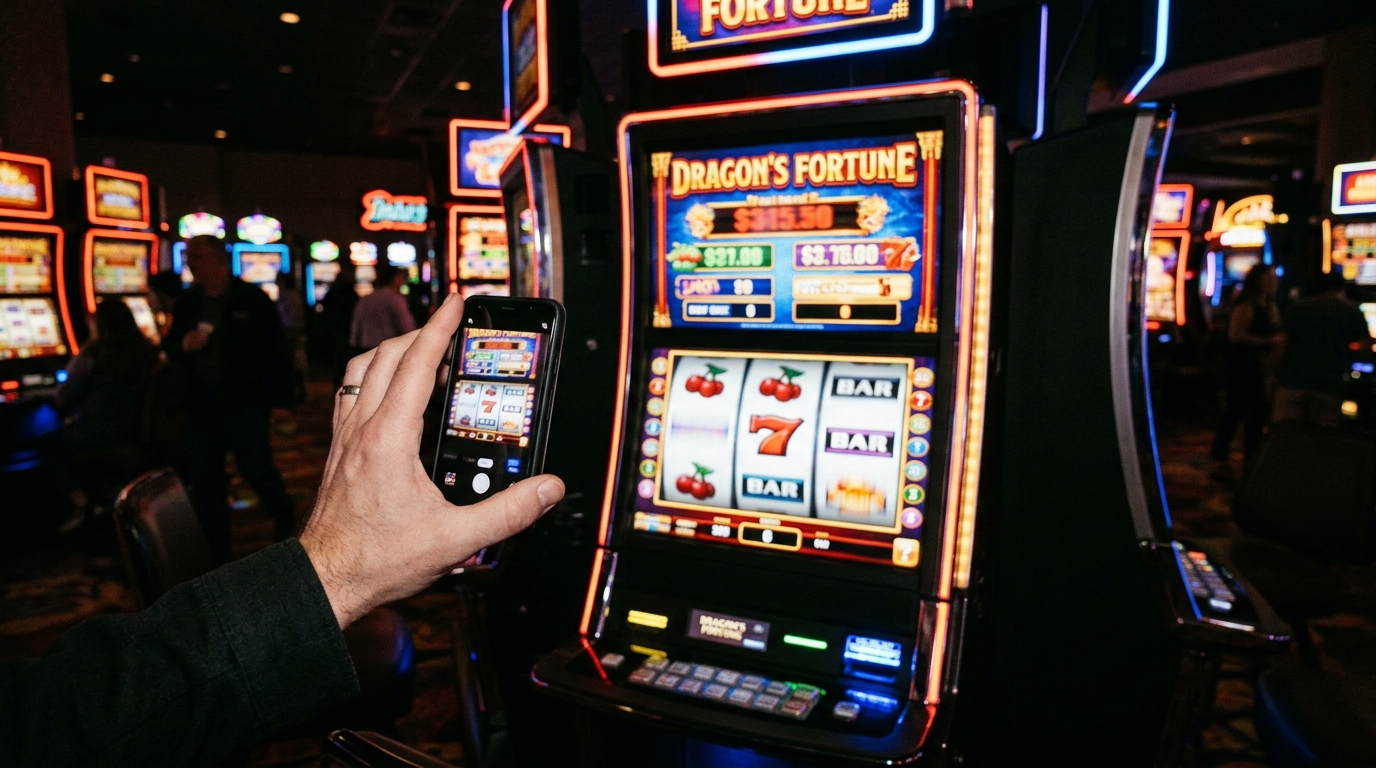
- Accomplices filmed the reels with a smartphone to relay the footage to a Russian server, which calculated the exact seed and sent back a vibratory signal indicating the precise moment to press the button
- It was a statistical anomaly (negative hold) spotted by the Lumiere Place accountants in June 2014, followed by video surveillance, which led to the identification of Murat Bliev and his accomplices, revealing a network of 40 to 70 members based in Saint Petersburg, active for nearly a decade
- Des casinos américains pillés méthodiquement, sans complice interne ni piratage bancaire
- Le mystère qui a mis le FBI en échec pendant des mois
- Quand un ingénieur russe transforme le hasard en science exacte
- Le smartphone, arme secrète des complices sur le terrain
- Ce que cette affaire révèle sur la fragilité du hasard numérique
Des casinos américains pillés méthodiquement, sans complice interne ni piratage bancaire
In several Missouri establishments, then gradually in other American states, managers began to notice a statistically improbable phenomenon: certain slot machines displayed what is known as a negative hold, meaning losses far exceeding what randomness should produce, without any major jackpot officially being declared. For a casino, this kind of anomaly is almost as alarming as a armed robbery, except that here, no one saw anything coming.
What made the affair even more troubling was that no trace of classic hacking was detectable. No intrusion into the banking servers, no malware installed on the machines, and above all no casino employee implicated in any scheme. The winnings seemed to come from nowhere, as if randomness itself had decided to cooperate with a group of especially lucky players.
Le mystère qui a mis le FBI en échec pendant des mois
Ultimately, it was the Lumiere Place casino’s accountants in St. Louis who sounded the alarm in June 2014, alerted by this anomaly judged highly improbable from a purely mathematical standpoint. The security team reviewed the surveillance footage and managed to spot a man with unusual behavior, repeatedly returning to the same machines with an attitude far too calm for a typical player.
This lead culminated in the arrest of Murat Bliev, quickly identified as one of the cogs in the operation, along with his accomplices Ivan Gudalov and Igor Larenov. A subsequent attempt in December 2014 at the Hollywood Casino in St. Louis confirmed that these arrests were not isolated, but rather the peak of a broader and more organized network operating across several U.S. states.
Quand un ingénieur russe transforme le hasard en science exacte
The origin of this fraud traces back to an unlikely context. In 2009, Russia partially banned casinos on its soil, triggering a mass resale of gaming equipment, including Aristocrat Mark VI slot machines. It was by acquiring this kind of equipment that a Russian mathematician and programmer, nicknamed Alex, could quietly study, away from prying eyes, the inner workings of the pseudo‑random number generators, the very PRNGs supposed to guarantee the unpredictability of draws.
Contrary to what one might think, these generators do not produce true randomness, but a sequence of results computed from a starting value called a seed. By precisely understanding the algorithm used by Aristocrat, Alex managed to demonstrate that, in theory, it was possible to predict future machine outcomes from its past behavior. Randomness, seemingly absolute, thus became a mechanism perfectly decipherable for anyone who mastered the right equations.
Le smartphone, arme secrète des complices sur le terrain
Theory alone was not enough: a device capable of applying it in real time was required, in an environment as loud and unpredictable as a casino. This is where the role of the scouts comes in—accomplices who discreetly film, with a simple smartphone, around twenty spins on a targeted machine. These videos were then transmitted to a server based in Russia, where a brute-force algorithm analyzed the precise timing of symbol appearances to deduce the exact seed in use at that moment.
Once the seed was identified, the server returned a simple vibratory signal to the phone of another accomplice who stood in front of the machine. This signal indicated, down to the fraction of a second, the exact moment to press the button to trigger a win. The network, believed to consist of forty to seventy members with a base in Saint Petersburg, would have operated for nearly a decade before being finally detected.
Ce que cette affaire révèle sur la fragilité du hasard numérique
The suspects were charged with conspiracy to commit fraud, their activities crossing multiple internal borders within the United States. Three of them pleaded guilty and received two years of federal prison time, followed by expulsion from the country, while other members of the network were apprehended later, in 2016, up to Singapore, evidence that this organization extended well beyond a provincial casino.
This case underscores a truth often forgotten: what we call randomness in the digital world is never entirely unpredictable. It rests on algorithms designed by humans, and thus potentially comprehensible by other humans who are sufficiently determined and skilled. Since then, casinos have strengthened their security systems, but this story reminds us that no machine, however sophisticated, is completely immune to a mind capable of piercing its deepest secrets.
Ultimately, this affair is not only about gambling or money: it questions our trust in systems we deem infallible. If slot reels can be tamed by a simple phone and a bit of mathematics, how many other everyday technologies rely on a gamble just as fragile, without us even realizing it?
