
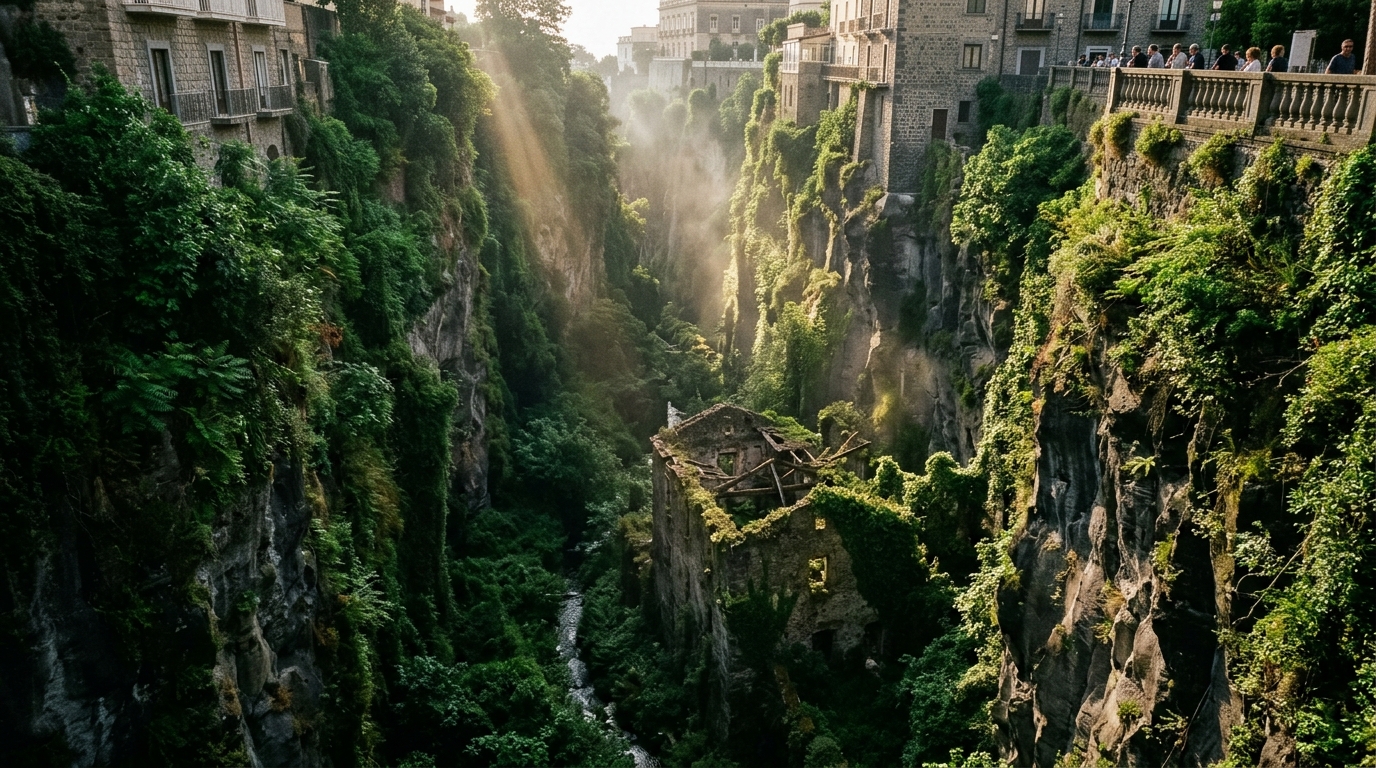
It only takes a look over a railing, somewhere behind Piazza Tasso, for the vertigo to seize you. Down below, about fifteen meters away, collapsed stone roofs disappear beneath a tangle of ferns and ivy. You can glimpse openings, arches of masonry, almost an entire street swallowed by a verdant fault. This isn’t an ancient ruin forgotten in the jungle, but an industrial site that operated until the last century, in the heart of Sorrento, in Campania. And what brought down these mills isn’t a cataclysm: neither bombs nor seismic upheavals. The answer is much quieter, and that is precisely what makes it fascinating.
- The Valley of the Sorrento Mills formed thanks to a volcanic eruption 35,000 years ago, later carved by two streams.
- The site has housed since the Middle Ages a flour mill, a sawmill, and a public washhouse, until its gradual abandonment following urban modernization works in 1866.
- Today inaccessible for safety reasons, the site is overgrown with dense vegetation, including a rare species of fern, and can only be visited from surface viewpoints.
- A fissure carved by a 35,000-year-old volcanic eruption
- When the town finally ate its own mills
- The washhouse, the sawmill, and the flour mill: an industry forgotten beneath the ferns
- What Nature Has Reclaimed, No One Will Take It Back
A Fissure Carved by a 35,000-Year-Old Volcanic Eruption
To understand why this valley exists, one must go back to a time when humans had not yet set foot on the Sorrentine Peninsula. About 35,000 years ago, a volcanic eruption disrupted the landscape, ejecting materials that ultimately carved a deep notch into the limestone plateau above the future town. This groove, today named Vallone dei Mulini, owes its present shape as much to the patient work of water as to the eruption. Two streams, the Casarlano-Cesarano and the Saint Antonino, continued gnawing at the rock for millennia, sculpting narrow and vertiginous gorges.
It is precisely at the point where these two streams meet that the valley widens slightly, forming a kind of sunken clearing. A place almost providential for medieval inhabitants, who saw in it far more than a geological curiosity: a free and inexhaustible source of energy.
When the Town Finally Ate Its Own Mills
For centuries, this corner of rugged nature was nonetheless a place of noise and intense activity, far from the contemplative image it projects today. But the story of its abandonment is not the product of a sudden drama. No war ravaged these walls, no earthquake toppled the roofs. The real cause is far more prosaic, and ultimately familiar: it was urban modernization that did the valley in.
Some sources trace the decisive turning point to 1866, when the municipality of Sorrento undertook works that would gradually isolate the site from the rest of the town. New roads were laid out on the surface, more practical, faster, while production methods evolved with nascent industrialization. Little by little, descending into the gorge to power a mill became an economic anachronism. The site, once central to Sorrentine life, was literally cut off from the city that continued to grow above it. At the turn of the twentieth century, the last activities faded away, without noise, without drama, simply swept away by the natural march of progress.
The Washhouse, the Sawmill, and the Flour Mill: An Industry Forgotten Beneath the Ferns
Before fading into oblivion, the Valley of the Mills was indeed a real economic and social hub. The first flour mill is attested there as early as the tenth century, harnessing the flow’s power to grind wheat destined for the people of Sorrento. Some buildings visible today would even date back to the thirteenth century, testifying to the exceptional longevity of this artisanal activity tucked at the bottom of the fissure.
Over time, a sawmill was established, taking advantage again of the stream’s hydraulic power to mill valuable timbers such as olive, cherry, or walnut. This wood, shaped in the dim, humid darkness of the gorge, fed directly the craft of the Sorrentine marquetry, a know-how still renowned across Italy today. A public washhouse completed this setup, where the city’s women came daily to beat their laundry in the valley’s cool waters. One can easily imagine the echo of conversations mixing with the clatter of water wheels and saws, turning this ravine into a space far livelier than it appears on current postcards.
What Nature Has Reclaimed, No One Will Take It Back
Since the last workers left, vegetation did not take long to reclaim its rights. The cool, humid microclimate created by the enveloping rock walls offers ideal conditions for flora that thrives on moisture: ferns, evergreen oaks, and ashes have colonized the collapsed roofs and the old stone staircases. The site even harbors a somewhat rare species of fern, which seems to have found in these abandoned masonry a substrate perfectly suited to its development.
Today, it is impossible to reach the bottom of the gorge directly for obvious safety reasons, the structures having not been maintained for more than a century. Visitors strolling around Piazza Tasso or along Via Fuorimura during the season when the Campanian hinterland dons autumn colors must content themselves with observing the scene from surface viewpoints. A retreating vantage that, paradoxically, makes the spectacle even more striking: you watch a piece of industrial history slowly dissolve into the vegetation, with no way to intervene.
The Valley of the Mills has thus become one of Campania’s most emblematic abandoned sites, a stark example of how quickly nature can reclaim space once human activity ceases and the environment remains protected. Neither war nor the earthquakes that have marked the region needed to intervene: it only took a few paved roads and a handful of decades of abandonment for the ferns to do the rest. It invites broader reflection on all those places we abandon unknowingly, places that vegetation is patiently preparing to cover.
