
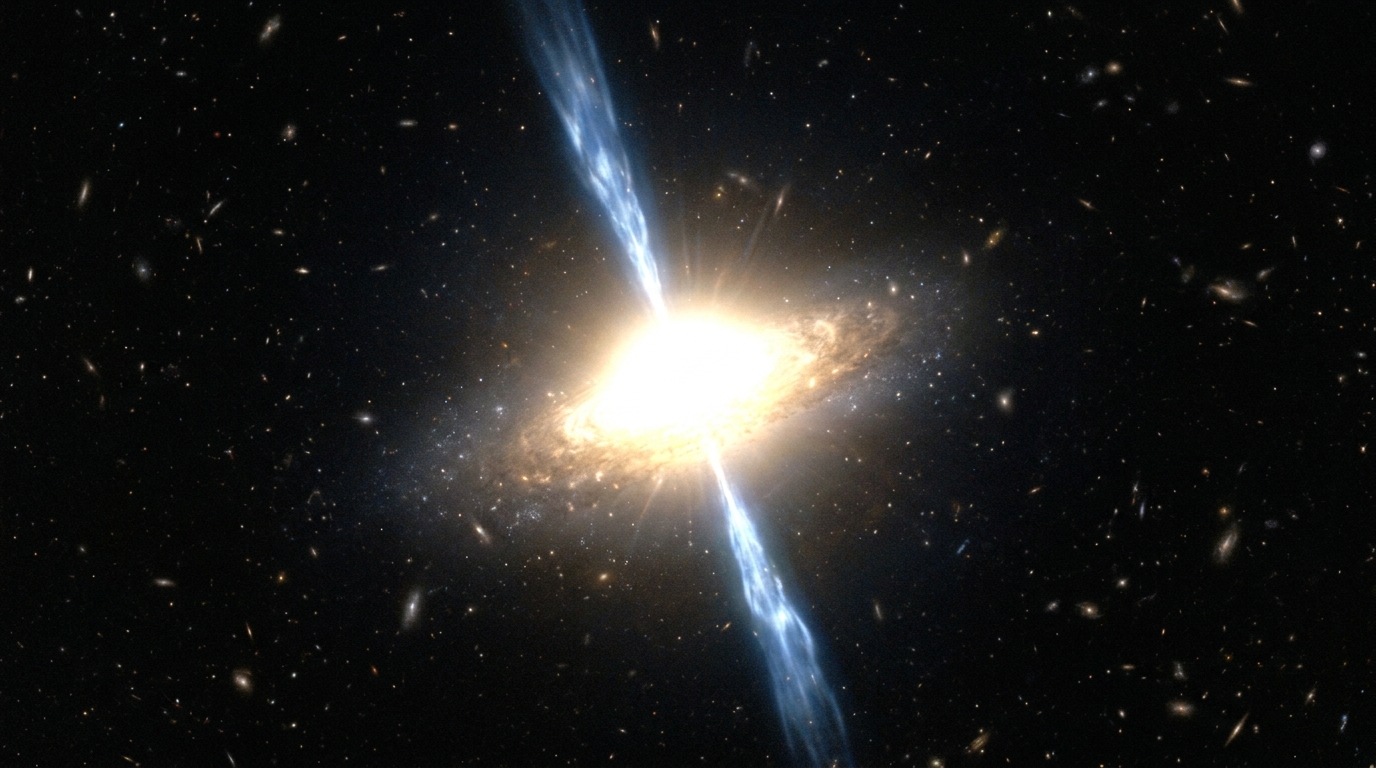
It is often misimagined that the universe’s brightest objects are gigantic stars or entire galactic clusters. Yet a single point of light, smaller than a solar system, can overwhelm the combined glow of hundreds of billions of stars. This is precisely what the study of a quasar at the edge of the observable universe reveals, a phenomenon that upends our understanding of the cosmos’ origins.
- The quasar SDSS J0100+2802, observed as it appeared 900 million years after the Big Bang, harbors a supermassive black hole of roughly 12 billion solar masses
- Its accretion disk radiates power of 3×10^41 watts, a brightness confirmed by X‑ray observations that rule out any gravitational lensing magnification
- This rapid, enormous growth of the black hole challenges standard formation models, fueling several competing hypotheses not yet definitive by the scientific community
- A quasar born at the edge of time
- Twelve billion solar masses: the insatiable appetite of a cosmic behemoth
- The accretion disk, this furnace eclipsing entire galaxies
- What this phenomenon reveals about the birth of the universe
As nights lengthen and looking up at the starry sky becomes almost second nature, it is worth recalling just how certain celestial bodies defy comprehension. Far beyond shooting stars or naked-eye planets, some objects are so distant that their light took longer to reach us than the age of our own planet. Among them, a quasar named SDSS J0100+2802 stands out for shining with a power that seems to defy the known laws of physics.
A quasar born at the edge of time
Located near the boundary between the constellations of Pisces and Andromeda, this quasar lies about 12.8 billion light-years from Earth. A staggering figure, but one to read as a time machine: the light we observe today was emitted roughly 900 million years after the Big Bang, at a moment when the universe was just beginning to emerge from its darkest ages.
Astronomers gauge this distance through redshift, which here reaches the remarkable value of 6.30. The higher the figure, the older and farther the object. In other words, by observing SDSS J0100+2802, scientists are not merely watching a bright point in the sky: they are peering through a window onto the dawn of the universe, at a time when galaxies were already forming and reshaping the cosmos.
Twelve billion solar masses: the insatiable appetite of a cosmic behemoth
At the heart of this quasar sits a supermassive black hole with a mass estimated at about 12 billion times the Sun. To grasp the scale, its diameter would be around 70.9 billion kilometers, seven times the diameter of Pluto’s orbit. A object of such magnitude appearing so early in cosmic history raises a fundamental question for astrophysicists: how could a black hole reach such an immense mass merely 875 million years after the Big Bang?
This mass was inferred by measuring the speed at which the surrounding gas is drawn into the black hole, a method that relies in part on analyzing the MgII emission lines. By contrast, classical black-hole formation models, which depend on the gravitational collapse of a massive star at the end of its life, cannot explain growth at such a rapid pace. It would have required the black hole to consume matter at an almost continuous, frenzied rate since the very earliest moments of the universe, which remains one of modern cosmology’s greatest puzzles.
The accretion disk, this furnace eclipsing entire galaxies
But where does this intense light come from exactly? The answer lies in the accretion disk, the rotating ring of gas and dust spiraling around the black hole. Under extreme gravitational forces, the matter in this disk heats to unimaginable temperatures before ultimately plummeting into the black hole, releasing a staggering amount of energy in the process.
Concretely, this quasar emits a power of 3×10^41 watts, about 40,000 times the combined luminosity of the 400 billion stars that make up our Milky Way. It is therefore four times brighter than quasar SDSS J1148+5251 and seven times brighter than ULAS J1120+0641, two other well-known benchmarks among astronomers studying the early universe. What makes this luminosity even more remarkable is that it is not a case of optical illusion: X-ray observations published in 2021 confirmed that no gravitational lensing is artificially amplifying this brightness. The black hole simply exhibits the largest accretion rate ever observed at such a distant cosmic epoch.
What this phenomenon reveals about the birth of the universe
The discovery of this quasar was announced in February 2015 by an international team led by Chinese astronomer Xue-Bing Wu, with support from the Yunnan Observatory. Since then, the object has continued to fuel debates within the scientific community, because it forces a reconsideration of the standard scenarios for forming the universe’s most massive structures.
How could such a colossal black hole have formed so early when the universe hadn’t even reached 7% of its current age? Several hypotheses circulate, ranging from the direct collapse of enormous primordial gas clouds to the rapid merger of smaller black holes. None of these theories currently enjoys universal consensus, which makes this quasar particularly precious: it serves as a natural laboratory for observing the extreme conditions that prevailed in the first hundreds of millions of years of our universe.
Ultimately, SDSS J0100+2802 brilliantly illustrates astronomy’s capacity to confront us with scales that far exceed everyday intuition. A single point of light, invisible to the naked eye, capable of rivaling tens of thousands of galaxies, reminds us how many mysteries the universe still hides. And perhaps the key to understanding the formation of the oldest galaxies lies precisely in these cosmic giants born at the dawn of time?
