
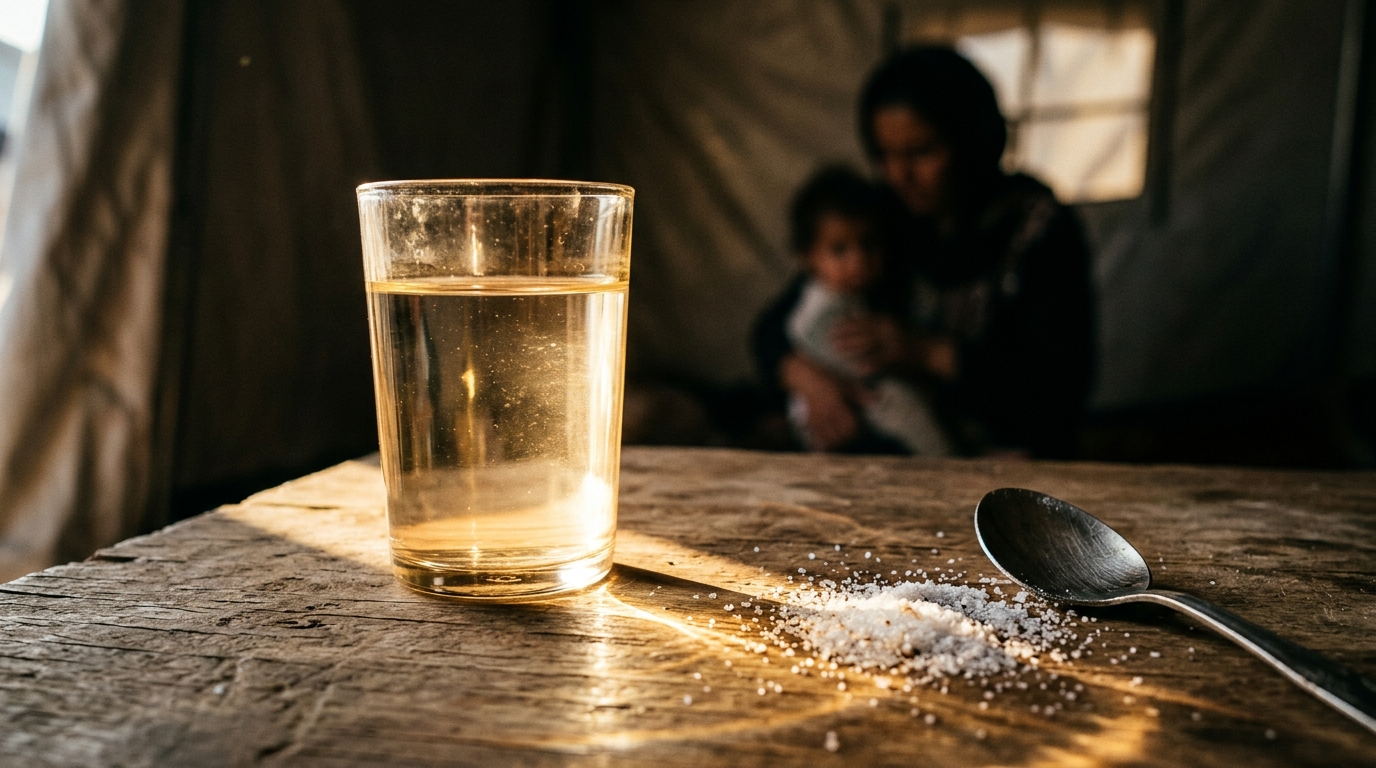
Imagine a makeshift tent set in the mud, dozens of bodies lying directly on the ground, skin grayish, eyes hollowed by dehydration. Around them, a single doctor and a handful of nurses, but almost no IV fluids available. It is in this refugee-camp setting, at the border of a birth into Bangladesh, that an Indian pediatrician would improvise, with improvised means, one of the most life-saving medical discoveries of the last century.
- In 1971, facing a shortage of IV fluids in refugee camps near Bangaon, pediatrician Dilip Mahalanabis develops an oral solution based on sodium, glucose, and bicarbonate diluted in water
- This solution exploits an intact intestinal mechanism for absorbing glucose and sodium, which drives the uptake of water lost to diarrhea, even in cholera
- Having never patented his formula, Mahalanabis enabled the global diffusion of this oral rehydration solution, now regarded as one of the major public health advances of the twentieth century
- When IV fluids run short, a doctor improvises a solution that will save thousands of lives
- Cholera drains the body, but an intestinal mechanism remains intact despite the infection
- Glucose and salt: the simple formula that diverts the intestine to absorb the water lost
- From Bangaon to the world: how a mix of fortune became a universal medical standard
When IV Fluids Run Short, a Doctor Improvised a Solution That Will Save Thousands of Lives
In 1971, the Bangladeshi liberation war sent millions fleeing into India. In camps set up near Bangaon, a cholera outbreak spread at a frightening pace. The pediatrician Dilip Mahalanabis, then a researcher at Johns Hopkins Medical Center in Calcutta, faced an unbearable dilemma: his patients were dying by the dozens, and intravenous saline solutions, the only treatment recognized at the time, were desperately scarce.
Even more, according to his own testimony later gathered by the World Health Organization Bulletin, only two members of his team truly knew how to place an drip. In a camp where patients kept arriving in waves, this technical constraint transformed a logistical shortage into a genuine humanitarian emergency. They had to find something else, and fast, or mortality would continue to rise at an alarming rate.
Cholera Drains the Body, but an Intestinal Mechanism Remains Intact Despite the Infection
To grasp the ingenuity of what followed, one must first understand what cholera actually does to the body. The responsible bacterium, once it takes hold in the intestine, triggers a massive outflow of water and minerals outward from the body. The patient literally becomes emptied, sometimes losing several liters of fluid in a single day, causing rapid dehydration and, without prompt treatment, death.
But a physiological detail, long undervalued, would change everything: even ravaged by infection, the intestine retains its ability to absorb glucose together with sodium. This biological pair acts like an entry door that remains open no matter what; a mechanism the cholera bacterium does not damage. It is precisely this flaw in the disease’s armor that researchers would exploit.
Glucose and Salt: the Simple Formula That Diverts the Gut to Absorb the Water Lost
With his team, Dilip Mahalanabis devised a preparation that looked almost trivial in the face of such gravity: a mixture of sodium, glucose, and bicarbonate, simply diluted in water. Administered orally, this drink would exploit the still-functional intestinal mechanism to draw water into the body, without a needle or any sophisticated medical device.
The principle is almost astonishing in its simplicity: glucose facilitates the absorption of sodium by the intestinal cells, and this absorption drags along the water lost to diarrhea. In other words, one can divert a biological doorway that the disease failed to lock. The on-the-ground results, later reported by The Lancet Infectious Diseases, were spectacular: the mortality rate among cholera-stricken refugees collapsed dramatically thanks to this oral rehydration solution.
From Bangaon to the World: How a Fortuitous Blend Became a Universal Medical Standard
Despite these impressive results, the scientific community of the time remained skeptical. Several medical journals refused to publish Dilip Mahalanabis’s original article, perhaps deeming too simple, almost naive, a solution capable of rivaling intravenous infusion. This resistance would delay for several years the formal recognition of the method, despite its proven effectiveness on the ground.
It was another Indian physician, Dhiman Barua, then with the World Health Organization, who directly observed the results in Bangaon and decided to take this discovery beyond Indian borders. Between 1975 and 1979, Dilip Mahalanabis himself worked in cholera-control units in Afghanistan, Egypt, and Yemen, helping disseminate this approach across very different contexts. A decisive choice would also accelerate this global diffusion: the physician never filed a patent on his formula, leaving it freely accessible to all health systems, including the poorest.
Today, this oral rehydration solution is considered by many medical publications to be one of the most important twentieth-century advances in public health. Dilip Mahalanabis passed away in Kolkata in 2022, at the age of 87, after dedicating most of his career to fighting diarrheal diseases, a scourge still too little recognized in our latitudes but which continues to threaten millions of people each year.
From that makeshift camp near Bangaon to the medical protocols applied today around the world, the story of this discovery recalls a simple truth: sometimes the most effective solutions do not require complex technology, but a keen observation of what the human body can still do, even weakened by illness. A lesson in scientific humility that continues, more than fifty years later, to save lives wherever clean water and sugar suffice to act as a remedy.
