
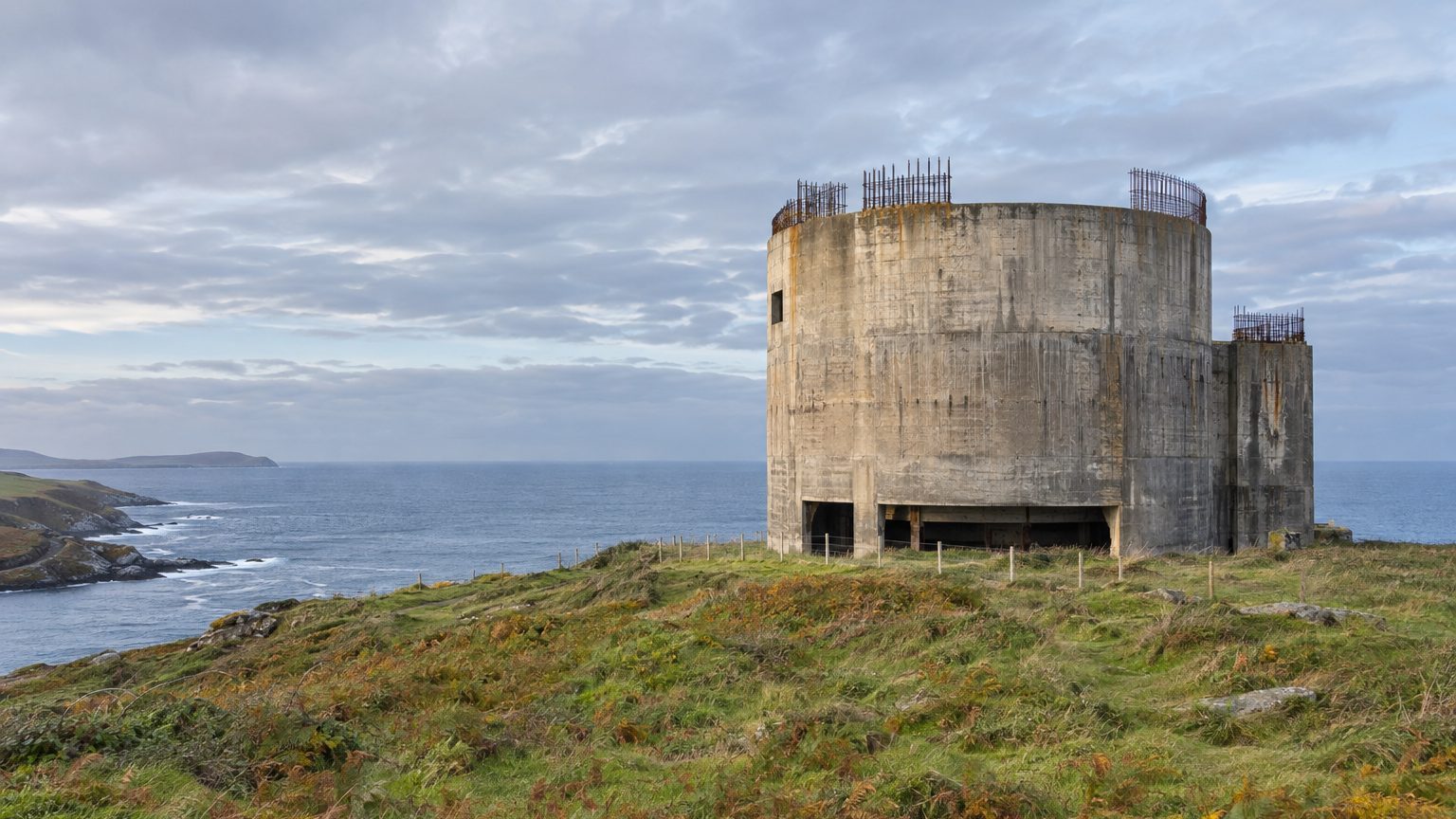
Two 900 MWe pressurized water reactors, together totaling 1,800 MWe, lie dormant at Lemoiz, off the Basque coast. Nearly finished, they were never put into service and have never fed a kilowatt-hour into the grid. The reasons for this failure are not a design flaw or a funding shortfall: violence and politics decided the fate of the project, not engineers.
- Two 900 MWe reactors, nearly completed, never went into service.
- Over 300 attacks and acts of sabotage targeted the project between 1978 and 1982.
- Five Iberduero employees were killed during that period.
- A nuclear moratorium formally closed the project in 1984.
Lemoiz has lain dormant since 1984 on 170 hectares
The Iberduero power plant site spans roughly 170 hectares along the Basordas cove. According to eldiario.es, about 1,000 tons of iron and 8 million cubic meters of concrete remain on the site. The figure is staggering and has only one press source: best read as an order of magnitude rather than a survey of exact measurements.
The 1984 nuclear moratorium formally closed the project.
The precise chronology varies by source. Construction slowed after the PSOE’s 1982 election and paused in 1983 or 1984, depending on the version. The 1984 moratorium then settled the matter, with the reference sheet noting April 1, 1984 as the shutdown date. The land ownership story moved at a similarly glacial pace: the PNV negotiated in 2017 with Mariano Rajoy’s government to transfer the land, and Pedro Sánchez’s administration carried it out in 2019.
More than 300 attacks, five employees killed
ETA carried out more than 300 attacks and sabotage operations against the project. The first fatalities occurred in March 1978: Andrés Guerra and Alberto Negro perished in a bombing, followed by Ángel Baños who was killed by an explosive in the turbine hall in June 1979.
On January 29, 1981, José María Ryan, the plant’s chief engineer, was abducted. His body was found on February 6, 1981, eight days later. His successor in that role, Ángel Pascual, was shot on May 5, 1982.
In total, five Iberduero employees were killed between 1978 and 1982.
ETA or political decision: who halted Lemoiz?
The debate remains whether ETA or a political decision bore the greater responsibility. On one side, more than 300 attacks and five deaths created a climate of confrontation that made a project of this scale almost an act of force. On the other side, the project halted after the PSOE came to power, and a moratorium completed it on paper. Online references also point to opposition from environmentalists, who had been vocal around the project even before the deadliest assaults.
In both readings, the obstacle came from outside the construction site, not from its technical plans.
None of the consulted sources point to a technical problem or insufficient funding as the reason for stopping. A structure of such magnitude, perched by the water, became a monument by default: too imposing to ignore, too laden with memory to be casually demolished. Lehendakari Imanol Pradales speaks of an uncomfortable and highly complex heritage, describing Lemoiz as a symbol evoking a past marked by dictatorship, terrorism, and unchecked development.
Flatfish in the concrete: the plan unveiled on April 27, 2026
On April 27, 2026, during an on-site presentation, the lehendakari formally introduced the Sea Eight project, or Aquacría Basordas, the subsidiary’s name. It envisions a sole farming operation covering about 46,000 square meters, with an annual production target of roughly 3,000 tons. The project is structured as a public-private partnership, with a total investment of €170 million over ten years and around 200 highly skilled direct jobs.
The name Sea Eight derives from the “eighth ocean,” referring to land-based aquaculture. The complex would span the entire lifecycle, from hatching and larval rearing to fattening and commercial processing, including hatchery, nursery, and grow-out facilities, plus processing and logistics installations. The promoter is not a newcomer: Sea Eight, the aquaculture arm of the Atitlan group, already operates sole farms in Gijón, Cambados, and in Portugal at Torreira and Póvoa de Varzim.
The schedule is tight, but biologically driven rather than political. Construction is planned to begin in 2027, with the first fish arriving in 2029, and the first marketable soles expected around 2030, though some sources place this closer to 2031 depending on the species’ biological cycles. Before all that, the repair of the outer dyke was awarded for €2.5 million, a crucial step to enable sea-side operation of the site.
Memory remains a consideration. The lehendakari and EH Bildu representatives have argued for a form of “remembrance” and reparative memory, suggesting the future site could preserve a trace of its history. No decisions have yet been made on the form this trace might take.
Nothing has yet been built: construction is not scheduled to begin until 2027. The 3,000 tons per year represent a target full-production capacity, not a current production level. Between the abduction of José María Ryan in 1981 and the planned first fish in 2029, 48 years will have passed.
Source: eldiario.es
