
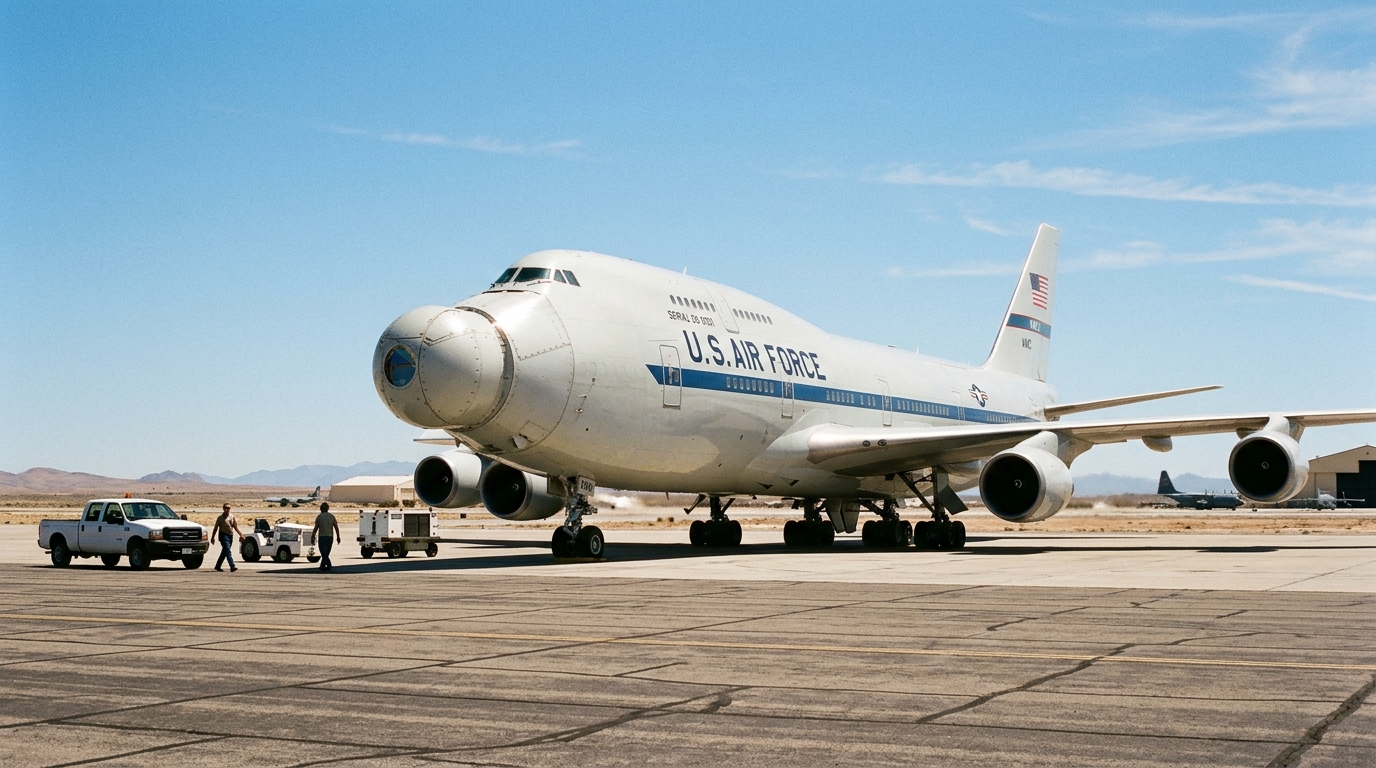
Historically, the idea of a beam capable of annihilating a projectile in flight belongs more to science fiction than to military hangars. Yet history frequently reminds us that reality can catch up with imagination, only to crash later against a far more down-to-earth wall: budgets and logistics. This is precisely what happened to a certain American Boeing 747, converted into a one-megawatt laser weapon, which proved its formidable effectiveness before being dismantled. A look back at a technological adventure as fascinating as its ending is frustrating.
- The YAL-1, a Boeing 747-400F equipped with a one-megawatt COIL chemical laser, destroyed two missiles of different types while in the propulsion phase in February 2010
- The program was abandoned not because of a technical failure but due to its limited range (200–300 km) and its cost, around $5 billion over sixteen years
- The sole unit was withdrawn from service in 2012 and scrapped in 2014, its recycled parts having notably served Air Force One and NASA’s SOFIA telescope
- When Iraq Forced America to Dream of a Flying Laser
- A Boeing 747 Transformed into an Absolute Weapon: The Birth of the YAL-1
- Two Missiles Pulverized in Midair: The Day the Laser Proved Itself
- No Breakdowns, No Failures: Why This Sky Giant Ended Up in the Aircraft Boneyard
Quand l’Irak a forcé l’Amérique à rêver d’un laser volant
It all began during the first Gulf War, between 1990 and 1991. At that time, Iraq launched numerous Scud missiles, sowing panic and revealing a glaring flaw in Western defense capabilities: there was then no effective means to intercept these missiles before they reached their targets. This realization, chilling for the American high command, would plant the seed for a project as ambitious as it was costly.
The idea then germinated: what if one could destroy a ballistic missile during its propulsion phase, that critical moment when it is still slow, fuel-laden, and particularly vulnerable? Rather than waiting for impact or attempting a late interception, why not neutralize the threat at the source, directly above enemy territory? It is this logic that would give birth, years later, to one of the most spectacular arms programs ever launched by the United States.
Un Boeing 747 transformé en arme absolue : la naissance du YAL-1
In 2001, the U.S. Missile Defense Agency entrusted this titanic challenge to a consortium led by Boeing, aided by Northrop Grumman for the laser design and Lockheed Martin for the fire-control system and the turret. The result of this collaboration bears a name as sober as its goal is colossal: the YAL-1 Airborne Laser.
Concretely, it was a fully rebuilt Boeing 747-400F cargo aircraft, with the nose housing an iodine-oxygen chemical laser, better known by the acronym COIL, capable of delivering a power of one megawatt. The aircraft then housed the largest laser turret ever built for aerospace use. The initial concept was even more dizzying: the military envisioned a fleet of seven such aircraft, patrolling near hostile borders to detect and shoot down enemy missiles as soon as they lifted off. Only one unit would ultimately come to fruition, but its journey would be enough to leave its mark on the history of military aviation.
Deux missiles pulvérisés en plein ciel : le jour où le laser a fait ses preuves
It was in February 2010, off the coast of California, that the YAL-1 would truly enter the lore. On February 3, the aircraft managed to destroy a solid-fuel ballistic missile while it was still in the propulsion phase, a world first for this type of airborne weapon. Only eight days later, the feat was repeated: this time, a liquid-fuel Scud-type missile was pulverized in flight over the Pacific.
These two consecutive and successful tests validated a concept engineers had been working on for nearly a decade. On paper, the demonstration was dazzling: a modified civilian Boeing could neutralize two different ballistic threats with a simple light beam of unprecedented power. It suggested that the program would be scaled up and deployed widely. And yet, history would take a very different turn.
Ni panne ni échec : pourquoi ce géant du ciel a fini au cimetière des avions
Contrary to what one might imagine, it was not a technical malfunction that felled the YAL-1. The laser worked, and quite well. The problem lay elsewhere, in the operational viability of the concept itself. Its effective range, limited to about 200 to 300 kilometers, forced this enormous Boeing 747 to patrol extremely close to, or even inside, enemy airspace to hope to intercept a missile as it lifted off. In other words, a plane as massive and as hard to maneuver would become, in this scenario, a particularly easy target for hostile defenses.
Add to that the sensitive issue of cost. By 2009, Secretary of Defense Robert Gates had reduced the program to a mere research test bed, canceling the construction of a second aircraft. A 2011 report stated that the program had already consumed about $5 billion over sixteen years, some broader estimates even mentioning up to $11 billion when including the entire historical development. Robert Gates himself is said to have priced a new unit at $1.5 billion more, not counting the $100 million per year needed to keep the aircraft in the air. Faced with these figures, the Missile Defense Agency officially announced the program’s definitive end in December 2011.
The YAL-1 took its final flight on February 14, 2012, bound for Davis-Monthan Air Base in Arizona, where it joined the famous aircraft boneyard of the 309th Aerospace Maintenance and Regeneration Group. It remained stored for several years before being permanently scrapped in September 2014. Its dismantling, far from being a dull ending, had one last utility: recovering its parts saved American taxpayers about $15 million, some components finding a second life aboard Air Force One or NASA’s airborne telescope SOFIA.
The YAL-1 thus remains a fascinating paradox of modern military history: an undeniable technical success, sacrificed not on the altar of failure, but on that of budgetary and strategic realism. A scientifically sound achievement, perfectly functional, but simply ill-suited to the constraints of the real world. A reminder that in innovation, technological prowess and operational relevance do not always go hand in hand, a lesson that continues to inform current research on directed-energy weapons.
