
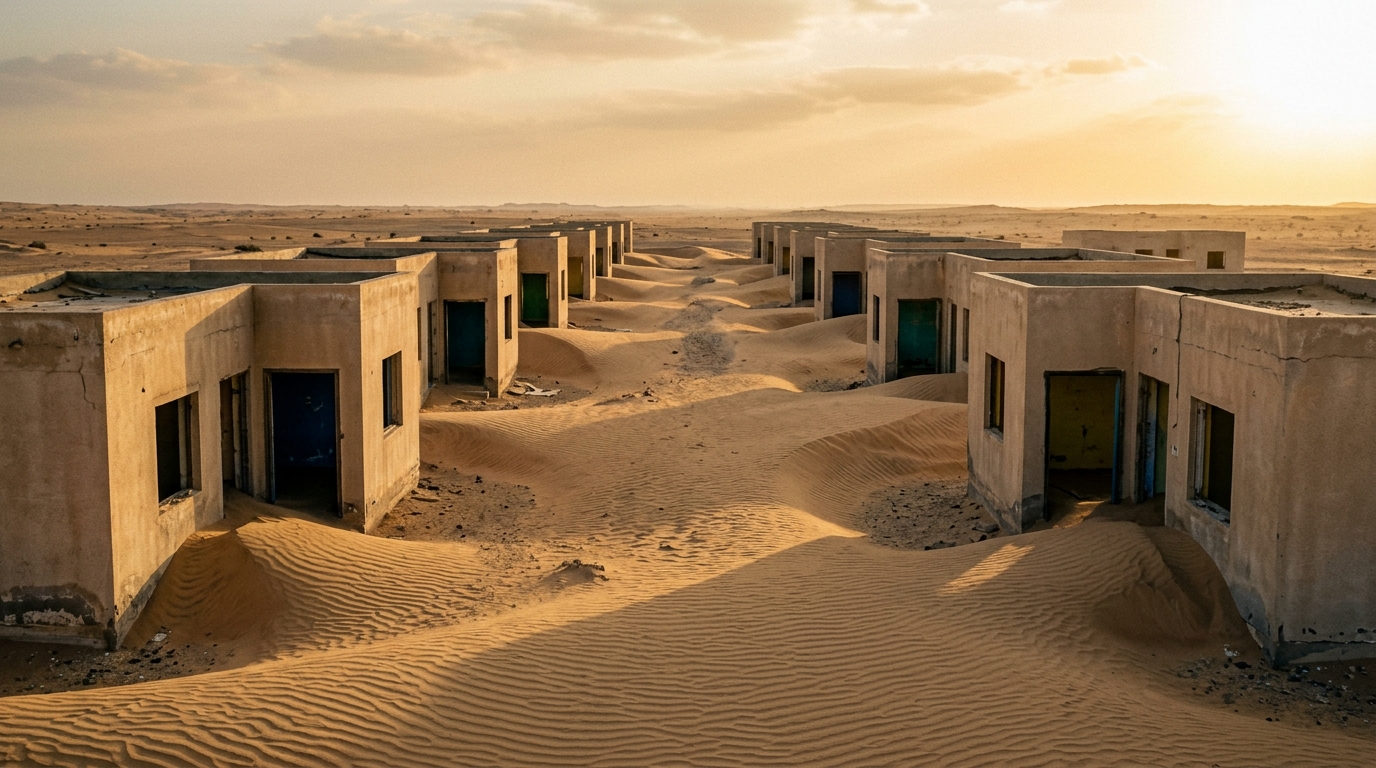
- Al-Madam, a village built in the 1970s as part of the Sha’bi housing government program to sedentarize Bedouins of the Al Kutbi tribe, was abandoned only a few years after its construction without any official explanation.
- Two hypotheses circulate to explain this exodus: violent sandstorms that made the place uninhabitable, or the popular legend of djinns driving the inhabitants away.
- Difficult to access since the 2016 closure of the Oman border, the site has received no tourist promotion, unlike other ghost villages such as Kolmanskop in Namibia.
- Two rows of identical houses, a silence that explains nothing
- A village built to settle the nomads
- The mystery that even the authorities have never solved
- Sand, ruin and silence: what Al-Madam still tells today
At first glance, Al-Madam resembles any abandoned village in the Persian Gulf. But as one approaches, an unexpectedly methodical arrangement comes into view: two rows of identical houses facing each other, divided by an alley gradually obscured by sand, with a small mosque at its center. This isn’t a makeshift camp nor an ancient ruin handed down through centuries of history, but a set of sturdy, purpose-built dwellings designed to last. Yet their occupants left without leaving any trace of their departure.
This hamlet is in fact only an extension of the larger town of Al-Madam, itself developed around old trade routes that used to link Oman to the Emirati locality of Hatta. The tiny ghost village sits isolated in a desert area south of this larger agglomeration, as if suspended between two eras. In some places, decorative floor coverings or fragments of wall paintings can still be seen, discreet witnesses to a daily life that seems to have halted without warning. Elsewhere, the sand has simply won, rendering certain rooms completely inaccessible.
A village built to settle the nomads
To understand why these houses exist, one must go back to the 1960s, a pivotal period for the United Arab Emirates. The discovery of oil reserves in the region profoundly disrupted the traditional lifestyle of Bedouin communities, who had long been largely nomadic. It was in this context that a government program named Sha’bi housing emerged, with a clear objective: to offer modern, permanent dwellings to families accustomed to following water sources and pastures according to the seasons.
According to this hypothesis, advanced notably by architecture professor Yasser Elsheshtawy, the village of Al-Madam would thus be one of the realizations of this sedentarization policy. The Al Kutbi tribe would have been the first to settle there, gradually abandoning nomadic life in favor of solid walls and a fixed roof. A transition that, in theory, was meant to provide greater comfort and stability to these families. But the history apparently did not unfold as planned, since these same houses eventually lay deserted only a few years after their construction.
The mystery that even the authorities have never solved
In 2018, the Sharjah Art Foundation attempted to shed some light on this enigma by conducting a public consultation with local residents and former inhabitants of the region. One testimony collected proved particularly valuable: a man interviewed claimed to have been married in the village, which helps date its construction and occupation to around the 1970s. A concrete clue, but one that remains isolated amid an ocean of ambiguities.
According to transcriptions of these interviews, violent sandstorms would have eventually rendered the place uninhabitable, progressively burying the dwellings under ever-higher dunes. A plausible explanation in a region where the desert reclaims space quickly as soon as an area is no longer maintained. But beside this meteorological version, another legend circulates among local residents: that of the djinns, those supernatural spirits of Arab-Muslim mythology, who would have driven the families away from Al-Madam. Between scientific explanation and popular tale, no version has ever been officially confirmed, and it is precisely this persistent ambiguity that continues to fuel fascination around the site.
Sand, ruin and silence: what Al-Madam still tells today
Today, Al-Madam remains difficult for the general public to access. The closure of the Oman border at the Mahda crossing in 2016 significantly reduced traffic on the road linking the village to Hatta, now reserved for Emirati and Omani citizens, as well as holders of a special permit. An additional isolation that, perhaps inadvertently, helps preserve the place’s mysterious character.
Unlike other ghost villages buried by sand around the world, such as the famous Kolmanskop in Namibia that became a managed tourist attraction, Al-Madam has received no official promotion. According to a spokesperson for the local authorities, no project to transform the site into a tourist destination is currently under consideration. The village thus continues to quietly fade beneath the dunes, far from the marked routes, as if the desert itself had decided to keep its secret.
Between forgotten government programs, devastating sandstorms, and legends of the djinns, Al-Madam crystallizes in its own way the tensions between imposed modernity and Bedouin traditions. This small village frozen in time reminds us how certain aspects of recent history can remain incomplete, even just a few kilometers from Dubai’s gleaming skyscrapers. So, whether it was a sandstorm, a planned exodus, or a simple local legend: perhaps the real question is not why the residents left, but why no one ever tried to document it?
