
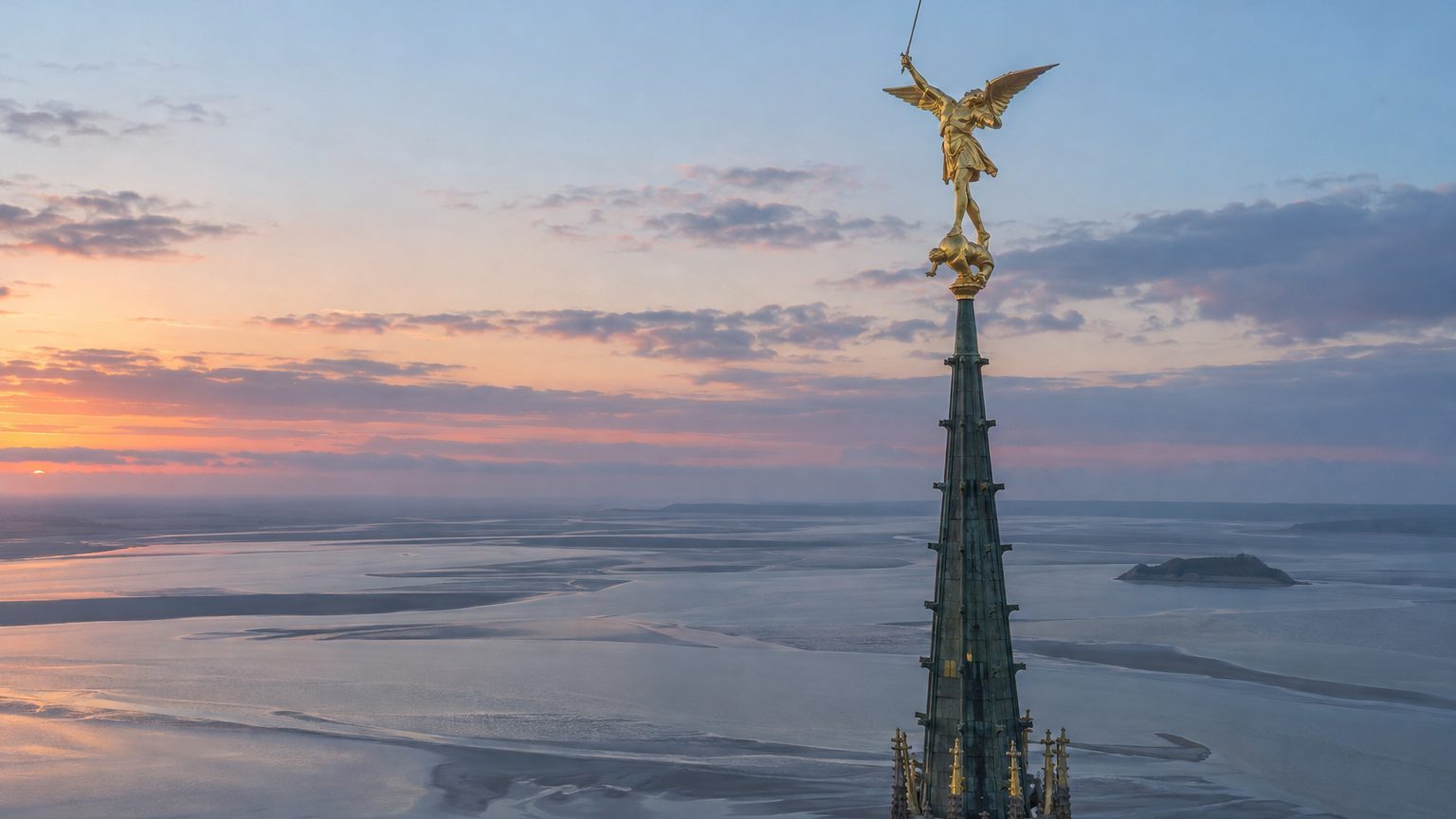
The Saint Michael dominating the Mont-Saint-Michel abbey has been slaying a dragon since 1897, but his daily work is something quite different: attracting lightning. His wings and sword render him a lightning rod, a detail often forgotten when one gazes at this golden silhouette standing 4.5 meters tall. It weighs 520 kg according to The Art Newspaper and rises more than 150 meters above the sea.
Storms and lightning have damaged it on several occasions.
- The Mont-Saint-Michel Saint Michael has attracted lightning since 1897.
- Its wings and sword act as a lightning rod.
- The statue was restored in 2016 after a helicopter flight.
An architect’s commission for a new spire
The statue is signed Emmanuel Frémiet (1824-1910), a sculptor who had worked alongside Viollet-le-Duc at the Pierrefonds castle. It was commissioned by architect Victor Petitgrand to crown the new spire, according to the Centre des monuments nationaux (CMN). It has overlooked the tower since 1897, nearly 130 years of sea winds.
The material says a lot about its function: gilded copper, that is, a conductive metal covered with gold leaf. It weighs more than half a ton, roughly the equivalent of seven adults perched atop a spire. In terms of dimensions, it stands 4.5 meters high, about a floor and a half of a building. The Normandie prefecture lists it among Frémiet’s masterpieces, under the title “the Archangel Michael vanquishing the dragon.”
According to Aleteia, the idea began with a bronze statuette created by Frémiet in 1879, which Petitgrand asked him to translate into a life-size plaster model. In a letter dated April 9, 1895, the sculptor committed to a statue of 2 to 2.2 meters, wings not included.
For a pilgrimage site, the symbolism is obvious: the patron saint watches from the highest point. Yet this place of honor is also the most exposed. The Normandie prefecture speaks of extreme climatic exposure conditions, to which the entire monument has nonetheless withstood.
Wings, sword, lightning rods: the archangel’s real trade
The principle of a lightning rod is simple: give lightning a preferred strike point and then guide it down to the ground via a conductive path. At the Mont’s summit, this role is partly fulfilled by the statue itself, whose wings and sword function as a lightning rod, reports 24matins.
The CMN took advantage of the 2016 restoration to bring the entire lightning-protection system up to standard. The project was not limited to the statue alone. Scaffolding had been erected as early as January 2016 to prepare for its removal.
The operation, valued at €450,000, included the reinforcement of the lightning conductors, auxiliary masonry work, and roofing. It was part of a broader restoration and redevelopment campaign conducted and financed by the CMN, whose works completed in 2015 account for nearly €7 million. This part thus represents just over 6% of the total envelope. The CMN noted that the statue had suffered heavily from lightning and the elements.
A helicopter flight, then a workshop in Dordogne
On March 15, 2016, the archangel took to the helicopter.
Just before 9 a.m., after an initial unsuccessful attempt, the statue rose at the end of the cable. The operation was carried out under the CMN’s project management. The project management responsibility lay with François Jeannieu, the chief architect of historical monuments. A truck then headed to Marsac-sur-l’Isle, in Dordogne.
At the Socra workshop, the archangel was to be restored and gilded again, due to significant wear of the gold leaf covering it. The gilding was entrusted to Ateliers Gohard, cited by The Art Newspaper. The re-gilding was planned for May 2016, about two months after departure.
Three restorations, intervals narrowing
1935, 1987, 2016: three restorations.
The interval between interventions has shortened from 52 years to 29 years, according to these dates. The prefecture mentions a first removal of the statue in 1987, and several restoration operations on the entire monument since the 1980s. Before the 2016 departure, sampling and analyses were planned with the Laboratory for Research on Historic Monuments (LRMH). Their aim: to understand the causes of the gilding’s rapid degradation since the last restoration.
The figures also vary. Before the removal, some communications spoke of 410 kg, the prefecture cites more than 500 kg, and The Art Newspaper 520 kg. As for altitude, the CMN and the prefecture keep to more than 150 meters, while other sources put it at 156 or 160 meters.
Sources: prefectures-regions.gouv.fr | batiactu.com
