
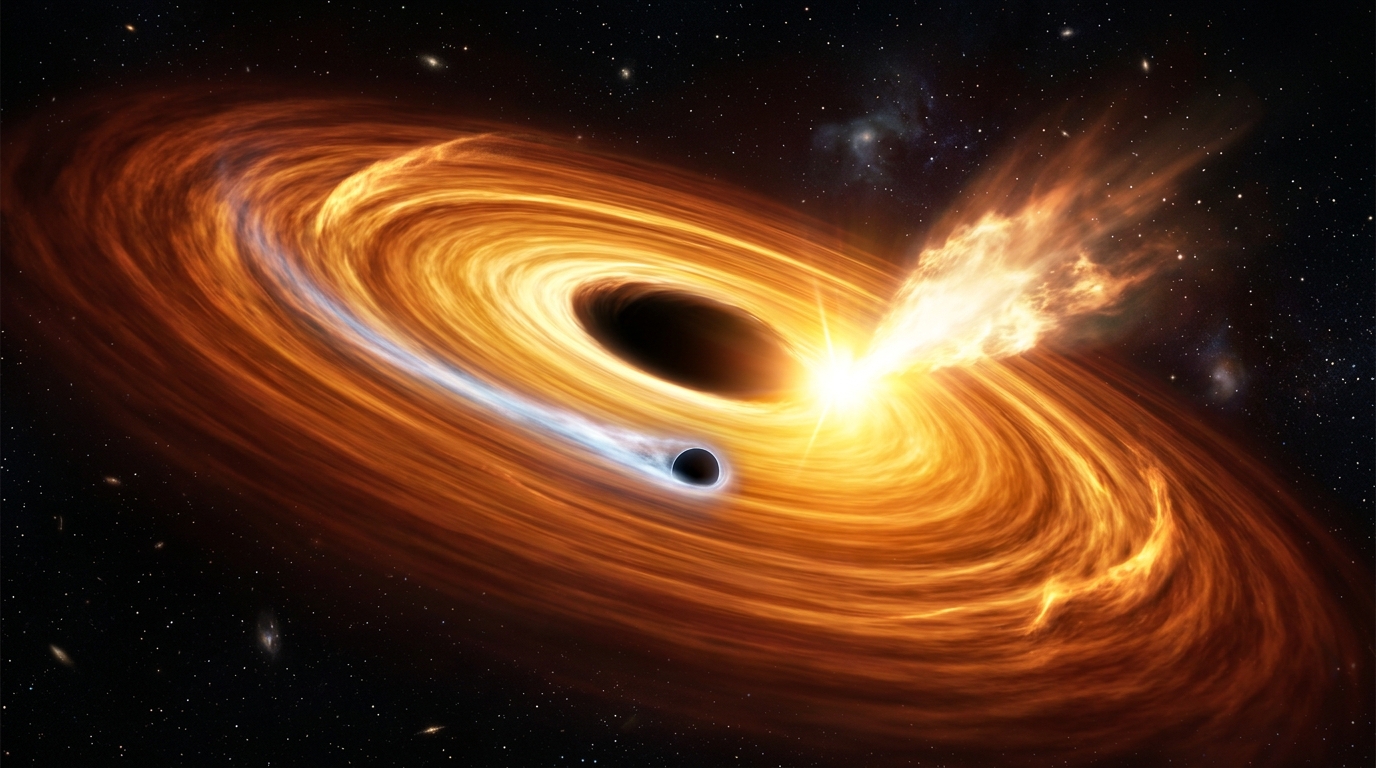
There exists, tucked away in the Cancer constellation, a cosmic beacon whose steady beating has spanned more than a century of astronomical observations without anyone truly understanding what made it blink in that way. This point of light, now identified under the name OJ 287, flares up with troubling regularity, roughly every twelve years, since the first photographic records exist. It was only after a scientific investigative process worthy of a crime novel that astronomers finally understood that this blinking was not a matter of chance, but the signature of a titanic gravitational ballet, involving two supermassive black holes entwined in an orbiting dance of unprecedented violence.
- OJ 287 is a blazar located about 3.5–4 billion light-years away, with its central black hole weighing approximately 18 billion solar masses
- A second black hole of about 150 million solar masses orbits the first every twelve years, crossing the accretion disk twice per orbit and triggering the bright flares observed
- This binary system, confirmed notably by the TESS satellite, serves as a natural laboratory for studying the final stages leading up to the merger of two supermassive black holes
- A flash repeated since 1888 that has intrigued generations of astronomers
- 18 billion solar masses: the measurement that changed the game
- Two black holes, one dance: the secret of the binary system
- What OJ 287 reveals about the universe’s most massive monsters
A flash repeated since 1888 that has intrigued generations of astronomers
It is by wading through old photographic plates that scientists realized that the quasar nestled about 3.5 to 4 billion light-years from Earth exhibited recurring bursts of brightness, and this had been the case since at least the end of the 19th century. OJ 287 belongs to a family of particularly energetic objects known as BL Lacertae blazars, active galaxies whose cores spew an enormous amount of radiation. But what distinguishes OJ 287 from other members of this family is the regularity of its eruptions, which return almost like clockwork every twelve years.
For a long time, this periodicity remained a frustrating mystery. Scientists knew they were observing something extraordinary, but no theory could satisfactorily explain why this light source re-lit with such constancy, orbit after orbit, decade after decade. It would take until the 1980s for a Finnish team, led by researcher Mauri Valtonen, to propose a hypothesis capable of holding up against this century-old puzzle.
18 billion solar masses: the measurement that changed the game
The hypothesis proposed by the Finnish researchers rested on a nearly unbelievable idea for the time: a central object of absolutely colossal mass. The subsequent measurements confirmed this intuition with a number that induces vertigo: the black hole at the heart of OJ 287 weighs about 18 billion times the mass of the Sun. To convey an idea of what such a mass represents, one would have to imagine gathering eighteen billion stars like ours into a single point, an object so dense that light itself cannot escape once it passes its event horizon.
This value places OJ 287 among the most massive black holes ever measured in the observable universe, well above the giants typically found at the centers of galaxies, including the one at the center of our Milky Way. It is precisely this gigantic mass that later allowed scientists to understand why the light flashes seen from Earth were so intense and so regular: an object of such mass generates a gravitational field capable of dictating the motion of everything that orbits nearby.
Two black holes, one dance: the secret of the binary system
The real turning point in understanding OJ 287 came with the revelation that it was not a single isolated black hole, but rather a binary system. Around the 18-billion-solar-mass behemoth orbits a second black hole, much more modest on cosmological scales with about 150 million solar masses, which remains substantial compared to our star. This companion completes its orbit around the giant in roughly twelve years, and it is precisely this motion that explains the blinking observed for more than a century.
In each orbit, the smaller black hole crosses the accretion disk, this gigantic crown of gas and dust swirling around the primary black hole. Each crossing triggers a colossal shock that releases tremendous energy, producing a flash of light capable of rivaling the luminosity of a billion stars combined. It is this repeated collision, twice per orbit, that sketches the characteristic light signal observed from Earth. Confirmation of this scenario came notably from NASA’s TESS satellite, an instrument originally designed to hunt exoplanets but which proved valuable for validating the presence of this companion in orbit. More recently, a virtual radio telescope, as vast as half the Moon’s orbital distance, enabled the very first radio images of this infernal couple in the midst of their gravitational dance.
What OJ 287 reveals about the universe’s most massive monsters
If OJ 287 fascinates the scientific community so much, it is because it constitutes a unique natural laboratory for testing our gravity models under extreme conditions, where conventional equations sometimes struggle to predict everything with certainty. A major eruption had been anticipated for the end of 2022, but it ultimately did not occur as expected, a missed rendezvous that fueled many debates among researchers about the accuracy of the models used to forecast the behavior of this binary system. Far from being a failure, this gap between prediction and observation illustrates how this pair of black holes continues to resist our understanding, despite decades of diligent monitoring.
This kind of object also offers a glimpse of what might happen in the distant future when two galaxies merge and their central black holes eventually meet. OJ 287 thus provides a rare window into the final stages of this process, the moment when two gravitational giants entwine themselves before potentially merging into a single, even more massive object. A prospect that, if it were to occur in this very target, would release an unimaginable amount of energy in the form of gravitational waves.
Reflecting on this blinking beacon in Cancer’s sky for more than a century, we realize how the patience and rigor of observers, generation after generation, have ultimately pierced a secret the universe kept well hidden. OJ 287 will likely continue its twelve-year orbit for a long time to come, with each flare reminding us that the cosmos harbors monsters whose power far exceeds our imagination. It remains to be seen what other surprises this pair of black holes may still have in store for us as observational instruments grow more precise.
