
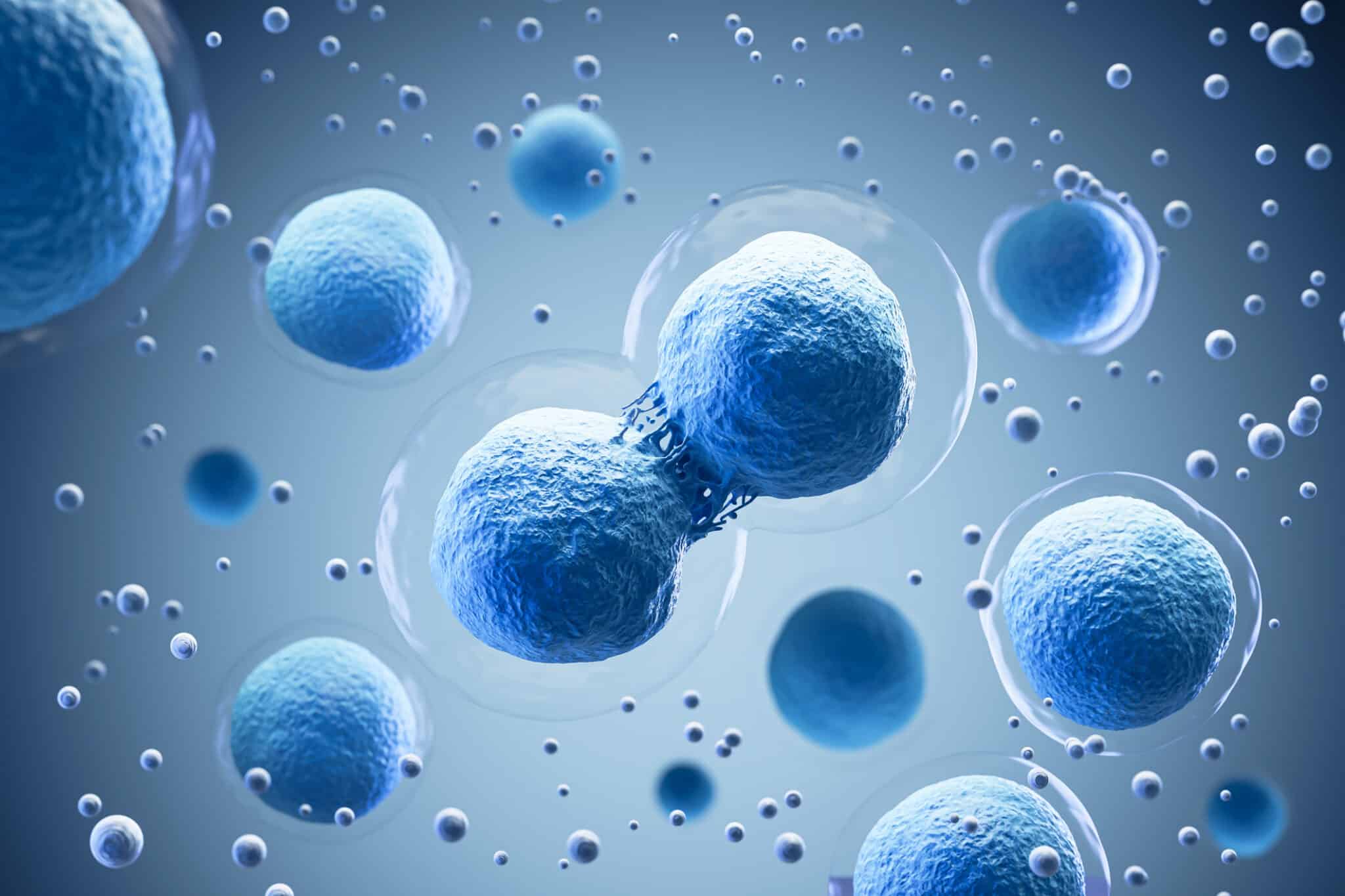
For decades, mitosis—the process of cell division—has been taught as a rigid, almost mechanical sequence. Each cell, at the dawn of its division, rounds up to ensure a symmetric distribution of its genetic material, giving birth to two identical daughter cells. But a new study could well shake this century‑old dogma. Researchers from the University of Manchester have indeed demonstrated that certain cells divide… without following this classic scenario.
Their findings reveal an unexpected phenomenon: isomorphic division. Unlike the so‑called canonical division, in which the mother cell adopts a spherical shape before mitosis, some cells retain their initial morphology — often elongated — and give rise to two daughter cells that differ in both shape and function. A discovery that reshapes our understanding of tissue formation… and perhaps, in the long run, of cancer.
When Form Determines Cell Fate
Under the leadership of biologists Shane Herbert and Holly Lovegrove, the team observed this surprising behavior in embryonic zebrafish stem cells during the formation of blood vessels. At this stage, the cells must constantly reorganize to build complex tissues. But instead of rounding up to divide in a perfectly symmetric manner, some cells retain their initial shape, which directly influences the morphology and function of the daughter cells.
Result: division is no longer a simple copy‑paste. It becomes a mechanism of diversification, producing cells with divergent trajectories. This process could help explain how certain cell layers — such as epithelial or endothelial cells — manage to differentiate in the right place, at the right time.
An Old Doctrine Questioned
Why had this phenomenon never been observed before? Partly because cell division has long been studied under artificial conditions, where the cells were forced to round up on flat surfaces. To push beyond this limit, the researchers turned to a cutting‑edge technique: micropatterning.
By etching specific shapes onto antiadhesive surfaces using a UV laser, they compelled the cells to adopt precise morphologies before their division. This protocol allowed them to show that the more elongated a cell is before mitosis, the greater its likelihood of remaining isomorphic — i.e., dividing without changing shape.
Preserving Memory… by Maintaining Form
But why is this so important? Because a cell’s shape carries a memory of its pre‑division state. By preserving their morphology during mitosis, these cells transmit to the daughter cells valuable information — about their orientation, their surroundings, or their future role in the tissue. This is information that the usual rounding almost entirely erases.
As the authors explain in their article published in Science:
“Isomorphic division enables the transfer to daughter cells of a wealth of information about the pre-mitotic cellular state, most of which is lost and reset during the traditional mitotic rounding.”
And If Cancer Were to Exploit This Mechanism?
This discovery extends beyond the realm of embryonic development. Because asymmetrical cell division, by generating cells with divergent behaviours, also plays a pivotal role in cancer progression. Tumor cells capable of dividing without normalizing could give rise to more invasive clones, able to migrate or form metastases.
By better understanding how a cell’s shape influences its future, researchers could open new therapeutic avenues. Manipulating cellular morphology before division could become a lever to control differentiation — or to block the proliferation of cancerous cells.
A Turning Point for Cellular Biology
In short, this advance not only challenges a technical detail of cell division. It rewrites a fundamental page of biology, showing that cells are not all bound to follow the same rules. And that by preserving their shape, they can better remember where they come from… to better decide where they go.
