
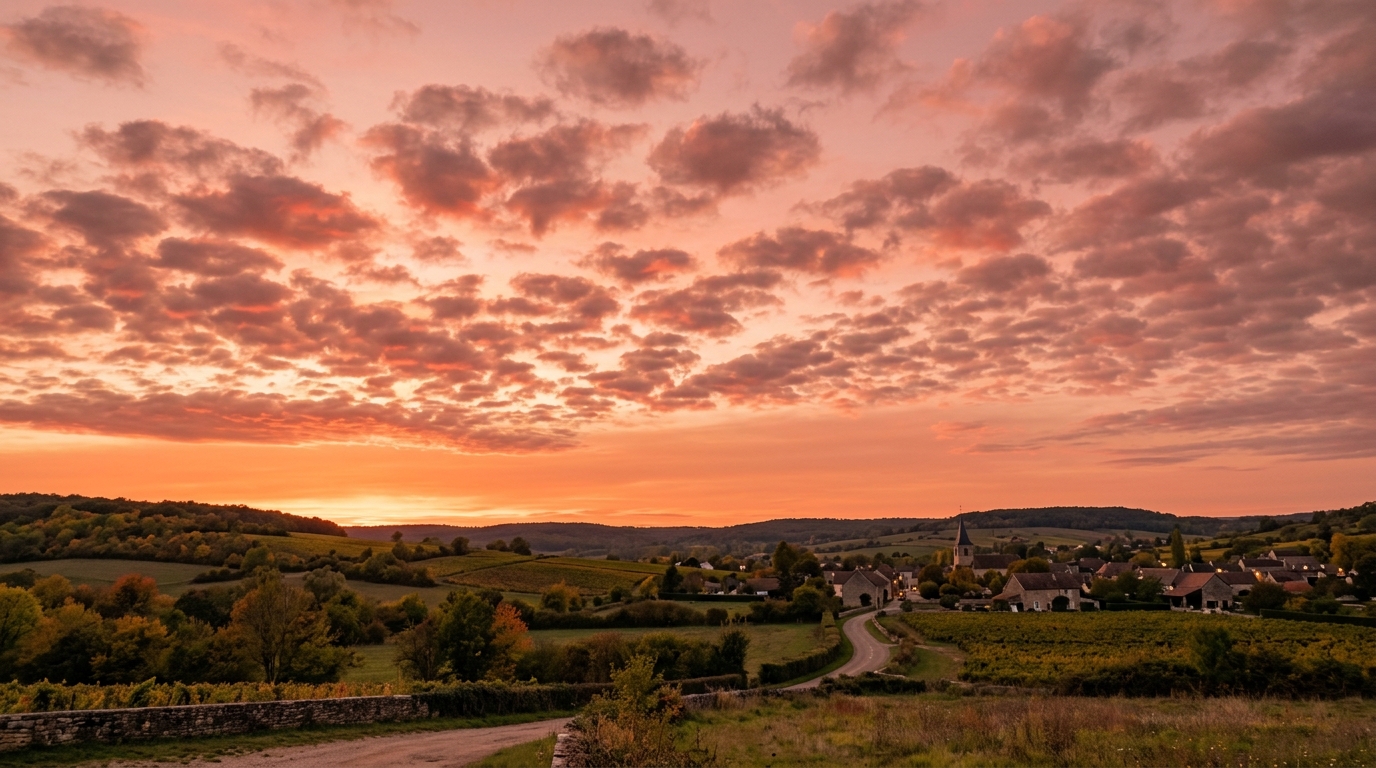
Why does the sky turn red-orange at sunrise and sunset, while it remains blue all day long? The answer lies in one word: distance. Near the horizon, the Sun’s light travels through a much thicker layer of atmosphere than at noon, and this longer journey changes everything. On the way, it loses almost all of its blue. This purely physical phenomenon also explains why an old rural saying sometimes contains a grain of truth. Here is how it works, and what it means in practical terms for your morning or evening outings.
- Rayleigh scattering removes blue along the long, grazing path, leaving only red and orange.
- A colored dawn can begin 30 to 45 minutes before the Sun appears on the horizon, and a reddened sky can occur even without pollution or sand.
- According to MeteoSwiss, a red dawn does not automatically herald bad weather; it depends on the current meteorological situation.
- Why light travels such a long path at the horizon
- Rayleigh scattering: how blue disappears along the way
- From red skies to weather lore: what it really signals
Why light travels such a long path at the horizon
When the Sun is overhead, its rays strike almost vertically and pass through the atmosphere along the shortest possible distance. At sunrise or sunset, however, the Sun is near the horizon: its light enters the atmosphere at a very oblique angle and must therefore travel through a thickness of air nearly 40 times greater than at noon. In practical terms, the rays pass through a much larger amount of atmosphere. This detail, often overlooked, is the key to the entire colorful spectacle we observe in the morning and evening. The longer the path, the more chances there are for the light to transform before reaching our eyes.
Rayleigh scattering: how blue disappears along the way
Sunlight contains several colors. As it travels through the atmosphere, this light meets air molecules that scatter shorter wavelengths more readily, especially blue. This mechanism, known as Rayleigh scattering, gives the sky its daytime color: blue is scattered in all directions, and that blue is what we see overhead. But at sunrise and sunset, the path is so long that blue is almost entirely removed before it even reaches the horizon. Only the more resistant colors, red and orange, continue their journey to us. Clouds then play an important role: they receive this already reddened light and diffuse it toward the ground. Their position, thickness, and the transparency of the air determine the intensity of the display. A completely clear sky is therefore not a prerequisite for a beautiful sunset: clouds in the right place can, in fact, enhance the colors.
Another useful point to know: dawn can begin 30 to 45 minutes before the Sun appears on the horizon. If you wait for the official sunrise time to pull out your phone, you risk missing the best moment. And contrary to a common belief, this reddening is not necessarily a sign of dusty or polluted air: it can occur in a clean atmosphere, with no dust or aerosols. Only independent observation can confirm the presence of particles from elsewhere.
From red skies to weather lore: what it really signals
Does the proverb that a reddened dawn foretells bad weather have any real basis? MeteoSwiss studied the question, and the answer is nuanced, because it depends on the current weather situation. A concrete example confirms this: a particularly flamboyant sunrise observed in the eastern part of Switzerland was indeed followed by a spell of bad weather, validating the proverb on that specific day. But this link is not automatic: a red dawn does not guarantee rain.
What is certain, however, is that these colorful moments become more common in our daily life at this time of year, simply because sunrise and sunset times align better with our morning and evening commutes. It’s a practical explanation, tied to our schedule, not evidence that the phenomenon would be more frequent statistically. Cooler seasons, however, often offer conditions favorable to crisper colors, especially when the air is less laden with haze and aerosols than in summer. Again, it remains a matter of that day’s atmospheric conditions, not a fixed calendar rule.
To fully enjoy the spectacle without being taken by surprise, a few simple habits apply. Step outside a little before the official sunrise or sunset time shown in your apps, so you don’t miss the first nuances. And above all, don’t seek exotic explanations for an orange sky: Rayleigh scattering and atmospheric phenomena are enough to explain it, without automatically attributing it to Sahara sand or a spike in pollution.
In the end, this play of light between the blue that fades away and the red that persists is nothing mysterious: it’s simply physics and the distance traveled through the atmosphere. Yet the spectacle remains fully magical, and it deserves that we lift our eyes a bit earlier in the morning or a bit longer in the evening.
